
Wine-Dark Sea
Red red wine/Go to my head/Make me forget that/The Sea really isn't that colour at all when you come to think about it actually

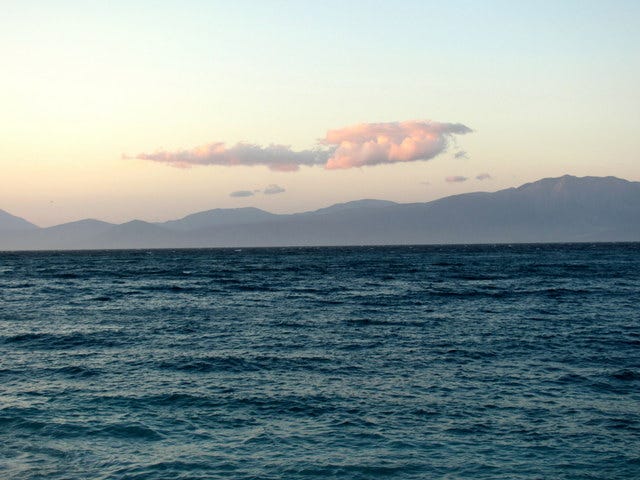
Why does Homer call the sea ‘wine-dark’, when we all know the sea is not such a colour? Not even the Red Sea (which it’s doubtful Homer even knew anyway). Seas are blue, bluegreen, purplegreen, shadowyblue, grey, dark grey, blackblue, indigo, snotgreen, scrotumtightening etc. They are not the colour of Merlot.
The phrase is οἶνοψ πόντος (oînops póntos), from οἶνος, ‘wine’ + ὄψ ‘eye; face’ + πόντος ‘sea’. It is one of Homer’s epithets: which is to say, a word or short phrase that fits easily into the hexameter metre of epic poetry, and can be deployed to help fill the line. So it is that Odysseus is so often ‘many-witted’, dawn is ‘rosy-fingered’, ships are ‘dark’ or ‘swift’. The thing about epithets is that they are primarily metrically, and not always semantically, appropriate: so Homer’s ‘swift ships’ are so-called even when they are pulled-up and motionless on the beach, and lions are ‘raw-flesh-eating’ (ὠμόφαγος) even when they’re not at luncheon. But οἶνοψ is a different thing: the sea is the sea, all the time, after all. The question is: why did Homer think the sea was the colour of wine?
Other things are ‘wine-coloured’ in Homer, notably cattle (for instance, Odyssey 13.32, Iliad 13:703), although in these cases we can picture a burgundy-coloured cow without too much difficulty. Interestingly, as Homer’s sea is wine-coloured, his wine is always either red (ερυθρός) or black (μέλας). White wine (which requires the skins of the grapes be removed before fementation) does not seem to have been part of the Homeric world.1
So what’s going on?
The scholars do not, let’s say, speak with one voice on this question. The perhaps over-obvious explanation (Homer was blind, and didn’t know shit about colours)2 does not seem to have been part of the critical debate. But pretty much everything else has been argued, including:
The Greeks were in the habit of drinking blue, or blue-green, wine. Hard to credit this.
Homer, blind or otherwise, was articulating a sophisticated and subtle distinction between colours as reflected off a liquid at its surface and the same bodies of liquid seen directly through.3
The phrase is meant to suggest that the sea is as intoxicating as wine, not that it has the same colour.4
That the marine colour is accurately described, but only at specific times of day and under specific atmospheric conditions. This is the argument of Robert Rutherfurd-Dyer, who confesses having been baffled by the epithet until a particular moment in his life: ‘recently I watched the sea at the mouth of the Damariscotta River, Maine, one evening as the sky was filled with the ash cloud from a volcanic eruption on the other coast of the United States. The ash cloud formed an unusually vivid sunset, reflected in the outgoing tide of the dark estuary. The rich blackish red and oily texture of the water were almost identical to Mavrodaphni. I realized I was looking at precisely that sea at which Homer’s Achilles looks … Setting aside the romantic notion that the phrase reflected oral memory of great eruptions such as that of Thera, I began to ask of the Homeric texts whether the phrase referred to particularly dark-red sunsets and was thus intended to convey information about time and weather.’5 Rutherfurd-Dyer goes to some lengths to show, or try to, that every time Homer talks of ‘wine-dark sea’ he is referring to a sunset or sunrise. This, I have to say, doesn’t persuade me, neither on its merits, nor on the usage of epic-epithets in Homer, which are rarely interested in localised specificity. And at no point in his argument does Rutherfurd-Dyer explain why a perfectly respectable and decent ‘Rutherford’ nominalism has become corrupted to ‘Rutherfurd’ in the United States.
There’s another theory, which is quite boring and therefore probably correct. It is that the epithet is a kind of verbal fossil, and not an attempt to connect a particular vinous colour with any actual sea. The argument here is that οἶνοψ derives from an older word in pre-Hellenic, Mycenaen Greek: the Linear B: 𐀺𐀜𐀦𐀰 (pronounced, it seems, wo-no-ko-so) and 𐀺𐀜𐀦𐀰𐀤 (wo-no-ko-so-ke), which was the name of a sacred bull, and was perhaps connected to the use of a particular type of vessel, shaped like a bullshead, in which ritual wine would be served during a religious ceremony. According to this theory ‘wine-dark sea’ is a kind of holdover, a buried reference to a lost sacrament in which the wine of the red-hide bull, as red as it, was imbibed from a sacred beaker.
You pays your money, you takes your choice.
A little epithet nerdery: Homeric scholars tells us that, metrically, and as deployed before πόντος, sea, οἶνοπα and οἶνοπι are always found in the fifth foot of the hexameter line. However, when cattle are described with this colour, οἶνοπε always occupies the fourth foot. Isn’t that interesting?
It has always bothered me that Stevie Wonder, undoubtedly one of the world’s most significant artists in any medium in the 1970s, could title an album Stevie Wonder's Original Musiquarium. Surely if there’s one thing a blind artist cannot appreciate, it’s an aquarium?
‘Of the epithet οἶνοψ in Homer’s oft-quoted “wine-dark” sea … we may well wonder what point of comparison exists between wine and water. The author inclines to the view that a dark surface reflecting light is in all cases being described. Wine in the ancient world was seen, not through glass as in modern times, but in an opaque crater or cup. It was the surface that caught the eye. Similarly the sea viewed from land or shipboard may, under appropriate weather conditions, appear dark with reflected lights’ [Eleanor Irwin, Colour Terms in Greek Poetry (University of Toronto Press, 1974), 28]
This is the argument of Mark Bradley’s ‘Colour as Synaesthetic Experience in Antiquity’, in Shane Butler and Alex Purves (eds), Synaesthesia and the Ancient Senses (Acumen 2014).
Robert Rutherfurd-Dyer, ‘Homer’s Wine-Dark Sea’, Greece & Rome 30:2 (1983), 125
I always felt it was not a color comparison, but an intensity comparison. Wine is dark. The sea is darker than the sky and the pale land. Therefore, wine is to cup as sea is to world, lying dark in and all around it.
I think two things are relevant: 1. The phrase is “wine-dark”, not “wine-coloured” and 2. The Greeks didn’t have a word for blue.