
Walcott's ‘Omeros’ (1990)
Another Brick in the Walcott

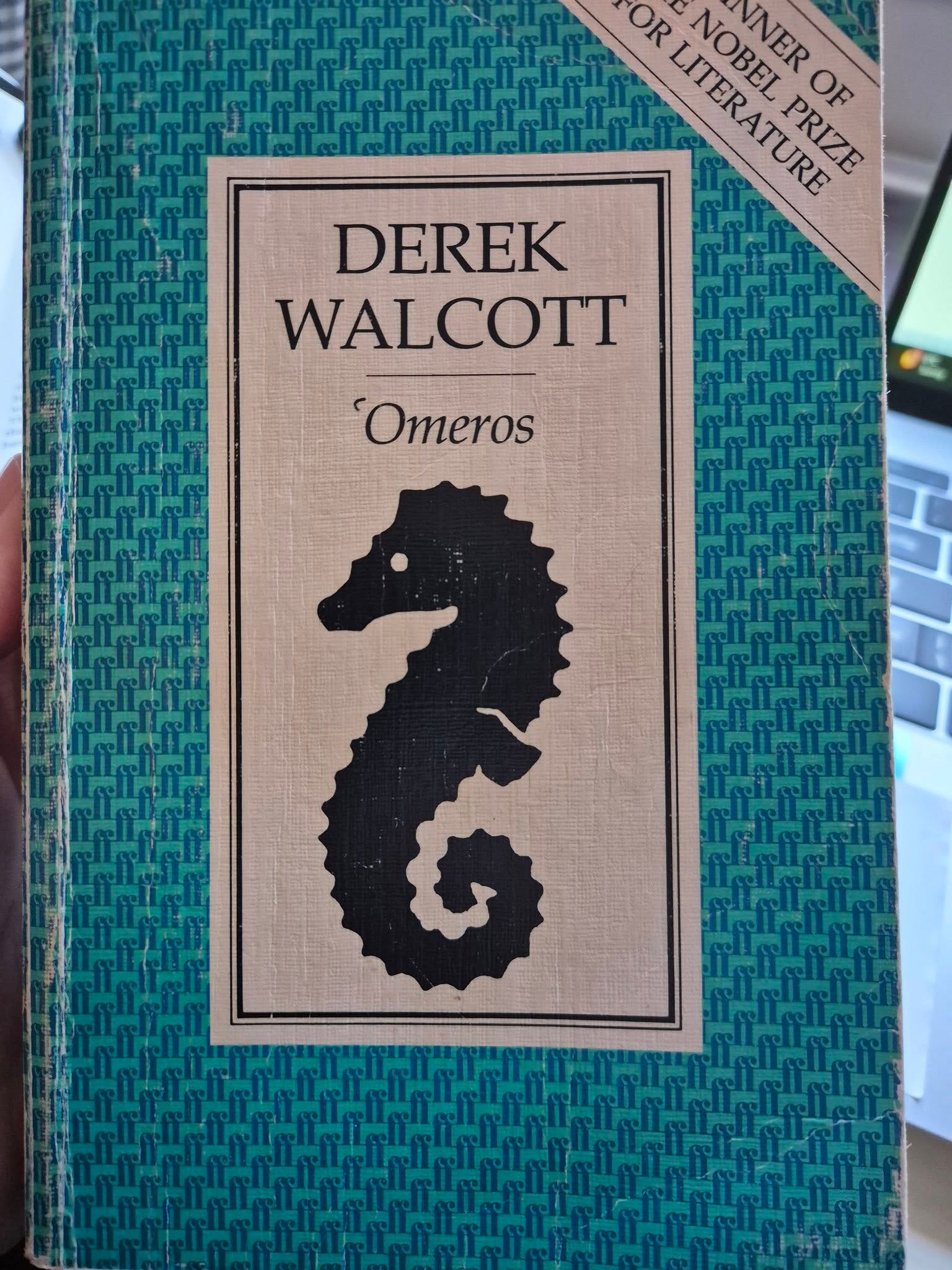
[My old, rather battered paperback edition of the text, chosen for these reasons. I added the rough breathing mark before the ‘O’ in biro.]
.
Is Omeros any good?
Of course! It’s the poem, everyone says, that won Walcott the Nobel Prize for Literature. It’s a modern-day epic of Caribbean life, a vast cornucopia of brilliant, vivid, colourful poetic images and moments, a braid of believable stories (St Lucian fisherman Achille and Hector fighting over the love of the beautiful Helen; Major Plunkett and his wife Maud; the perigrinations of ‘the poet’, a St Lucian figure based on Walcott himself) that encompass the history of the island, the slave trade and the middle passage and, as the ‘poet’ travels more widely, Native American history in the US and of course the Ancient Greek world of Homer. It remains Walcott’s most famous work, and has been very widely discussed and written-about.1
But—is it good though?
We can think of Omeros as both a neo-Homeric epic poem and as a kind of novel. Under the former rubric it is divided into ‘books’ like an epic poem, is written in verse, and contains various allusions to characters and myths with Homeric antecedence. Under the latter, it is divided into ‘chapters’, is full of closely observed mimetic detail and quotidian stuff, tells a complex, multi-layered plot, construes its characters in terms of modernity and psychology, explores its contemporary world in detail, and connects with the lived-experience of Walcott himself (who plays a large part in the text as the otherwise unnamed ‘poet’). I hardly need to summarise the work: it’s pretty famous. Achille and Hector, young fisherman on the Caribbean island of St Lucia (avatars of the heroes of the Iliad) fight over a beautiful young St Lucian girl called Helen. There’s also Philoctete, a fisherman unable to fish because he has (like the mythic Philoctetes, though for different reasons) a suppurating wound in his leg that won’t heal, in his case caused by an anchor—to leap to the end, Philoctete is cured by Ma Kilman, owner of the ‘No Pain Café’, and the village obeah-woman. There’s ‘Seven Seas’ an old, blind St-Lucian, his eyes as blank as Homer’s, and also Major Plunkett, white British expatriate and WW2 veteran, a pig farmer, together with his Irish wife Maud. Proud, beautiful Helen, over whom Achille and Hector clash, is Maud’s maid: she has a yellow dress that was either given to her by Maud, or perhaps which she stole from the Plunketts. The Major is somewhat obsessed with Helen, partly out of thwarted erotic fixation, partly because he considers her a kind of embodiment of St Lucia itself. Plunkett becomes entangled in historical researches about the many 18th-century Anglo-French naval battles (in which, he believes, one of his ancestors fought) that brought the island under colonial rule. In researching these, he neglects his wife, and doesn’t notice her wasting away—her death, near the end, is novelistically affecting. It’s harder to fit Major Plunkett and Maud into a Homeric schema (are they parodic versions of Priam and Hecuba?) but that’s only to say that Omeros repudiates a too procrustean schematism. The ways in which Achille, Hector and Helen replay the old Trojan conflict are outweighed by the ways in which they don’t so so, in which they are simply three modern-day St Lucian individuals, living their lives, freed of history. A third plot-strand concerns ‘the poet’, a character closely based on Walcott himself. It’s in the sections of the poem that deal with him that Omeros most fully engages the historical context of the island, of colonialism, of slavery, the past of the West Indes and North America, of Europe: although in Book 3 Achille has a kind of elaborate dream that takes his spirit back to ancestral Africa.
Near the beginning of the work, the poet is saying goodbye to his lover.
“O-meros,” she laughed. “That’s what we call him in Greek,” stroking the small bust with its boxer’s broken nose, and I thought of Seven Seas sitting near the reekof drying fishnets, listening to the shallows’ noise. I said: “Homer and Virg are New England farmers, and the winged horse guards their gas-station, you’re right.”I felt the foam head watching as I stroked an arm, as cold as its marble, then the shoulders in winter light in the studio attic. I said, “Omeros,”and O was the conch-shell’s invocation, mer was both mother and sea in our Antillean patois, os, a grey bone, and the white surf as it crashesand spreads its sibilant collar on a lace shore. Omeros was the crunch of dry leaves, and the washes that echoed from a cave-mouth when the tide has ebbed. [Omeros, 2:3]
The poet’s lover is a Greek woman called Antigone (Omeros was written towards the end of Walcott’s marriage to Norline Metivier, a union troubled by his repeated infidelities). She has had enough of hanging out on St Lucia and bonking the poet: she’s going back to her native Greece. Before she goes, she schools the poet about the name on the bust in her room: not ‘Homer’, aspirated as with the Ancient Greek and modern English version of the name, but Όμηρος, without the ‘h’. The poet concurs: ‘Homer’ and ‘Virgil’, he says, are now names disconnected from archaic Greek: they are modern, rural New England names. The poet prefers the to-him unusual ‘Omeros’, which he breaks down into the Caribbean-French of his home (Walcott himself was born on St Lucia into a Methodist, English-speaking family, although the dominant tradition on the island is Catholic and French-speaking: a reality that largely informs Omeros). O the sound of a conch shell being sounded, mer and os the French for sea and bone. This sort of interlingual wordplay runs through the whole of the poem, and it’s picky of me to object—although I do: the middle vowel of ‘Omeros’ is an eta, a long ē [η], O-meer-oss. But Walcott wants to stress the sea because he is writing an oceanic poem about an island surrounded by, and characters defined by, the sea. Fair enough. The bones are the bones of the dead, and in this context they are particularly associated with the transatlantic slave trade, that brought some of Walcott’s ancestors across the Atlantic via death and suffering to enslavement and hard labour:
But if it [the marble bust] could read between the lines of her floor like a white-hot deck uncaulked by Antillean heat, to the shadows in its hold, its nostrils might flareat the stench from manacled ankles, the coffled feet scraping like leaves, and perhaps the inculpable marble would have turned its white seeds away, to widenthe bow of its mouth at the horror under her table, from the lyre of her armchair draped with its white chiton, to do what the past always does: suffer, and stare.She lay calm as a port, and a cloud covered her with my shadow; then a prow with painted eyes slowly emerged from the fragrant rain of black hair.And I heard a hollow moan exhaled from a vase, not for kings floundering in lances of rain; the prose of abrupt fishermen cursing over canoes. [Omeros 2:3]
Lances of rain: we’ll come back to that. The cursing fishermen are Achille and Hector, who open the poem by cutting down some laurier-cannelles (a type of tree, Cinnamomum verum, also called the Cinnamon tree—a significant native wood in St. Lucia, famous for its use in making traditional canoes). Achille steals a metal bailing-tin from Hector’s canoe, and Hector threatens him with his cutlass. But this theft is symbolic: they’re actually fighting over Helen. Here the poet reimagines the ‘lines’ of Antigone’s floorboards as the deck of a slave-ship, and fancies the head of Homer flaring his nostrils at the stench of the manacled human cargo below, turning its blind eyes (‘white seeds’) away, opening its mouth in horror. Ultimately, says the poem, history is not about addressing such injustice, such monstrosity: it is a matter only of suffering and staring. One connection Walcott doesn’t make is that the Greek name Homeros is identical to ὅμηρος (hómēros, “hostage”). Scholars wonder if this was an early nickname; or perhaps Homer was himself enslaved, taken hostage. Certainly the Iliad and Odyssey are fully apprised of the reality of slavery. Homer’s world was a slave-owning one, in which women in particular are prizes of war. You wouldn’t call him inculpable, although Walcott’s poem here does.
Walcott in this passage moves from this memory of the slave-trade straight into a sex scene. One might consider this segue as manifesting indecent haste, as well as other valences of indecency. Antigone has, in her room, a Greek-style folding chair which the poet compares to a lyre (a nice-enough poetic simile), and she has taken off her white dress, her chiton, and draped it over this piece of furniture. Then comes the slightly evasively-written coitus: she lies down ‘calm as a port’ and is ‘covered’ by the poet (‘to cover’ means, amongst other things, to copulate with), who, in the act, sees her face emerge from her long black hair, presumably as she strains upwards under him, and hears her orgasmic moaning. Her face reminds him of the prow of a boat, one of those Greek style barques with eyes painted on the side: not a comparison I would advise confiding to your inamorata has crossed your mind in the middle of the act (‘hey! you look like a boat!) Not altogether romantic. Boaty GreekBoatface.
I’ll say more about the whole poem in a moment, but before that: what about this ‘chapter’ of Omeros? Is it good poetry?
The poem’s rhyme scheme swirls around terza rima without ever settling clearly into that pattern. The rhyming in the poem has been extravagantly praised by some, for its variety, its nimble fluidity, its integration into the novelistic parataxis of the text, its sometimes arresting, even comic inventiveness.2 Then again, Walcott’s rhyming has also been criticized, and in the case of Craig Raine’s Arete review of the poem, lambasted. I find myself more in the latter than the former camp. Omeros’s rhyming is—well, it’s all over the place: as often half-rhyme as full-, frequently grotesque or bizarre in ways that can be hard to swallow. Take this section, quoted above: the plain Greek/reek plays against the dissonant nose/noise and the crazy run of farmers/arm as/Omeros/mer was. ‘Patois’ seems to hang solus (unless we’re supposed to pronounce not pat-wah but pat-oyz, to rhyme with noise? But that would be daft). The combinations of returns with patterns and shallows/noise/but yours aren’t even half-rhymes (more like a third). The chapter’s last lines eyes/vase/prose/canoes are ringing vocalic changes, not rhyming as such (do we pronounce vase the UK or US way? Neither is very satisfactory). This is to say nothing of the filler-phrase in line 6: ‘you’re right’ only there for the ‘light’ rhyme that follows (it adds nothing otherwise).
Then there is the question of similitude. There is no question but that Walcott is an often brilliant, as he is certainly a promiscuous, coiner of arresting and vivid similes. He loads his every rift with ore, he strains at every moment for richness and Keatsian lushness, for unexpected and memorable comparisons. There is, indeed, a kind of similitude overdrive at work in Walcott’s poetry, a restlessness that can become fidgety and distracting, expressively but also formally centripetal, even fragmentary. Is that compatible with epic as a mode? It’s a genuine question. Can an epic be composed of such moments? Can a cake be made entirely of icing?
Horizontal fire lit an enormous cloud …

Under a sucked-out sun, like a lemon lozenge
on a blue Delft-plate, he counted the black crosses
of shipping, clouds emptied as if my plague. [2.14.1]
A beach burns their memory. Copper almond leaves
crackling like Caribs in a pepper smoke, the blue
entering God's eye ... [3. 31.3]
Arguably the epic, under the logic of modernity, is no longer capable of the esemplastic unity that characterizes the Iliad, the Odyssey, the Aeneid, Divina Commedia, Paradise Lost. Perhaps that’s gone: perhaps epic now is inevitably post-Waste Land, shoring fragments against our ruin, or the prosaic-poetic gorgeous sprawl and variety of Joyce’s Ulysses or Pynchon. That Walcott owes much to Eliot is a critical commonplace, and Omeros pays homage to what it owes to Ulysses with an extended, not-very-well integrated section towards its end where Walcott, that is ‘The Poet’, visits Dublin—I talk about this passage below. But there is another model of the mode, the ‘encyclopedic epic’ that works as a compendium of total, or totalizing, knowledge.3 This seems more in-line with what Walcott is doing. The St Lucia characters enable him to include a great deal of information about island life and ecology, about Caribbean society low and high, about fishing and navigating the oceans. And the character of ‘the Poet’ broadens the scope of the whole, encompassing European history and the Middle Passage, Ireland, Canada, North America, the Pilgrim Fathers, the Native American experience (a good chunk of Book 5 concerns the Trail of Tears and Apache history). This sprawls, and it is beyond me to find any well-wrought-urnness, structurally speaking, about the whole. But it is the epic as a folder which Walcott can open at any time, and put in whatever happens to be on his mind at any particular time.4
This amplitude is a structural matter. A more pertinent question has to do with the texture, rather than the structure, of this large, sprawling piece.5 The poem tells its stories with many digressions, and spends a long on descriptions of places, things and people, rich in colour (often literally so) and specificity and construed overwhelmingly through poetic simile and metaphor. Simile indeed is, at the level of expression, the main motor of Omeros—not the traditional Homeric epic simile (the poem does not slow down its momentum with anything as extended as that), but myriad points of arresting and original comparison, hopping, flea-like, from spot to spot.
Walcott, who studied painting before he wrote poetry, is a vividly and colourfully visual poet.6 He had hoped to pursue as career as an artist, although it became clear early that he possessed a greater talent for words. It’s a strength for a lyric poet, but a—to put it as kindly as possible—mixed-blessing for a narrative writer, where the story of Omeros is repeatedly interrupted, and in places stalled, by the profusion of visualisations and painterly touches. This never (again) becomes epic ekphrasis, although arguably, in some of Walcott’s descriptions the distinction is blurred. What the poem lacks is momentum, narrative drive, the pure force of story that moves us through the Iliad and the Odyssey.
This texture of Omeros, then, is bitty, rich nuggets that cloy in large doses. To be clear: Walcott was a poet of extraordinary gifts, capable of superb, transcendent phrasing and imagery. ‘Seven Seas rose in the half-dark to make coffee./Sunrise was heating the ring of the horizon/and clouds were rising like loaves’ [1.2.2]. ‘Lightning lifted his stilts over the last hill’ [1.9.3]—a superb description of Achille watching the end of a thunderstorm. Cicadas ‘chattering like a sewing machine’ [1.11.3]. ‘The grille of shade made by the long-stemmed pillars’ [1.12.3]. An ocean liner passing, ‘white as a mirage, its hull bright as paper’ [1.13.2]. ‘Black-mapped creamy cattle/grazing their long shadows’ [2.14.1]. ‘Wiry heat/over the hot harbour’ [2. 23.2]. Of whales blowing spume from their blow-holes: ‘whales burst into flower’ [2:24:3]. As Achille weeps, Walcott describes the waves on the beach: ‘the white foam lowered its head’ [3.25.3]. Achille, paddling back to land from a fishing trip, ‘watched the lilac horns of his island/lift the horizon’ [3.30.1]. ‘The bay was black in starlight. The reek of the beach/was rimmed with white noise’ [3.32.2]. The wind in the olive groves flips the leaves of the tree: ‘silver cuirasses/flash in the reversible olives’ [5.37.3] (Walcott comes close to spoiling this line by adding ‘…their silvery leaves’, in case we don’t get the image—but it’s beautiful as is). ‘The gold sea/flat as a credit card’ [6.452]. A rainstorm is expressively, imagistically reversed: ‘rain/rose upwards from the sea, and the corrugated iron/of the sea glittered with nailheads’ [6.41.3]. ‘The sunflower’s dish, tracking the sun like radar’ [6.51.3]. Beautiful phrasing. And Omeros is packed with it.
But for every rimshot, there is a clunker. It is a question, as cricketers say, of shot-selection: Walcott seems oblivious to the moments when he swings and misses. ‘Yam leaves like maps of Africa’ [1.4.1] (but yam leaves are heart shaped). ‘The months revolved slowly like the silk parasols/at college cricket matches’ [2.22.3]—eh? ‘The back muscles/can bulge like porpoises leaping out of his line/from the gorge of our memory’ [2:24:2]—line, I suspect, is there because W. needed a rhyme for ‘vine’; but how are porpoises jumping out of a gorge, how is a gorge memory, how are they now inside his back, does this mean the porpoises are memory? ‘Children with bat-like cries seemed trapped behind bright/galvanized fences’ [3.32.2]—bat-like? You mean, squeaking ultrasound? Beyond human hearing? Achille is ‘circled by chain-sawing sharks’ [4.34.1]—buzzing like a buzzsaw, are they, these sharks? Spinning their sharkteeth round and round their jaws? ‘I smelt with my eyes’ [6.44.3]—did you, by George! On nature: ‘large green words lie waxen on/the page’s skin’ [6.53.2]—as with a child’s crayon, perhaps. ‘Rooms that echo with rain/of wrinkled clouds with Onan’s stain’ [4.33.3]—so the rainclouds are masturbating over the houses? And it has to be said, the Bad Sex Award rears its head on more than one occasion: ‘her fingers were branches. I boared through their bracken/towards her breasts, and their tenderness took me in … her small shoulders slacken/to her body’s smile’ [3.29.3]. It’s striking, and not in a good way, that Walcott, who can be so direct and precise when describing landscape, sea and sky, becomes so oblique and evasive, so trapped by a kind of sentimental pudeur, when describing shagging.
Walcott had an exceptionally perceptive and lively mind, but there’s a place where such a thing shades into ADHD, and indeed mania, where everything perceived gets crunched through the gears of the great simile-generating machine in his head, like Chaplin passing through the cogged bowels of the factory mechanism in Modern Times. There are so many ingenious similes and metaphors in this (very lengthy!) poem that it becomes indigestible in anything except small portions. The effect is intermittently vital, enlivening, memorable, but is as often wearying, writhing, an avoidance of formulae and cliché that becomes by sheer force of repetition formulaic.
I’m conscious, in saying this, of the potential for category error. To imply the poem is (as it might be) showy, vulgar, ill-disciplined, over-gilt is tacitly to assume a set of aesthetic values arguably incompatible with what Walcott was doing. Adam Lively identifies ‘the traditions of black culture—the traditions of cultural pluralism, flexibility, parody … the slipperiness of identity … aspects of black popular culture transposed into a literary key.’7 For Jahan Ramazani, Omeros’s multifariousness, its pulling-in-every-direction-at-once-ness, is, as the phrase goes, a feature not a bug. He argues that aesthetic hybridity, by inhabiting the fractures and disintegrations of the colonial project, and the diasporic energies of global dissipation (I paraphrase) expresses Walcott’s truths, beautifully. Omeros certainly encompasses straightforward beauty (‘through the emerald valleys and the indigo hills’ of St Lucia ‘the blue sea burst his heart again and again’ [2.20.2]: the kind of jeweller’s work with words for which the island’s tourist-board would surely be happy), whilst not flinching from historic and contemporary suffering, pain and injustice:
An epic divided to the vein, a poem split by a glottal scream, Omeros asks how the postcolonial poet can both grieve the agonizing harm of British colonialism and celebrate the empire’s literary bequest. Walcott’s pervasive figure of the wound can help us to understand his answer to this question, as the figurative site where concerns with imperial injury, literary archetype, and linguistic heritage most graphically intersect. “This wound I have stitched into Plunkett’s character,” ventures the poet early in Omeros. Conflating wound and suture, Walcott suggests that the odd surgery of poetry may have to disfigure a character with wounds to repair historical injuries. “He has to be wounded,” continues the poet defensively. Why must the poet stitch some kind of wound into all of his major characters, from Philoctete, the emblematic black descendant of slaves, to Plunkett, the representative white colonial; from the lovelorn Achille to Hector, Helen, even himself? Be cause, the poet explains affliction is one theme of this work, this fiction,” as indeed of Afro-Caribbean literature and much Third World literature in general. That the wound trope is central to Omeros suits preconceptions of postcolonial writing as either “victim’s literature” or “resistance literature.” But Walcott’s use of the figure — for example, attaching it here to the white colonial Plunkett — frustrates the assumptions it elicits.8
The textural motor of Omeros, the simile, is about linking disparate things—about we could say, the suture—just as the conceptual superstructure of the poem is about linking Homeric Greece and modern-day St Lucia. But neither of these things are healing wounds, as such. Everything in this poem is like something else, as similes bustle and proliferate, and words flaunt their sonic similarities in rhyme:
... but when a wave rhymes with one’s grave
a canoe with a coffin, once that parallel
is crossed, [it] cancels the line of master and slave. [3.30.2]
Does it, though? There are wounds in the poem (Philoctete’s leg, Major Plunkett’s head-wound) but not all that many, and the drift of the poem is not that the past has to be healed, but that it has to be gone-beyond, surpassed, cancelled.9 Walcott is much more interested in juxtaposition than dissipation or diaspora. Lance Callahan makes what I take to be this point, if somewhat obscurely articulated: his book-length reading of Omeros ‘chases a single, slippery idea back and forth across the various levels of discourse’ of the poem: ‘the elusive concept of interjacence as the central functional tenet of West Indian society.’10
+++
Another chapter, this one from much later in the poem. The titular mythopoeic referent of Omeros may be Homer, but the actual application is considerably more Joycean than Homeric. Walcott is not the first and he won’t be the last to copy Ulysses’s use of a template of Homeric myth to print out a contemporary, mimetic story. Anthony Burgess’s A Vision of Battlements (1965) is an in-his-master’s-steps-he-trod Joycean novel, taking the Aeneid rather than the Odyssey as template myth, and moving the modern-day story to Gibraltar rather than Dublin (although, of course, Ulysses also has a Gibraltarian element).
There’s actually little by way of specific parallelism between Omeros and Homer: there’s no formal invocation of the Muse, no catalogue of ships, no visit to the underworld. Walcott (as I say) does not go in for the actual epic simile or ekphrasis. More, there’s little of the Iliad in Omeros. The poem opens with a mock-epic (strictly speaking) styling of Philoctete and other island fishermen ‘attacking’ the trees out of which they will carve their canoes (‘I lift up the axe and pray for strength in my hands/to wound the first cedar’), there is Achille and Hector’s bickering over Helen, but that’s about it for direct conflict. I suppose we could say there’s a quantum of emotional conflict, and of course Walcott repeatedly invokes Iliadic emblems and referents in his poetic imagery—rainfall, and oars, are repeatedly described as ‘lances’, there are repeated images of ants, to recall Achilles’ myrmidons.
Craig Raine, in his no-holds-barred take-down of Walcott, criticizes Omeros as ‘an extraordinary anthology of repetition’, in which striking poetic phrases and images (‘initially one is dazzled by the metaphoric brilliance’) become dulled and vitiated with repetition, and repeated repetition. Some examples, from the many he provides (his page references are to the UK Faber edition):
On pages 98 and 321 there are ‘asterisks of rain’. On page 294, the starfish is an asterisk. On page 7 mosquitoes on his arms are ‘flattened to asterisks’ by Achille. On p.224 we meet ‘asterisks of bulletholes’.
Then there are the Homeric lances, flung everywhere to create a spurious overworked ‘classicism’: page 9, ‘the lances of oars’, page 230 ‘with lances for oars’, page 292 ‘lance of an oar’, page 15 ‘lances of rain’, page 50 ‘lances of rain’, page 149 ‘the rain’s lances’, page 51 ‘the lances/of a flinging palm’, page 31 ‘the palms’ rusted lances’, page 33 ‘copper spears of the palms’, page 35 ‘lances of sunlight’, page 297, ‘a lance of sunlight’. Not to mention ‘lances of yachts’ or ‘the feathered lances of cane.’11
I might try, if half-heartedly, to mount a defence of this tic of Walcott’s, as an equivalence of the Homeric epithet, which is also very repetitively applied in the Iliad and Odyssey. It’s not really the same, though. That said, Raine’s ‘spurious overworked “classicism”’ is a bit unfair: the classicism is hardly spurious, any more than are the Homeric allusions in Joyce’s Ulysses. Still, there is a sense of the endless churn of Walcott’s similes and metaphors recycling a fair bit of material.
If there’s little Iliadic about Omeros, there’s rather more Odyssey in the poem, more sailing the seas, visiting strange lands, sleeping with goddesses (or their earthly equivalents), more by way of one-eyed cyclopean encounters, meditations on home. In addition to the various characters moving all over the island (as Joyce’s characters move all over Dublin) there are two longer, transoceanic journeys: Achille returning, imaginatively, to Africa and his ancestral roots, and ‘the Poet’, the Walcott figure, travelling across the Atlantic to Europe (amongst other places). Walcott draws on his own experience, for as a globally famous figure he was invited to all manner of symposia and conferences and poetry-readings and cultural events. These myriad tripsare all described with the same charged sensuous energy as the rest of the poem: descriptions of landscape and effects of light and occasionally interactions with specific people (not the rest of the gubbins of international conference attendance).
The visit to Ireland—chapter 39—is really about the poem’s indebtedness to Joyce. First Walcott wanders the countryside:
The great headstones lifted like the keels of curraghs from Ireland’s groundswell and spray foamed on the walls of the broken abbey. That silver was the lake’s,a salver held by a tonsured hill. The old well’s silence increased as gravel was crunched by pilgrims following the monks’ footpath. Silence was in flower.It widened the furrows like a gap between hymns if that pause were protracted hour after hour by century-ringed oaks, by a square Celtic cross,by wafers of snowdrops from the day webbed mortar had cinched the stone to the whisk of a sorrel horse grazing its station. In it, a paper aspenrustled its missal. Its encircling power lifted the midges in vertiginous Latin, then sailed a rook into the slit of a towerlike a card in a post-box. It waxed a tea-van, draped a booth with sweaters, then it crossed the dry road to hear a brook talk the old language of Ireland. [Omeros, 5:39.1]
Setting aside the sheer boldface of offering the reader ‘aspen/Latin/tea-van’ as an actual set of rhyming rhymes, there is the question of how far this works as poetry. The rook flying into the tower’s arrowslit-loophole like a postcard being posted is nice, and I like the ‘tonsured hill’, but much of the rest is tourist-board cliché stuff, and the larger conceit—which is that silence moves amongst these things, and acts upon them, raising midges, waxing the tea-van and so on—is flatly contradicted by the fact that many of these things are noisy: gravel crunched by pedestrians, the leaves of the aspen rustling, the brook babbling ‘the old language of Ireland’. If silence apprehends these things, do they stop making a sound? And if they don’t, in what sense is this figure silence?
I remember reading a tweet (on the old Twitter site, a place to which I am not inclined to return to see if I can find it again) which characterized ‘poetry as such’ in this comically exasperated way: ‘look, we get it poets: things resemble other things’. Sometimes Walcott’s similes have point, purchase, eloquence. Sometimes they’re just him going ‘hey that x over there? It kind of looks like a y!’ What precisely is the force of the abbey’s gravestones looking like ‘the keels of curraghs’ (a kind of Irish coracle, a boat with a rounded prow)? Walcott notices it, writes it into his poem, halfheartedly tries to follow it up—the gravestones sticking out of the ground are like the keels of boats, so the ground is kind-of the sea? Sort of?—but he doesn’t follow that up (wisely, because it’s daft) and shifts instead to his riff on the anthropomorphised silence. But then why is it there, then? He just liked the comparison and let it stay?
The point of the Irish episode is to bring the poem back to its spiritual source, Dublin, and to Joyce, ‘our age’s Omeros, undimmed Master.’
I leant on the mossed embankment just as if he bloomed there every dusk with eye-patch and tilted hat rakish cane on one shoulder. Along the Liffey,the mansards dimmed to one indigo silhouette then a stroke of light brushed the honey-haired river, and there, in black cloche hat and coat, she scurried fasterto the changing rose of light. Anna Livia! Muse of our age’s Omeros, undimmed Master and true tenor of the place! So where was my gaunt,cane-twirling flaneur? I blest myself in his voice, and climbed up the wooden stairs to the restaurant with its brass spigots, its glints, its beer-brightened noise“There’s a bower of roses by Bendemeer’s stream” was one of the airs Maud Plunkett played, from Moore perhaps, and I murmured along with them, its theme,as each felted oar lifted and dipped with hammerlike strokes, was that of an adoring sunflower turning bright air to her Major. And then I saw him.The Dead were singing in fringed shawls, the wick-low shade leapt high and rouged their cold cheeks with vermilion round the pub piano, the air Maud Plunkett played,rowing with her felt hammer-strokes from my island to one with bright doors and cobbles, and then Mr. Joyce led us all, as gently as Howth when it drizzles,his voice like sun-drizzled Howth, its violet lees of moss at low tide, where a dog barks ‘Howth! Howth!’ at the shawled waves and the stone I rubbed in my pocketfrom the Martello brought one-eyed Ulysses to the copper-bright strand, watching the mail-packet butting past the Head, its wake glittering like keys. [Omeros 5.39.3]
‘Honey-haired river’ is a little hard to parse (is the meaning: river glinting with lots of little lines of yellow light that looks like hairs? Or bristling with lots of little wavelets that resemble (?) hairs? Or is the river as a whole one long flow of Rapunzelly hair?). The poet looks for Joyce outside, beside the river that was his Muse, but does not find him. Then he climbs to a first-floor restaurant where someone is singing, or playing, the old Thomas Moore song ‘Bendemeer’s Stream’—the Poet links the performance to his fictional character Maud Plunkett, who used to play it on her piano for her husband, the Major. At this, with the not altogether apt comparison between the hammers inside a piano striking the strings and oars rowing a boat, the poet finally does see Joyce, styling him as his own hero Ulysses, if ‘one-eyed’ (a Cyclopean Odysseus: a strange combination of man and monster—though of course Joyce was blind in his left eye, and had only 10% vision in his right). Abruptly the two of them are on the ‘copper-bright’ beach at Howth, watching the mail-packet boat heading out into the Irish Sea.
My sense is that this passage is trying a touch too hard: the ‘indigo’ silhouette of Dublin’s rooftops, the ‘violet’ lees of Howth, a twee, lavender miasma over everything. The puns (Joyce ‘blooming’ in the Dublin streets, the Irish candle burning its ‘wick low’, the dog barking the name of the village, ‘Howth’—actually pronounced hove, which is a less barky syllable, I’d say—the hammer strokes ‘felt’ as both tactile and textile, one-eyed Joyce staring at a ‘Wake’) are failures of tact.12 And the passage’s last image is muddily confusing: the boat’s wake is keys—like piano keys, of the kind Maud Plunkett strikes? Hard to visualise. Or is the referent metal lock-keys? That’s easier to visualise, kind-of, but rather unprepared-for. Raine thinks this whole scene a weak plagiary of the encounter in The Four Quartets between Eliot, as London fire-warden during the Blitz, and his ‘dead master’ (basically Dante, with some other deceased poets mixed in). Walcott doesn’t rise to the magnificence of that passage, certainly, though he doesn’t seem to me to be doing quite the same thing: there’s no conversation between Walcott’s poet and Joyce for instance. Joyce is just a figure, a image painted upon the canvas—one eye, rakish hat, dandy’s cane over his shoulder—in the way that so much of Omeros is a vivid but sealed-off set of visualisations. Eliot’s dead master tells him that a poet’s job is to ‘purify the dialect of the tribe’. Walcott, we could say, takes it upon himself to add sugar to the dialect of the tribe. To mix full-fat cream to the tribe’s stew, to clog the tribe’s arteries and induce tribal diabetes.
+++
So where does Omeros stand in the histoy of ‘the epic’? It’s a large question (of course). We might want to try and situate it in terms of a Lukácsian reading of the novelistic ambitions, ‘the theory,’ as George Steiner puts it, ‘of the evolution of literary forms which Lukács derived critically from Hegel.’
Roughly put, Hegel attached the origin, maturity and decline of the major genres in Western literature to corresponding epochs of consciousness. These, in turn, generated and were generated by (the dialectic) historical, ideological and social realities. The heroic epic enacted conditions of life and perception of an archaic social order. It yielded to the conflicts between individuation and society, between the familial and the political represented in drama. Out of the erosion of the mythological-polytheistic or theistic components in drama came the novel. The novel, after Defoe, is wholly expressive of the mundane, secular categories of middle-class and mercantile being. It recounts modes of existence in which non-theological, immanent values and ambitions predominate. Prose fiction, with its highly self-conscious adieux to epic-fabulous presumptions by Cervantes, constructs contexts of totality, related to those in the economic systems of mercantile capitalism and to those aimed at by positivist science. This ‘totality’ has, in Hegel, a crucial, informing function. Also in Lukács. But he reshapes Hegelian-Marxist mappings of the novel. The historical novel, from Scott and Manzoni to Tolstoy, necessarily incorporates epic attributes and purposes. The polyphony, the play of dialogue and rhetoric of conflict essential to drama enter into modern fiction. There is, therefore, a sense in which the prose novel is the logical culmination of Western literature and the sole genre capable of achieving totalities of representation in respect of the perennial dialectic of private and public, of the ideological and the material, of class-conflicts.
There’s another element at play in Walcott’s (certainly) novelistic totalising ambitions: his commitment to the moment of epiphanic lyric intensity, to the burst of brightness, colour, vividness: to the simile that makes-new and brings alive. I wonder how we might quantify it, but I’d say that Tolstoy (for example) puts in one such moment every hundred pages or so—think, for instance, of Prince Andrei at Austerlitz, and his transcendent sight of the patch of blue sky above him. There are such moments in the great novel, but they are buttressed and diluted by epository prose, plain narrative, dialogue and so on. To construct a novel, or an epic, entirely out of such moments was never Tolstoy’s ambition. Walcott pushes through supercharged apprehension, the epic of continual epiphany, a dazzling tapestry, a deliberately discontinuous, seemingly unending fireworks display. Turn from Lukács to Moretti (specifically, to his The Modern Epic: the World-system from Goethe to García Márquez (Verso 1996) which sets out a contrary argument, grounding the modern epic not in totality but bricolage:
The pivotal works in literary modernity, from Goethe’s Faust II to García Márquez’s One Hundred Years of Solitude are ‘epics’ of a distinctive kind and lineage. They are ‘world-texts’ … Moby-Dick, Wagner’s Ring, Ulysses, Latin American ‘magic realism’, diverse as they are, share a constellation of characteristic features. They are ‘internally discontinuous’; they may, accidentally as it were, achieve the status of a masterpiece, ‘but under no circumstance can it be a consistent, well-amalgamated masterpiece’; in them irony subverts the ‘unitary world view’ emblematic of the pre-modern epic. This means that these and related texts are ‘necessarily flawed’ … How else, save by virtue of customary illegibility and failure, can literature bridge or fully reveal the gap between ‘the totalising will of the epic and the subdivided reality of the modern world’? It is the very ‘imperfection of world texts’ which certifies to their authenticity, which signals ‘that they live in history’ and, more especially in our fragmented, multi-voiced (Bakhtin) current historical-spiritual condition.
Oh! More? Us.
There’s no shortage of study-guides and monographs on the poem: Robert D. Hamner Epic of the Dispossessed: Derek Walcott’s Omeros (University of Missouri Press 1997); Lance Callahan, In the Shadows of Divine Perfection: Derek Walcott’s Omeros (Routledge 2003); Don Banard, Walcott’s Omeros: A Reader’s Guidebook (Lynne Rienner Publishers 2014); A Study Guide for Derek Walcott’s Omeros (Gale, Cengage Learning 2015); Maria McGarrity, Allusions in Omeros: Notes and a Guide to Derek Walcott’s Masterpiece (University Press of Florida 2015); Rachel D. Friedman, Derek Walcott’s Encounter with Homer: Landscape, History and Poetic Voice in Omeros (Oxford OUP 2024)
Brad Leithauser, ‘Ancestral Rhyme’ (New Yorker 66, 11 February 1991), 94
‘Epic poetry has long enjoyed a critical association with various manifestations of encyclopedic knowledge learning. The reputation of Homer and Virgil’s comprehensive knowledge in antiquity and the Middle Ages helped make epic an enduring signifier of great magnitude and longevity … To [his early readers] Homer crafted his epics as vehicles for the encyclopedic knowledge he apparently possessed … Milton would have considered it the duty of a writer of epic to embrace all the learning of his day.’ [Seth Rudy, ‘Stories of Everything: Epics, Encyclopedias, and Concepts of “Complete” Knowledge’, The Eighteenth Century, 55:4 (2014), 411-414]
There are, inevitably, errors of fact and continuity in this huge work. A main plot glitch concerns Hector’s canoe. Hector loses his canoe in a storm: ‘lightning cracked and he saw the canoe founder’ [1.9.2]. He’s able to swim back to shore, but without a boat he can no longer fish. Instead he acquires a Mercury Comet, and makes a living picking tourists up from the airport and driving them to coastal hotels. But Hector affords this vehicle by selling his canoe (‘the van that Hector bought/from his canoe’s sale had stereo, leopard seat’ [2.22.1]) even though he no longer has the canoe. A smaller nitpick: Walcott describes the Comet as ‘a sixteen-seater passenger van’ [2.22.2], but Ford never produced a Comet van, and the largest station wagon seated only eight.
One more sunspot: Major Plunkett, we discover towards the end of the poem, used to be an RSM in the British Army. That means he’s not a Major and wouldn’t be addressed or titled as one. He’s a Sergeant-Major (a Major would keep his/her rank on retirement and would be entitled to be called ‘Major’; but lower ranks, including Lieutenant and all non-commissioned ranks, are not retained after the end of service. Plunkett would be ‘Mr Plunkett’). It’s possible that Plunkett styles himself ‘Major’, without warrant, and the islanders, not knowing any better, go along with it—but this strikes me as incompatible with the character as Walcott delineates him: he is a stickler for correctness, and would be so with his own rank. I think Walcott didn’t quite understand British military ranks, and was distracted by the ‘M’ in RSM.
Frank Kermode: ‘there is an old argument about texture and structure in poetry, and John Crowe Ransom thought that although you had to have the second the first, however irrelevant to the structure, was more important because, for one thing, it is what makes poetry different from prose. Of course there can be recurrent elements in the texture which help to constitute structure; but these, and possibly other structural agents the poet prefers to keep quiet about, can be in some degree occult … Poets care most about texture but understand that poems, and especially the more ambitious kinds, need structure. It has always been a problem, and modern solutions have been authoritatively offered, notably by Eliot and Pound For Post-Modernists, structure, in the old-fashioned sense, is an outworn myth, one of those grands récits that have to go and the sooner the better. But so is the very idea of history as consecutive narrative, an idea to which this poem, in however qualified a way, subscribes. Perhaps that final episode in the art gallery suggests, in addition to what it says more obviously, that the real structure of the poem is occult, accessible only through the details of texture.’ [Kermode, ‘Yoked Together’, London Review of Books (16, 18:22 September 1994)]
‘[Young] Walcott would need to earn his living as a writer; he would continue painting while wishing that he had the same natural talent for it that he had for words. His interest in painting would strongly influence his poetry and theatre; the poems would be filled with descriptions, colours, perspectives, distinctions between foreground, background, and middle distance, and adapt such painterly genres as the still life. He would imagine his plays as paintings, in colours and period styles, his characters as character types in costume. He would himself draw costumes, paint scenery. His manuscripts would be filled with illustrations and visual notes. The plays he directed would be filled with painterly scenes and allusions to paintings; as a director he would be praised for the visual interest and beauty of his tableaux, and faulted for how long the plays took on stage.’ [Bruce Alvin King, Derek Walcott (Oxford University Press 2000), 28]
Adam Lively, Masks: Blackness, Race and the Imagination (London Vintage, 1999), 221-223
Jahan Ramazani, The Hybrid Muse: Postcolonial Poetry in English (Chicago : University of Chicago Press 2001), 50
Philoctete believes the sore on his leg is a revenant of wounds his ancestors endured during the Middle Passage. Not literally (actually the wound is the result of a blow from an anchor) but what we might call synoptic-historically: ‘He believed the swelling came from the chained ankles/of his grandfathers. Or else why was there no cure?’ [1.3.3].
Lance Callahan, In the Shadows of Divine Perfection: Derek Walcott’s Omeros (Routledge 2003), ix
Craig Raine, More Dynamite: Essays 1990-2012 (London: Atlantic Books 2013), 15-16 This isn’t a complete itinerary, by any means. Raine’s last example, there, is elaborated in situ: ‘sunrise stirred the feathered lances of cane … the first breeze/rattled the spears … the cannonballs of rotting breadfruit’ [p.224]. And there are various other instances (Achille laying an oar on Hector’s grave: ‘He said: “Mate, this is your spear,” and laid the oar slowly’, p.232).
I mean, I love a pun, me. But they often clang falsely in Omeros, not only because they misfit the epic provenance of the work, but because they jar with the larger principle of organic harmony implied by the replication of heroic myth in mundane modernity. Major Plunkett, researching his history of St Lucia, visits the port, and Walcott indulges this puerility: ‘a penile cannon emerged from its embrochure./Abel semen, he smiled’ [2.19.3]. But then again, see the earlier quotations from Adam Lively and Jahan Ramazani.
I love "Omeros" for all the criticisms you outline here. As an Artist, I dip in and out exactly for inspiration from the visual similies. I do the same with "Ulysees". The whole is not as important to me as the snippets. Shards of colour and experience, made richer because of the literary anarchy. Bring on the cream!
Ramazani and Moretti seem to be trying to defend nothing else than the idea that bad is good. Good luck for them.
One problem with Walcott's "image-overload" method—or if you prefer, perhaps feature— of writing is that it is almost incomprehensible to those of us who can hardly translate words to mental pictures.