
On Chastity
From Buchanan to Blake and back

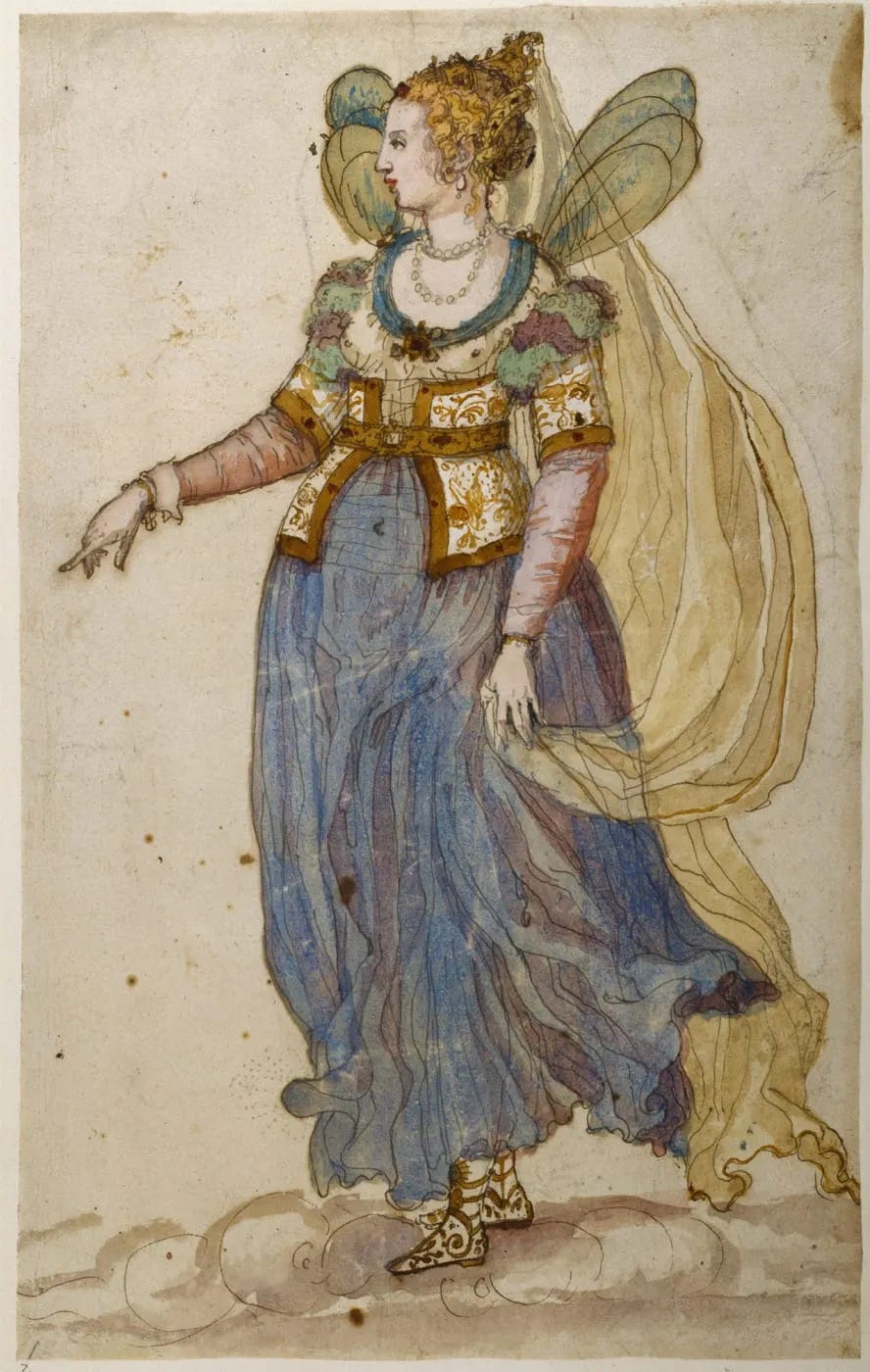
[Illustration: Costume for a female Masquer, c.1600. Devonshire House]
.
Scot George Buchanan was one of the most famous poets in sixteenth-century Europe. Shakespeare? Never heard of him. Spenser, Marlowe, Sidney? They didn’t have Buchanan’s reach, although the reason for that reach is the same reason why he is forgotten nowadays: he wrote in Latin. The days when Latin was a genuine lingua franca are far behind us, of course. The two front runners for today’s actual global common-tongue are English and Spanish, and the continuing fame of two of Buchanan’s contemporaries, Shakespeare and Cervantes, is closely bound-up with that fact. Still, Buchanan was a very interesting figure, a scholar and humanist as well as a poet and playwright. Scotland’s relative undersupply of universities meant that a whole generation of learned Scots went abroad: Duns Scotus to Paris and Cologne, Alexander Stewart at Padua, Buchanan teaching at universities in Paris, in Bordeaux, in Portugal. In that last place he was arrested by the Inquisition, on account of some satirical poems he had written (in Latin of course) about Franciscan monks. He was released after a year, whereupon he returned to Scotland to become tutor to Mary Stuart, Queen of Scots, and her son James. He converted to Protestantism, dying in 1582.
Here’s a poem Buchanan wrote in February 1564 that was publicly performed at Holyrood House, before Queen Mary and her nobles. The occasion was a banquet, which feast was followed by the performance of a masque entitled ‘Cupid, Chastity and Time’.
‘Blind Cupid’ entered first, while the servants sang an Italian sonnet. Next came a ‘fayre yong maid’, representative of Chastity, as the servants sang Latin verses written by George Buchanan. Finally, Time brought the banquet to its concluding course, again with the singing of Latin verses composed by Buchanan. As Sarah Carpenter has pointed out, ‘sung or spoken debates between Love and Chastity were performed at all three courts, in England, Scotland and France, between 1564 and 1565’. But whereas the conflict between Juno and Diana (resolved in favour of marriage) implies Elizabeth’s coercion by her courtiers and her alienation from the source of cultural production, ‘Cupid, Chastity and Time’ comes out in favour of chastity and reveals Mary using the masque to serve her own political (and matrimonial) ambitions.1
Mary married Lord Darnley the following year, though that didn’t work out so well for her — or, indeed, him (he was soon afterwards murdered in bizarre and to-this-day mysterious circumstances). Elizabeth, of course, never married, and eventually turned her chastity to her political advantage as ‘the Virgin Queen’
In Castitatem
Castitas blandi domitrix amoris,
Castitas vitae specimen prioris,
Labe cum puras soboles colebat
Aurea terras.
Castitas vitae specimen futurae
Morte cum victa, sociata membris
Pura mens puris radiantis aulam
Incolet aethrae.
Una nec certam Veneris sagittam,
Jura nec fati metuis severi,
Quippe quae rursus moriente major
Morte resurges.
Pura cum puris agites ut aevum
Angelis, quorum studium secuta
Colliges fructus socios secundae
Reddita vitae.
To Chastity
Chastity, conqueror of fawning lechery,
Chastity, example of how life was lived once,
when a purer progeny inhabited a
golden land,
Chastity, example for future times when
death being vanquished, our pure bodies
will unite with pure minds and, in radiant palaces,
dwell in Heaven above.
The well-targeted arrow from Venus’s bow
does not scare you, nor the laws of stern fate:
for you will rise up again, at the death
of death, resurgent,
purely spending eternity with the pure
angels, whose discipline you will follow
harvesting fruits with them, a second
life restored to you.
Alan Jacobs, having read-through of Augustine’s City of God, summarises the argument of that great work’s conclusion:
In his final book, Augustine tries to describe the condition of the blessed. Central to his concluding reflections is his claim that the blessed in heaven will possess true freedom, not because they can do anything they want, but because they cannot sin. They are free because they have been delivered from bondage to sin, their wills fully assent to the will of God; they are no longer divided selves. Dante expresses this very point at the end of Purgatorio XXVII, when Virgil, having guided Dante-the-pilgrim through his sanctification, utters his final words:
libero, dritto e sano è tuo arbitrio
e fallo fora non fare a suo senno:
per ch’io te sovra te corono e mitrio.That is: “Your will now is free, upright, and sound, and not to heed it would be wrong: Lord of yourself I crown and mitre you.” Dante-the-pilgrim is his own king, his own bishop; purged of sin, he is able to follow his own inclinations because those inclinations are perfectly sound. So Dante-the-poet here, and Augustine in Book XXII of the City of God, both depict the citizens of the City of God as they “stand in the security of [their City’s] everlasting seat.” Their wayfaring is over; they’re home to stay. But that’s not where we are.
This is exactly Buchanan’s position in his poem. Just as chastity used to be the general rule in the now-departed Golden Age, so in the coming paradise we will be chaste not because we are repressing our lustful urges but because our desires align perfectly with our purity. We will be chaste because that is who we are. It’s a definition of heaven.
Buchanan’s is an old poem, and might seem outmoded, its sentiment old-fashioned. Chastity, perhaps, strikes modern sensibilities as a musty, prudish, repressed, unhealthy kind of ‘virtue’. Freud teaches us that blankly repressing our desires leads to misery and neurosis (although he also notes that ‘civilisation’ inevitably entails some degree of repression — we cannot live with others, and others cannot live with us, unless we restrain our anger and lust to some degree, however discontenting this state of affairs must be: hence Civilisation and its Discontents). We might go further, and call chastity, as Percy Bysshe Shelley did in Queen Mab, a positive evil: ‘chastity is a monkish and evangelical superstition, a greater foe to natural temperance even than unintellectual sensuality; it strikes at the root of all domestic happiness, and consigns more than half of the human race to misery’. From a modern perspective Buchanan’s anticipation of the heavenly future in which we are ‘naturally’ chaste looks carceral, or worse, a kind of lobotomization of desire.
But this isn’t right. Chastity is sexual virtue, and whilst ideas of what constitutes sexual virtue have shifted ground they have not been abandoned altogether.2
