
Keats’s Hyperion
Scottish Grecians


[Averil Burleigh, ‘Hyperion’, from her 1911 illustrated edition of Keats’s poetry. We might question how he’s keeping that blanket up, and so preserving his modesty.]
+
Keats believed a poet should follow the trajectory of Vergil (and Spenser, and Milton): start with shorter poetry, write various kinds, some pastoral poems and then work their way up to an epic. There is no question but that if Keats had lived, he would have completed an epic, and probably would have written a number of them. How that would have affected his reputation, built as it is upon a number of flawless shorter poems and a skill at lyric intensity and extraordinary sensuous evocation of the qualia of lived experience, is hard to gauge. All that we have of his epic ambition are the first two-and-a-bit books of a blank-verse epic poem, Hyperion (presumably planned for 12 books, like Paradise Lost, which Keats himself cited as inspiration—and as reason for abandoning the project, ‘too many Miltonic inversions’ in the versifying) and the truncated rewriting of the same story as The Fall of Hyperion. He stopped writing Hyperion because he thought it wasn’t working. He stopped writing The Fall of Hyperion because he died, an ungainsayable excuse for not finishing something. We never got the Keatsian epic he planned. I wonder what it would have looked like.
Paradise Lost begins with Satan and his rebel angels cast down into the darkness visible of Hell, rallying themselves, building Pandemonium in that abject place, and debating how to carry on the war against God. Keats treats his Greek mythological theme the same way. The larger story is of the overthrow of the older generation of Greek gods, the Titans, by the younger generation, the Olympian gods. Hesiod says that the primordial couple Uranus (Sky) and Gaia (Earth) had twelve children: six male Titans—Cronus, Oceanus, Coeus, Crius, Hyperion and Iapetus—and six female Titans: Theia, Rhea, Themis, Mnemosyne, Phoebe, and Tethys. As well as being gods, with all the attributes we associate with the Olympian deities who supplanted them, the Titans were notable for their gigantic size. They came to power when Cronus (Latin name: Saturn) seized power from his father, Uranus. They lost power when Zeus (Latin name: Jove, Jupiter) led the Olympian gods against them in a ten-year war called the Titanomachy (‘battle of the Titans’). Losing this war, the Titans were cast down, plummeting from the upper world of the divine to the dark and gloomy realm of Tartarus, a portion of Hades, reserved for the damned and the wicked, an equivalent of hell in Greek and Roman mythology.
Keats’s story, as per its title, concentrates on one of the Titans, Hyperion, god of the sun. He is, as the poem opens, the last Titan standing. All the others have been overthrown, deposited not (in Keats’s version) into Tartarus, but rather some earthly location, a sad, shadowy valley:
Deep in the shady sadness of a vale
Far sunken from the healthy breath of morn,
Far from the fiery noon, and eve’s one star,
Sat gray-hair’d Saturn, quiet as a stone,
Still as the silence round about his lair;
Forest on forest hung about his head
Like cloud on cloud. No stir of air was there,
Not so much life as on a summer’s day
Robs not one light seed from the feather’d grass,
But where the dead leaf fell, there did it rest.
A stream went voiceless by, still deadened more
By reason of his fallen divinity
Spreading a shade: the Naiad ‘mid her reeds
Press’d her cold finger closer to her lips. [Hyperion 1:1-14]
Keats’s friend Ben (not Bill) Bailey uses this passage to illustrate what he calls Keats’s poetic theory ‘of melody in verse’, which particularly concerned ‘the management of open and closed vowels [which should] not clash one with another so as to mar the verse’ but which should be ‘interchanged, like different notes of music to prevent monotony.’1 There’s no question but that Keats ear for vowels, his vocalic fluency and subtlety, contrinutes largely to the exquisite pitch and flow of his verse. Edward Thomas, himself a pretty good poet (though not in Keats’s class) disliked the way what is ostensibly blank verse slips into rhyme (line 5’s ‘lair’ rhymes with line 7’s ‘there’) and objected to ‘“shady”, “healthy”, “fiery”’ appearing in successive lines.2 But this is to undersell what Keats is doing here, and to object to what is a strength of the versifying: these lines are shot-through with rhymes, like silk:—not just internal rhymes (‘Far … star’ 3, ‘hair[ed] … lair’ 4-5, ‘seed … reeds’ 9-14, ‘shade … Naiad 13) but absolute repetitions that turn rhyme into, precisely, stasis, to match the frozen misery of defeated Saturn: ‘Far … Far’ 2-3, ‘Sat … Sat[urn]’ 4, ‘Forest … forest’ 6, ‘cloud … cloud’ 7, ‘Not … not’ 8-9. The whole, in fact, is an exercise in threading rhymes into the trellis of blank verse: rarely at the line-endings, but throughout.
But, re-reading Hyperion this week to teach it, I was struck by something else. Keats is taking a Greek myth as the subject of his epic poem, but in writing it he brings in two geographic and cultural references that are not Greek: Egypt and Scotland. Keats positions his various Titanic characters out of Greek mythology and locates them in the Highlands.
Scotland, you say? Well, yes. Look at the flanks of the valley into the depths of which Saturn has been plunged: ‘forest on forest hung about his head/Like cloud on cloud.’ Consider the dark green, shadowy, overcast world which Keats describes: not the bright sunlit blue-sky yellow sands of the Mediterranean, but a sodden, misty, chilly place: ‘all the gloom and sorrow of the place’ [91], a location of ‘ooze’ and ‘mist’ and ‘shade’.
Along the margin-sand large foot-marks went,
No further than to where his feet had stray’d,
And slept there since. Upon the sodden ground
His old right hand lay nerveless, listless, dead,
Unsceptred; and his realmless eyes were closed.
Saturn’s hair is described as ‘druid locks’. The forest is not cypress and pine, but ‘green-rob’d senators of mighty woods/Tall oaks’. In Endymion and Lamia Keats creates a Mediterranean world of sunshine and colour (an imagined one, since he hadn’t at that point seen it with his own eyes) and Isabella or the Pot of Basil is a warm Italian poem. But Hyperion moves the landscape away from the Med.
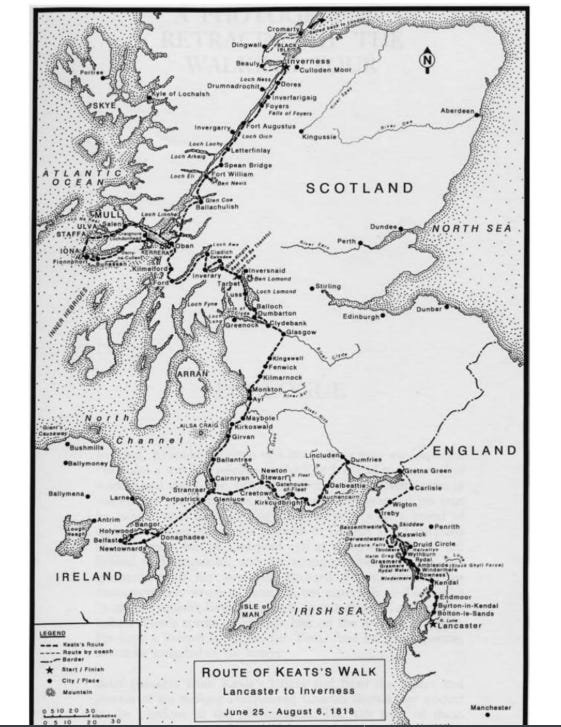
There’s a reason for this. Keats was incubating his epic when he and his friend Charles Brown went on a walking tour of Scotland. In 1818 they took a coach to Lancaster, made their way to Dumfries, and then walked variously through the highlands until they reached Inverness. At this point Keats was not well, and he took a packet-boat back to London. His unwellness did not go away. He nursed his brother Tom through a painful death by tuberculosis, and then his own TB got worse until, in 1819, he travelled to Rome, hoping that the warmer climate might help him (spoiler: it didn’t—he died of the disease early in 1821). On the way to Dumfries, Keats was reading Dante (in translation) and Ossian which certainly fed into his imagining of the Hyperion project. But so, manifestly, did the sights and scenery of his walking tour. Andrew Motion relates:
While he and Brown … [headed] westward to the coast, Keats came across more and more evidence of Scotland’s rural poverty. He beadily described the barefoot men and women on the road, carrying their shoes and stockings to ‘look smart in the Towns’, and ‘plenty of wretched Cottages where smoke has no outlet but by the door.’ From Auchencairn Keats and Brown ‘walked the ten miles to Kirkcudbright, with a two mile detour to see Dundrennan Abbey. He and Brown were both delighted by the “stately” grey stone ruins, and the sloping views towards the “winding bay”. When they reached their lodgings in the evening the rain began to fall.’3
Rain? In Scotland?? Inconceivable!
After a detour by boat to Ireland, Brown and Keats returned to Scotand:
They travelled through Stranraer into Ayrshire, the road curving steeply uphill along the coast, giving views which Brown, in his plain way, called ‘both grand and beautiful’ … Listening to the waves thrashing on rocks below them, and to the echoes in sea caves, they passed through wooded glens towards the Vale of Glenap, and entered what Brown referred to as ‘an enchanted region—another world.’ They ‘strode along, snuffing up the mountain air.’
They made their way to Inverary where a thunderstorm detained them, and Keats began a letter to Ben Bailey. Then:
As the thunder cleared Keats put away his letter to Bailey unfinished, and tramped with Brown to Cladich, at the north east end of Loch Aw, where they spent the night … ‘Trudging’ for twenty miles they found each ‘new and beautiful picture’ only a partial recompense. ‘No supper but Eggs and Oat Cake,’ Keats complained that evening. ‘We have lost the sight of white bread entirely—now we had eaten nothing but eggs all day—about 10 a piece and they had become sickening. On 21st July, bending north-west towards Kilmelfort, the views were even more impressive, and the food slightly better—a ‘small Chicken’ and even a ‘good bottle of Port.’ To their left they could see the sea inlets of the jagged coast; to their right, the flat black water of Loch Awe, broken by wooden islands, and ringed by low heather-covered hills. ‘Indolent’ eagles floated above them, ‘without the least motion of wings.’ [Motion, 288]
When Hyperion sees eagles, it is for the first time—because, of course, they are Zeus’s (that is, Jupiter’s) bird, representative of his triumph over the Titans.
... while sometimes eagle’s wings,
Unseen before by Gods or wondering men,
Darken’d the place; and neighing steeds were heard,
Not heard before by Gods or wondering men. [Hyperion 182-5]
As Keats began to write Hyperion he recreated this landscape as the place where the fallen Titans assemble. Thea leads Saturn ‘through the shade a space … Through aged boughs, that yielded like the mist/Which eagles cleave upmounting from their nest.’
The other topographical, or cultural, influence on the poem was Egypt, a reflection of the vogue for Egyptian antiquities, after Napoleon’s Egyptian campaign in 1798 and the British military rebuff.4 Thea, Hyperion’s wife, consoles Saturn. The poem dwells on her enormousness:
By her in stature the tall Amazon
Had stood a pigmy’s height: she would have ta’en
Achilles by the hair and bent his neck;
 Or with a finger stay’d Ixion’s wheel.
Her face was large as that of Memphian sphinx,
Pedestal’d haply in a palace court,
When sages look’d to Egypt for their lore. [1:27-33]
The sphingine comparison was up to date: ‘Severn and I took a turn round the [British] Museum,’ Keats wrote, in January 1819. ‘There is a Sphinx there of a giant size and most voluptuous Egyptian expression’ [Letters 2:68]. Thea’s husband’s palace is modelled on Ancient Egypt
His palace bright
Bastion’d with pyramids of glowing gold,
And touch’d with shade of bronzed obelisks,
Glar’d a blood-red through all its thousand courts,
Arches, and domes, and fiery galleries;
And all its curtains of Aurorian clouds
Flush’d angerly: [1:176-82]
Fraught with intimations of his impending downfall, Hyperion paces ‘with stride colossal, on from hall to hall’, his flaming robes streaming behind him:
On he flared,
From stately nave to nave, from vault to vault,
Through bowers of fragrant and enwreathed light,
And diamond-paved lustrous long arcades,
Until he reach’d the great main cupola. [1:217-21]
All very Empire style. But then, in book 2, Hyperion descends to join the assembly of the fallen Titans, and we’re back in an Ossianic Scotland.
It was a den where no insulting light
Could glimmer on their tears; where their own groans
They felt, but heard not, for the solid roar
Of thunderous waterfalls and torrents hoarse,
Pouring a constant bulk, uncertain where.
Crag jutting forth to crag, and rocks that seem’d
Ever as if just rising from a sleep,
Forehead to forehead held their monstrous horns. [Hyperion 2:5-12]
It’s a question as to why Keats takes Greek myth and relocates it away from Greece. Something in the sublimity of the Highlands, its splendid gloom and scale, its chill and mood, fitted it to Keats’s imagining of the Tartarean space into which the Titans have fallen. He treats Greek material in Ossianic style.6 Fiona Stafford argues that ‘Keats’s 1818 summer trip was inspired and mapped by poetry’, and that he impressed the landscape via his creative association of ‘the literary giants in his mind—Shakespeare, Burns, Ossian, Dante, Wordsworth’ which ‘came face to face with those embedded in the rocks and mountains, catalysing Keats’s creative energy as they clashed, and helping to forge a language adequate to his epic ambition.’ Stafford’s argument, really, is that Scotland gave him access ‘to older ways of thinking and imagining’ and that he connected with ‘an intuitive version of an ancient animism, a shared language for expressing extraordinary natural power.’7 This is interesting, if hard to prove.
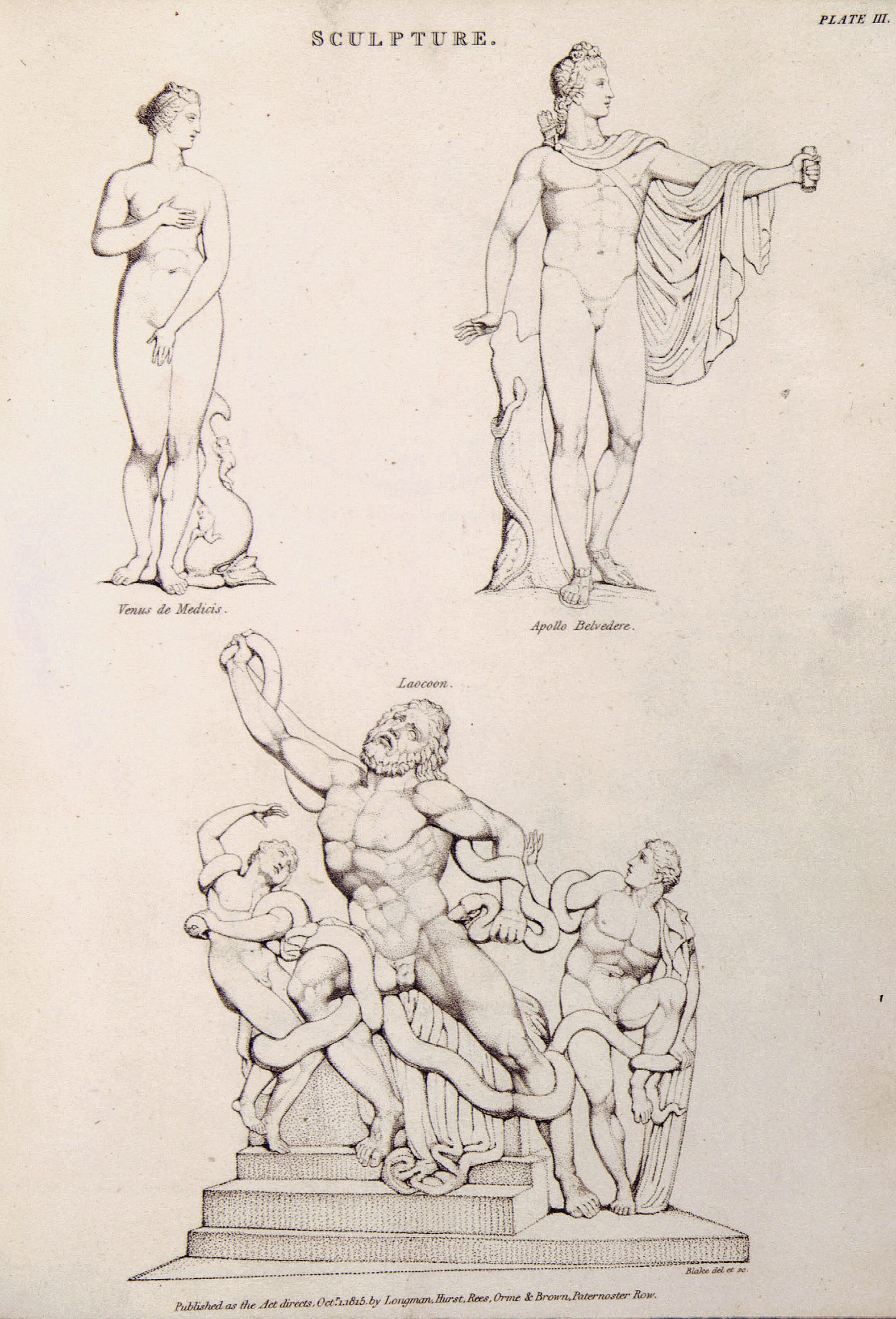
And actually, I read the characters in Hyperion not as Ossianic embodiments of the landscape, animist figurations of features of the Highlands, but as informed by Keats’s experiences with statuary. In this they do reconnect with the Greek provenance of the stories. Near the end of Book 1 Hyperion suffers another intimation of his coming downfall: a kind of seizure:
At this, through all his bulk an agony
Crept gradual, from the feet unto the crown,
Like a lithe serpent vast and muscular
Making slow way, with head and neck convuls’d
From over-strained might. [Hyperion, 1:259-63]
This motionless hugeness is statuesque: Keats is thinking of the Laocoön, a lifesize copy of which statue was in the Royal Academy. Here’s Blake’s illustration of it:
Likewise in his earlier account of Saturn rising in agony:
This passion lifted him upon his feet,
And made his hands to struggle in the air,
His Druid locks to shake and ooze with sweat,
His eyes to fever out, his voice to cease.
He stood, and heard not Thea’s sobbing deep; [1:134-9]
The poem is a series of these statuesque frozen moments, time itself in abeyance at this moment of trauma—‘O aching time! O moments big as years!’ Thea cries.
One thing Hyperion does not acquire is epic motion, momentum, dynamism. With the single exception of Hyperion storming fierily through his palace (quoted above) everyone in this poem moves slowly, or else is monumentally still and statuesque. This is Grecian, we might say.
The Keats Circle 2:277
Andrew Motion, Keats (Faber 1997), 275
‘Napoleon had gone to Egypt with not only a huge army but an entire travelling academy, the Institut d’Egypte, made up of 167 scientists, artists, poets, architects, engineers known collectively as “the savants”. The savants’ purpose was to map, chart, describe and eventually collect everything that was to be known about ancient and modern Egypt. For two years, while Napoleon achieved a precarious hold over the country, they did just that, amassing in the process the most substantial body of data then available on any ancient civilisation. In March 1801, acting supposedly in the name of the sultan, the British invaded. By then Napoleon had already left, claiming that more urgent matters back in France required his attention. The members of the Institut huddled together in the port city of Alexandria, awaiting deportation along with all that remained of Napoleon’s Armée d’Orient, now engaged in a collectors’ war with the English commander, General John Hely-Hutchinson. Hely-Hutchinson maintained that everything that they had in their possession—including their own drawings and notes – was to be considered war booty. The French, led by the biologist Geoffroy Saint-Hilaire, violently disagreed. Rather than “let this iniquitous, vandalous spoliation take place”, Saint-Hilaire vowed that he would burn all he had. “Count on the memory of history,” he told the unfortunate English negotiator William Richard Hamilton, “you too will have burned a library in Alexandria.” In the end, the savants left with 55 cases of specimens and scientific papers. But the British got most of the artefacts, including the Rosetta Stone, all of which were taken back to London to become the basis of the Egyptian collection of the British Museum. As a military venture, Napoleon’s bizarre attempt to persuade the Egyptians that he was, as Victor Hugo later phrased it, “the Mohammad of the West”, and that Islam and the Rights of Man could be made compatible, was a tragi-comic disaster. But its cultural impact on Europe was considerable. A form of “Egyptomania” gripped Britain and France, spawning an entire decorative and architectural style – known broadly as “Empire”.’ [Anthony Pagden]
Keats is sometimes knocked for his lack of Greek (he famously read Homer only in Chapman’s Elizabethan translation, not the original) but he knew enough to put the emphasis correctly, here, where the name Ixion is concerned: Ἰξῑ́ων, Ixī́ōn, on the second and third syllables, not the first, as it is commonly pronounced.
Ossian, that is James Macpherson, is fond of comparing his characters to the landscape through which they move: ‘as rushes a stream of foam from the dark shady deep of Cromla; when the thunder is travelling above, and dark-brown night sits on half the hill. Through the breaches of the tempest look forth the dim faces of ghosts. So fierce, so vast, so terrible rushed on the sons of Erin. The chief like a whale of ocean, whom all his billows pursue, poured valour forth, as a stream, rolling his might along the shore. The sons of Lochlin heard the noise, as the sound of a winter-storm … Like autumn's dark storms, pouring from two echoing hills, towards each other approached the heroes. Like two deep streams from high rocks meeting, mixing, roaring on the plain; loud, rough and dark in battle meet Lochlin and Innis-fail.’ [Fingal bk 1]
Stafford, ‘Keats and the Sleeping Giants’, in Katie Garner and Nicholas Roe (eds) John Keats and Romantic Scotland (Oxford University Press 2022), 21-40
Thank you, you are a gent
Not to be "that guy" but Northern Ireland wasn't a thing in the 1820s, more the 1920s, after partition.
At the time Keats was there it was simply Ireland, a dominion of the UK