
The Browning Version
Huge Grace Breathing

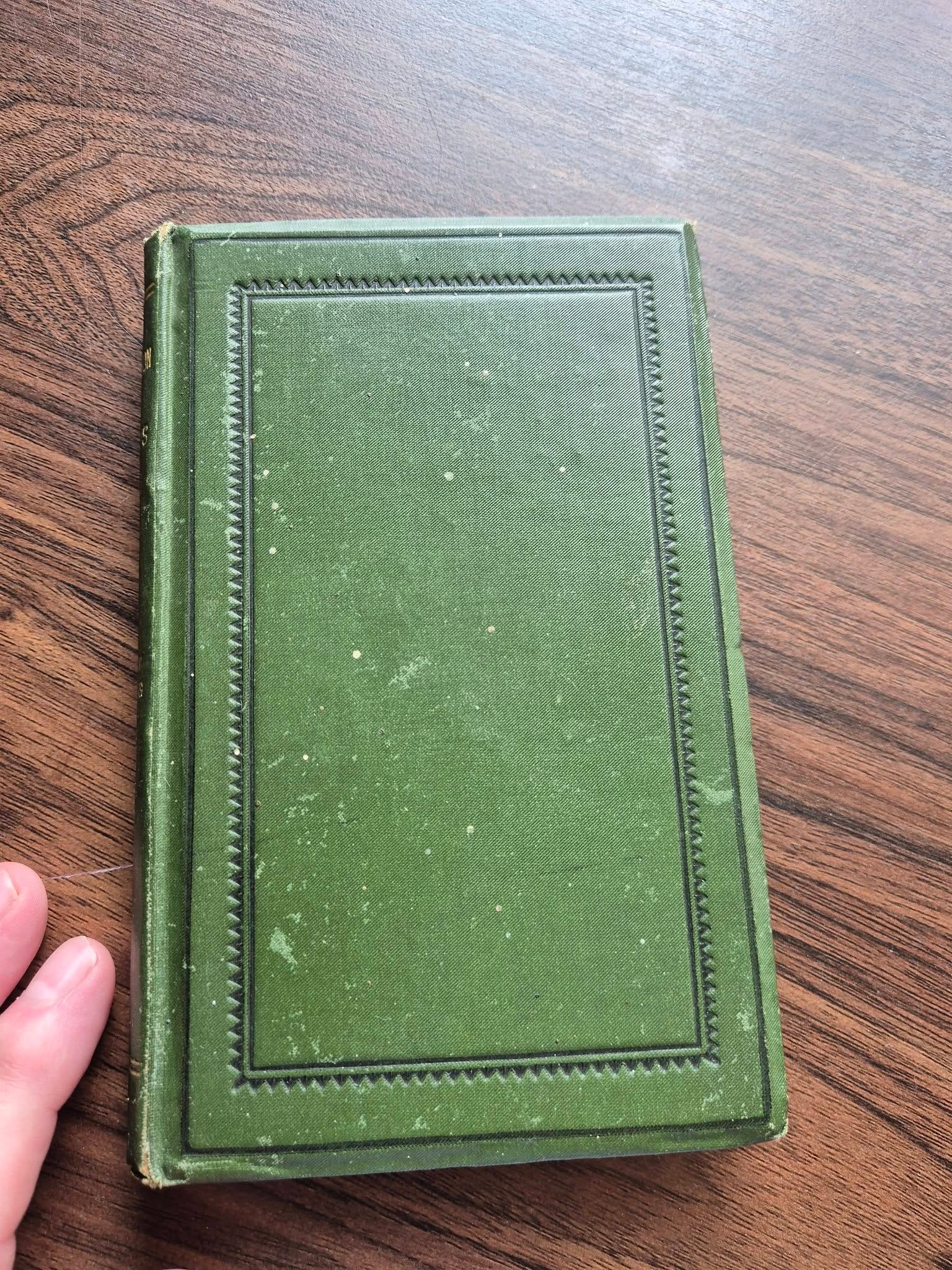
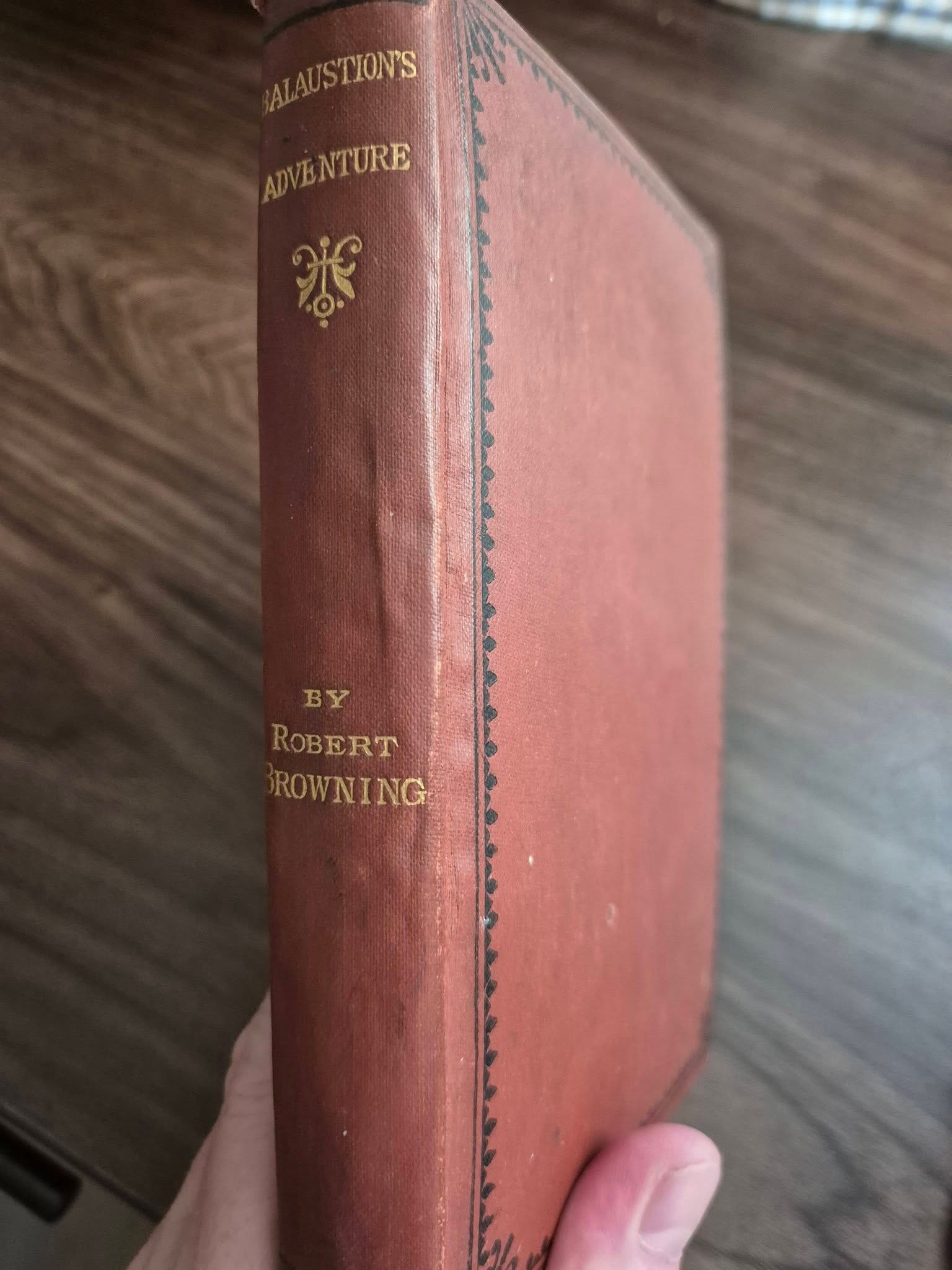
My PhD (at Cambridge, back in the final stretch of the 1980s) was ‘Robert Browning and the Classics’ and was very largely concerned with three of RB’s late book-length publications. Two were Balaustion’s Adventure (1871) and Aristophanes’ Apology (1875), works I know extremely, one might say freakishly, well. The former is a narrative poem set in 5th-century BC Greece that includes, folded into its narrative, a complete retelling of Euripides’ Alkestis. It was a surprise hit.1 Smith, Elder & Co, his publisher, hurried out a second edition, and then a third—the first edition is hard to get hold of, but I have managed to obtain a 3rd edition. Maybe one day I’ll get hold of a 1st.
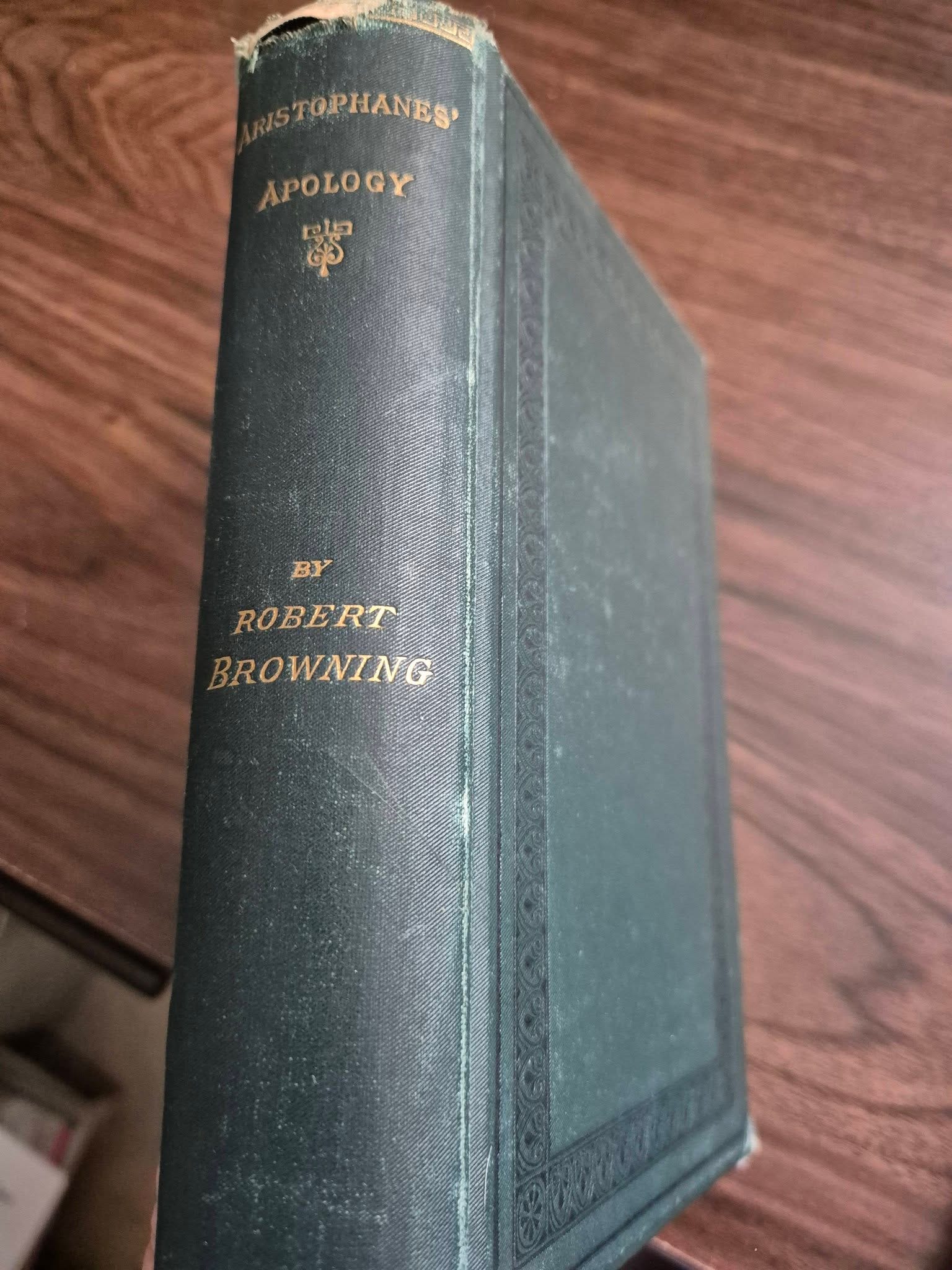
Aristophanes’ Apology, subtitled ‘The Last Adventure of Balaustion’, was much less successful, commercially.
![May be an image of book and text that says 'ARISTOPHANES' APOLOGY INCLUDING A TRANSCRIPT FROM EURIPIDES BEING THE LAST ADVENTURE OF BALAUSTION BY ROBERTBROWNING ROBERT BROWNING LONDON SMITH, ELDER,& & CO., 15 WATERLOO PLACE 1875 [AU rights reserved]'](https://substackcdn.com/image/fetch/$s_!B46A!,f_auto,q_auto:good,fl_progressive:steep/https%3A%2F%2Fsubstack-post-media.s3.amazonaws.com%2Fpublic%2Fimages%2Ff4acd36a-ede3-4704-b09d-afcfebc172fe_1536x2048.jpeg "May be an image of book and text that says 'ARISTOPHANES' APOLOGY INCLUDING A TRANSCRIPT FROM EURIPIDES BEING THE LAST ADVENTURE OF BALAUSTION BY ROBERTBROWNING ROBERT BROWNING LONDON SMITH, ELDER,& & CO., 15 WATERLOO PLACE 1875 [AU rights reserved]'")
That it flopped is not surprising. This book is quite a bit longer, and considerably more abstruse and difficult to read (I love it for these reasons, I must say) than the first. In it Balaustion, the fictional Greek woman and passionate fan of Euripides—in some ways a version of Browning’s beloved and much-missed wife Elizabeth Barrett Browning (EBB had died in 1861)—returns to argue art against saucy masculine Aristophanes, at enormous length. They bang-on (in a purely verbal sense) about propriety and nobility, about satire and indelicacy in art for thousands and thousands of lines of blank verse. The book also includes a complete line-by-line, translation of Euripides’ Herakles into English—Balaustion presents this as an argument-winner (which it really isn’t). Browning’s version of this great play is granulated, odd, freakishly over-literal. He calls it a ‘transcription’ rather than a translation because he is deliberately discarding the previously obtaining traditions of English translation and going with something much more bizarre and garbled, obsessive closeness of attention to the original, a deliberate defamiliarising of usual idiom, conventional word-order tossed to the winds, bizarre idioms and freakish expressions. Not since Sordello, Browning’s famously obscure and incomprehensible epic poem, had the echt Browning obscurity manifested itself so gloriously. Let your freak flag fly, as the phrase goes. Towards the end of my PhD I was delighted to chance upon a first edition of this Browning work. It’s a first edition because only one edition of this notably unpopular work was ever published.
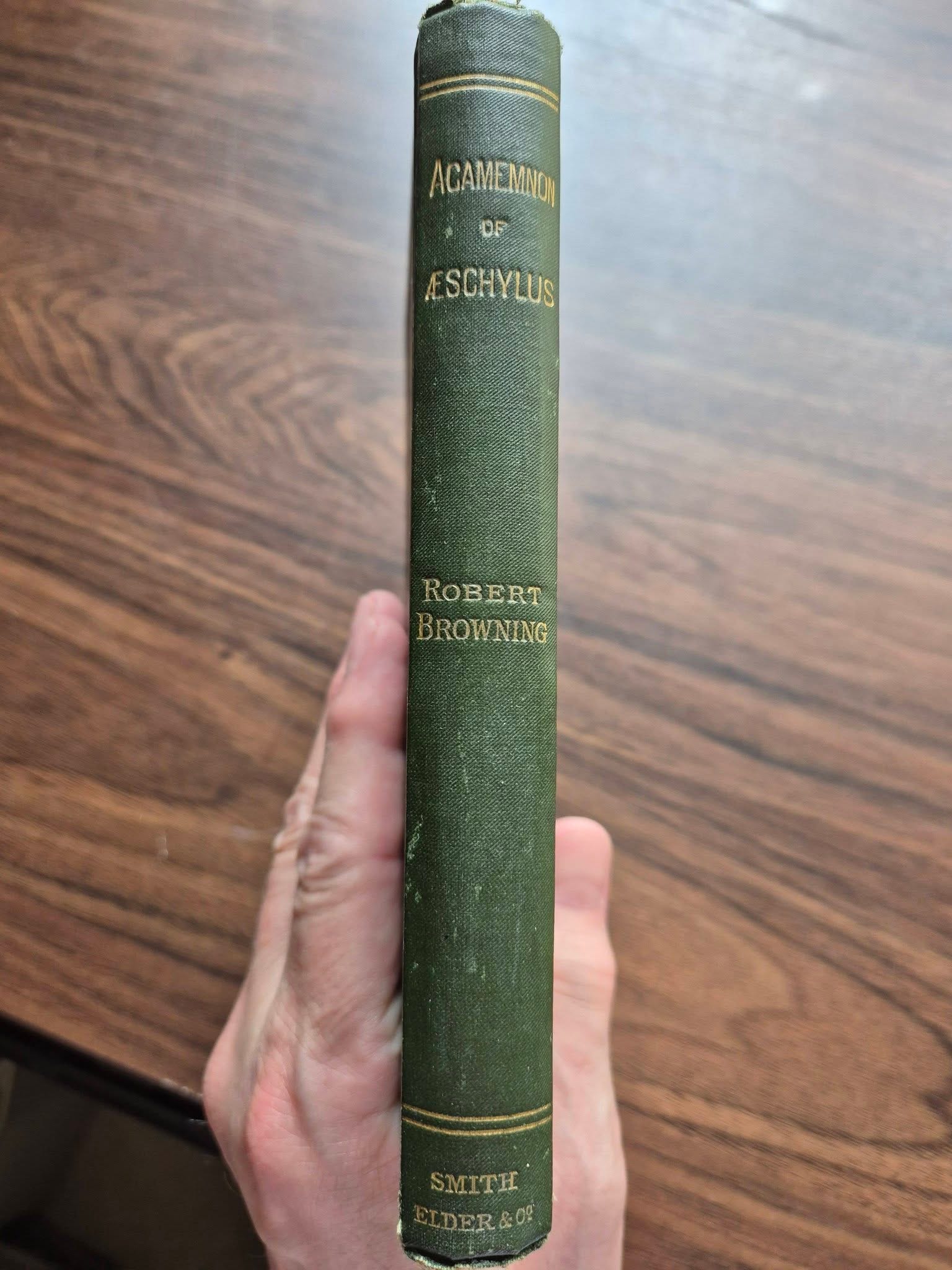
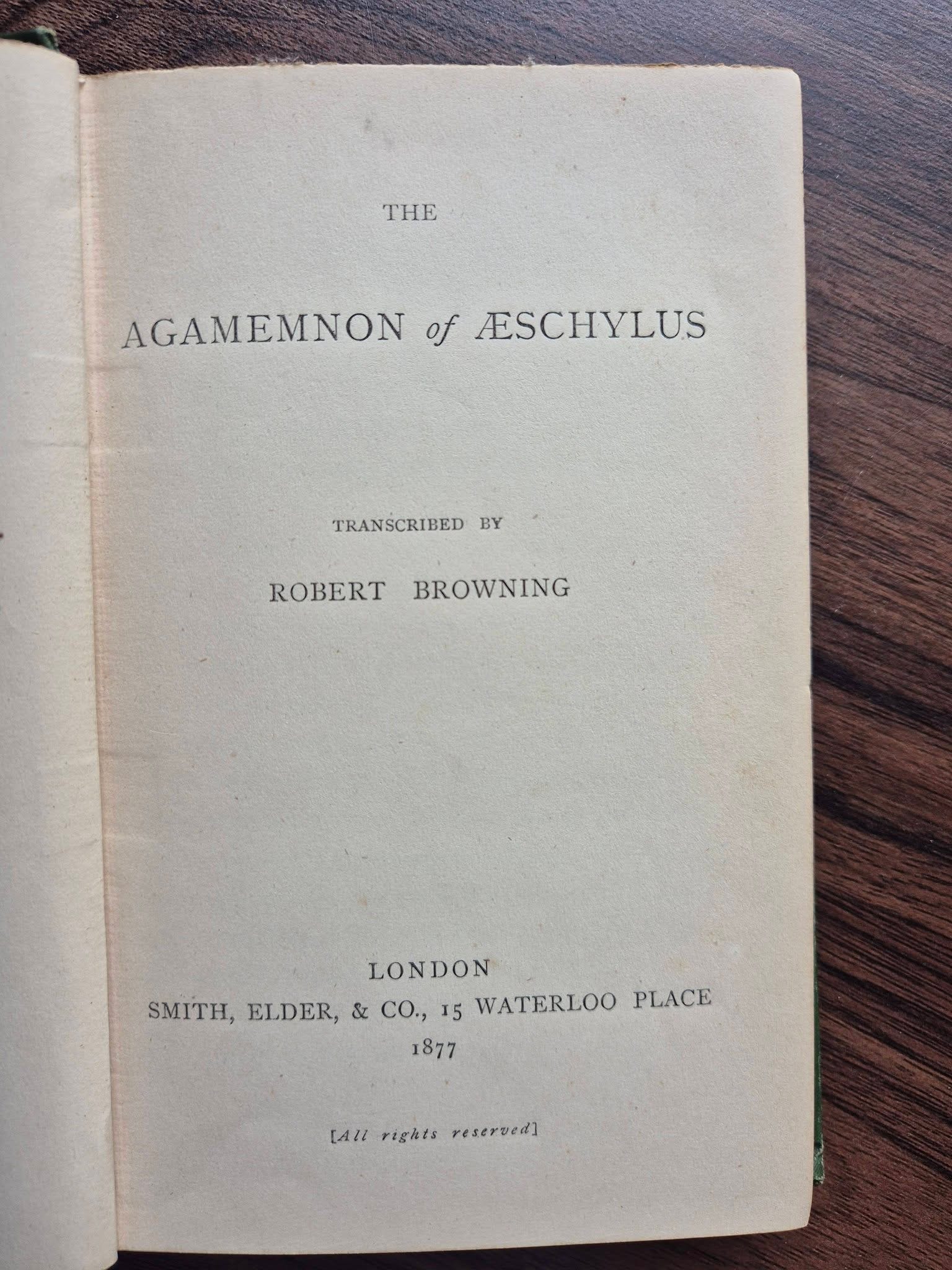
Ah, but then there’s Browning’s Agamemnon (1877). The was last in Browning’s triad of deep engagements with Attic tragedy (he wrote some classics-inspired poetry in later volumes, up until his death in 1889, but he never again spent so much time and labour on the Greeks as he did 1871-77) and it attracted a deal of notoriety, not to say opprobium. Its problem is, or was perceived as being, that when you read it as an English text it is pretty much gibberish. Which, often, it is. One reviewer complained that he had to keep checking back with the original Greek to work out what Browning was saying with his English version. Browning dedicated the translation to Thomas Carlyle, who was somewhat embarassed by the compliment: ‘Oh yes, he [Browning] called down some months ago to ask if he might dedicate it to me. I told him I should feel highly honoured. But—O bless me! Can you understand it at all?’
Yes, Browning says I ordered him to do this translation . . . but O dear! he's a very foolish fellow. He picks you out the English for the Greek word by word, and now and again sticks two or three words together with hyphens; then again he snips up the sense and jingles it into rhyme! I could have told him he could do no good whatever under such conditions.
In the words of Yopie Prins, ‘most nineteenth- and twentieth-century readers agreed with Carlyle that Browning's translation is unreadable. Swinburne, for example, who had previously defended Browning against charges of obscurity, pronounced the Agamemnon ‘beyond belief—or caricature’, and Ezra Pound, who learned more from this translation than he was willing to admit, described it as ‘a stilted unsayable jargon.’2 Frederic Kenyon, a good friend of Browning’s, considered it a ‘perverse tour de force.’ William DeVane, Browning’s earliest and most loyal critic, also identified ‘strange perversity’ in the garbled English of the piece.
I have to say, along with Yopie, I love Browning’s Agamemnon, in all its thorny, peculiar, proto-Modernist Demoiselles d’Avignon beauty.3 But the initial print run essayed by Smith & Elder was small, and though school editions of the text eventually became quite widespread (hence the title of Terence Rattigan once-famous 1948 play, The Browning Version) the first edition is rare.
Imagine my delighted surprise, then, when—browsing in Henley-on-Thames’s Oxfam Books earlier today—I chanced upon this.
Add to this delight my miserly ecstasy with respect to the price requested:
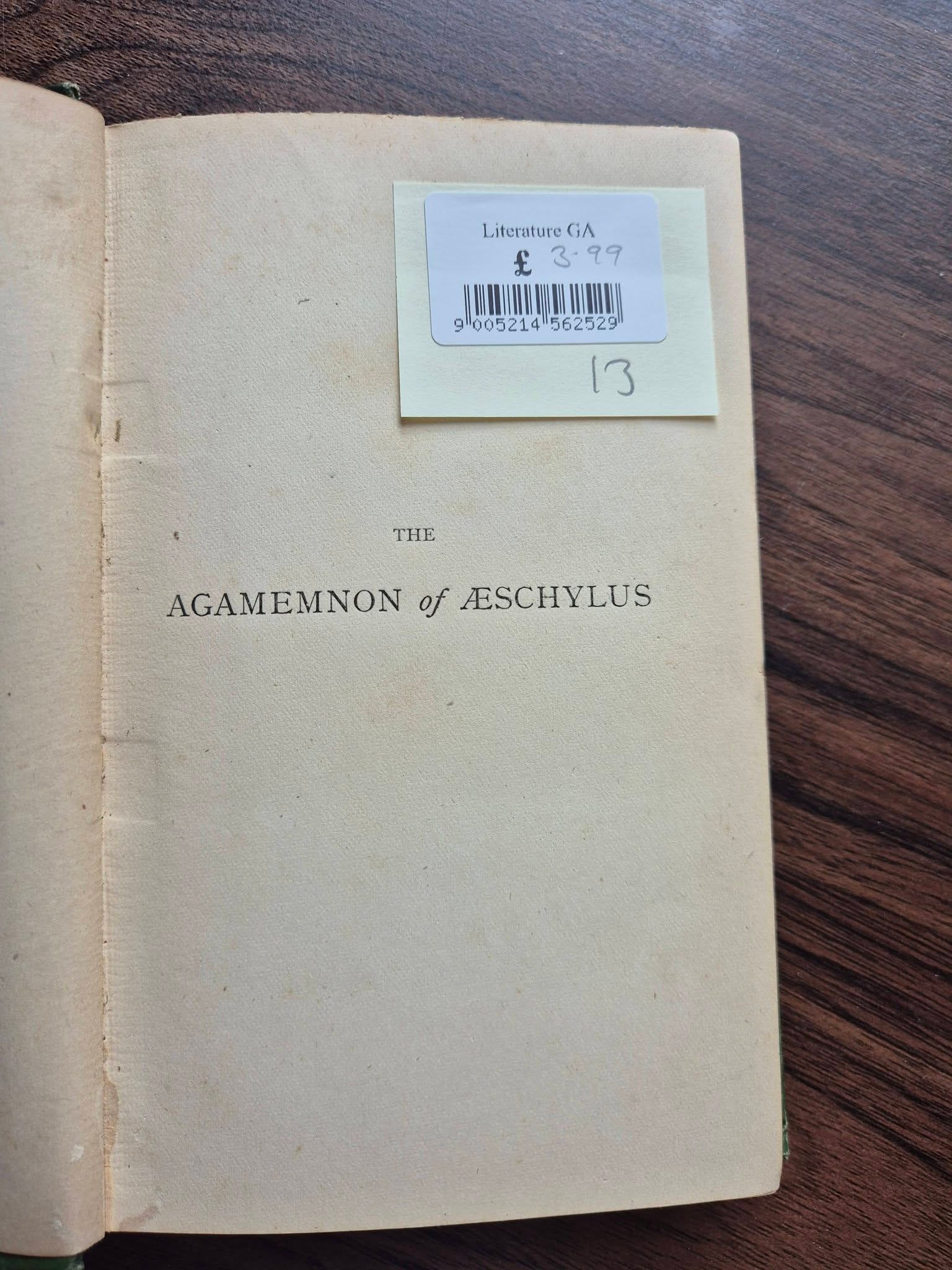
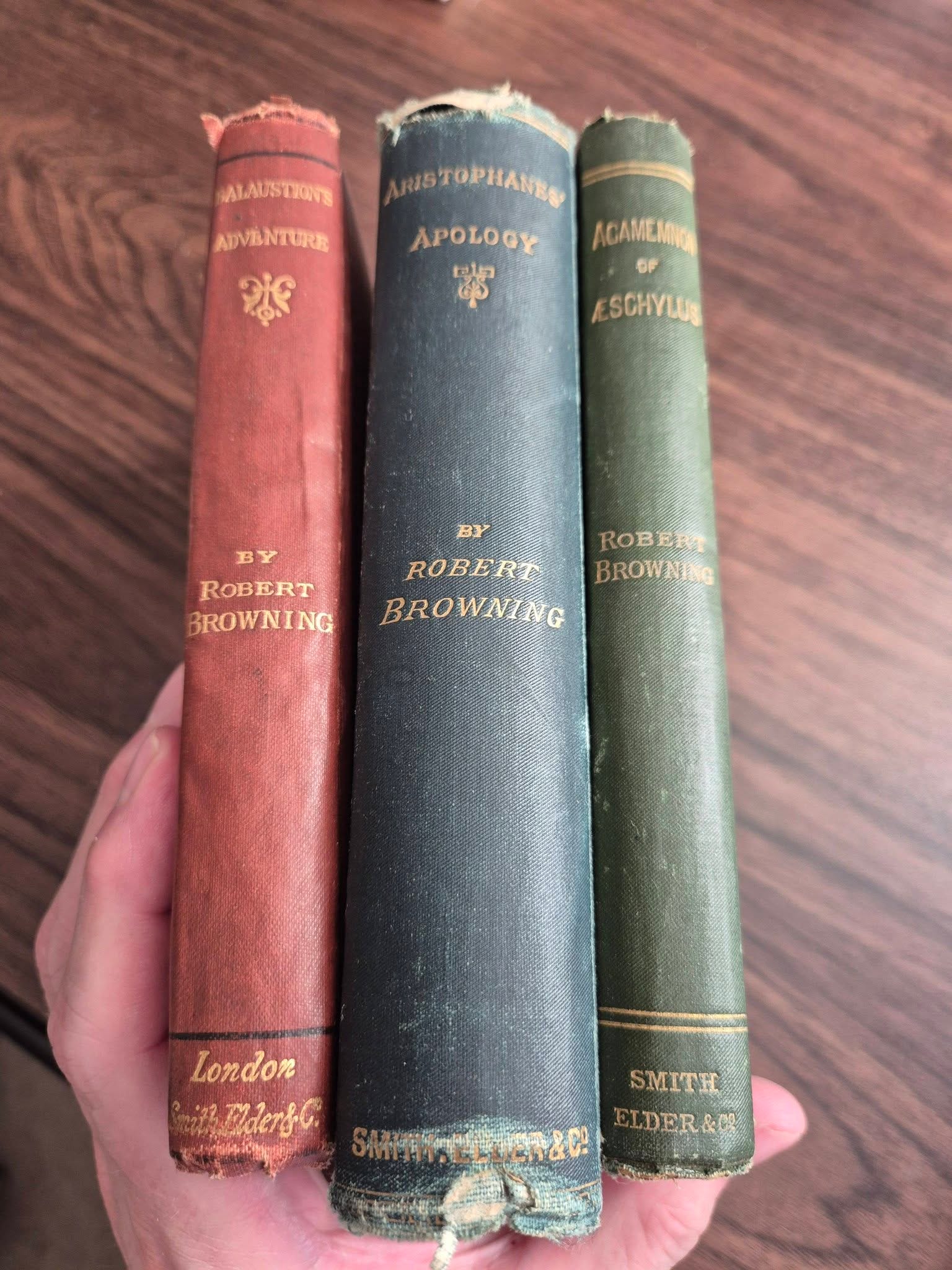
My trio of PhD texts original editions is complete!4
One more thing. This volume was sold uncut, as was the way with many 19th-century books: a reader needed a paper-knife to hand, to slice the tops of the bound-up pages open so as to read the work.
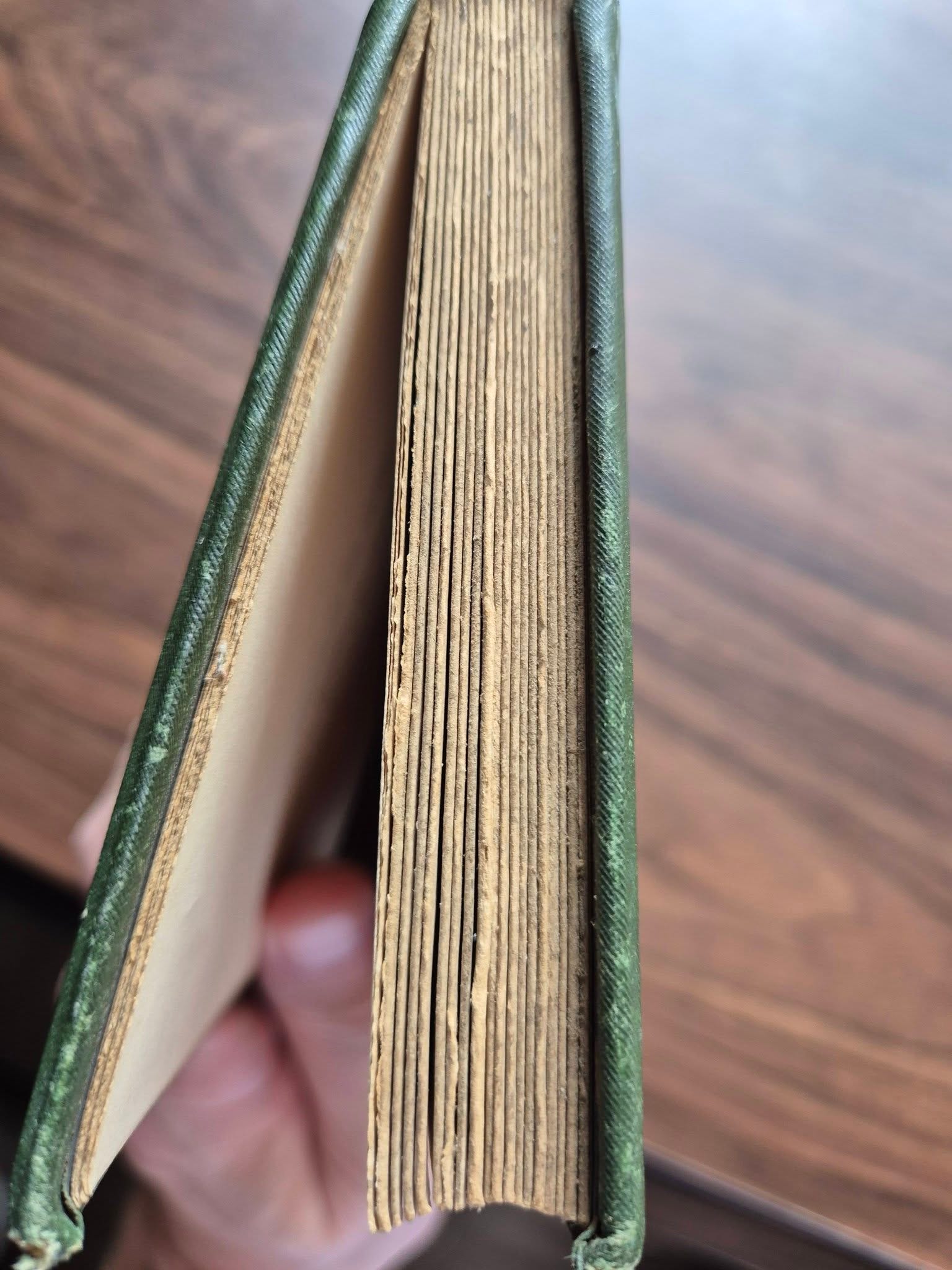
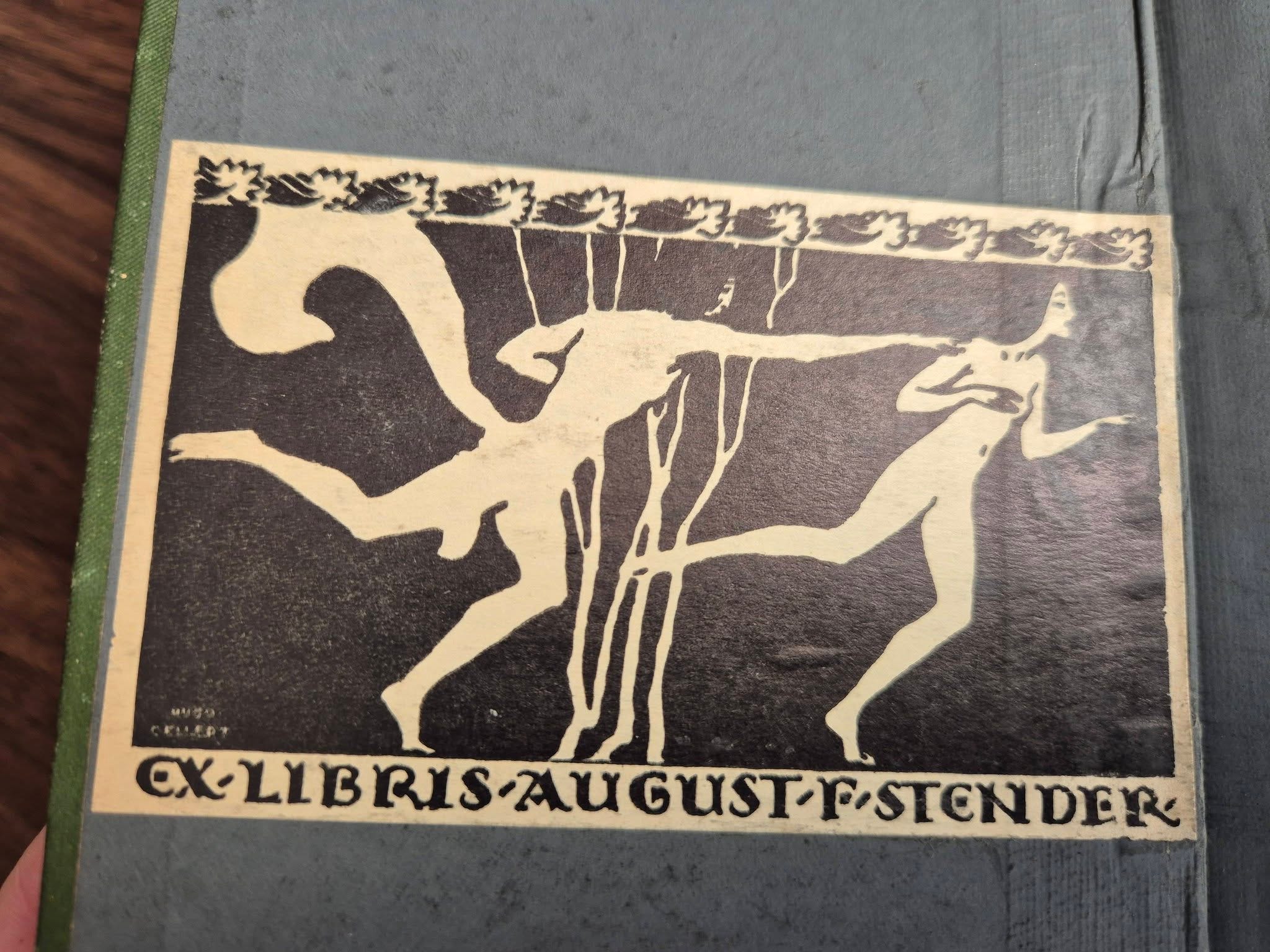
Because of this fact, I can tell how far the original purchaser of this volume got (he added his bookplate, so I know this was ‘August F Stender’)5 —he bought and started reading Browning’s complicated and forbidding text. What progress did he make? Well, he cut to read pages 1 and 2; and he cut to read pages 3, 4 and 5; and then he cut to read pages 6 and 7 …
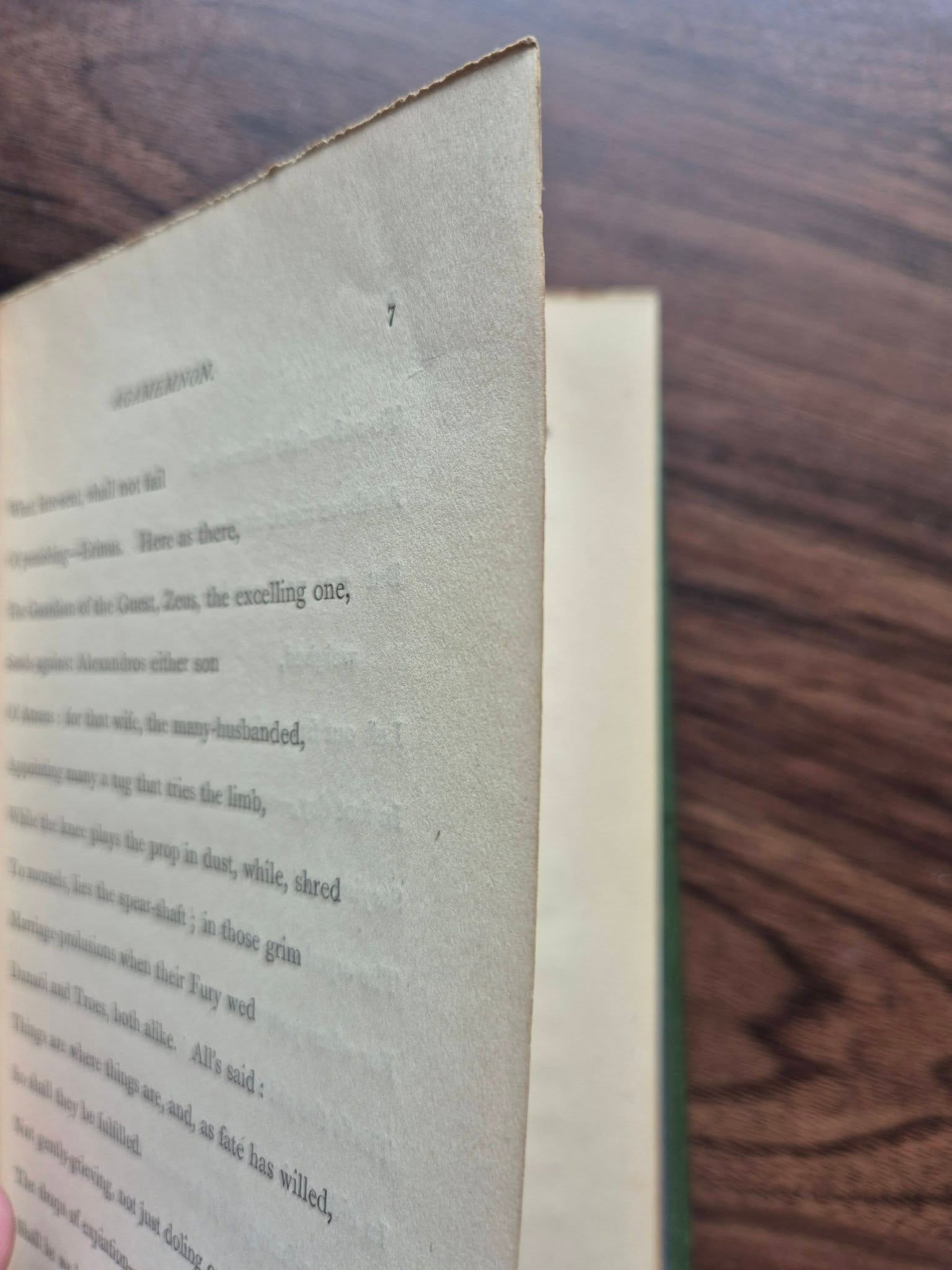
… and then at page 9 he very clearly ‘noped’ big-time. Page 9 is his ‘fuck this for a game of soldiers’ moment. And can we blame him?
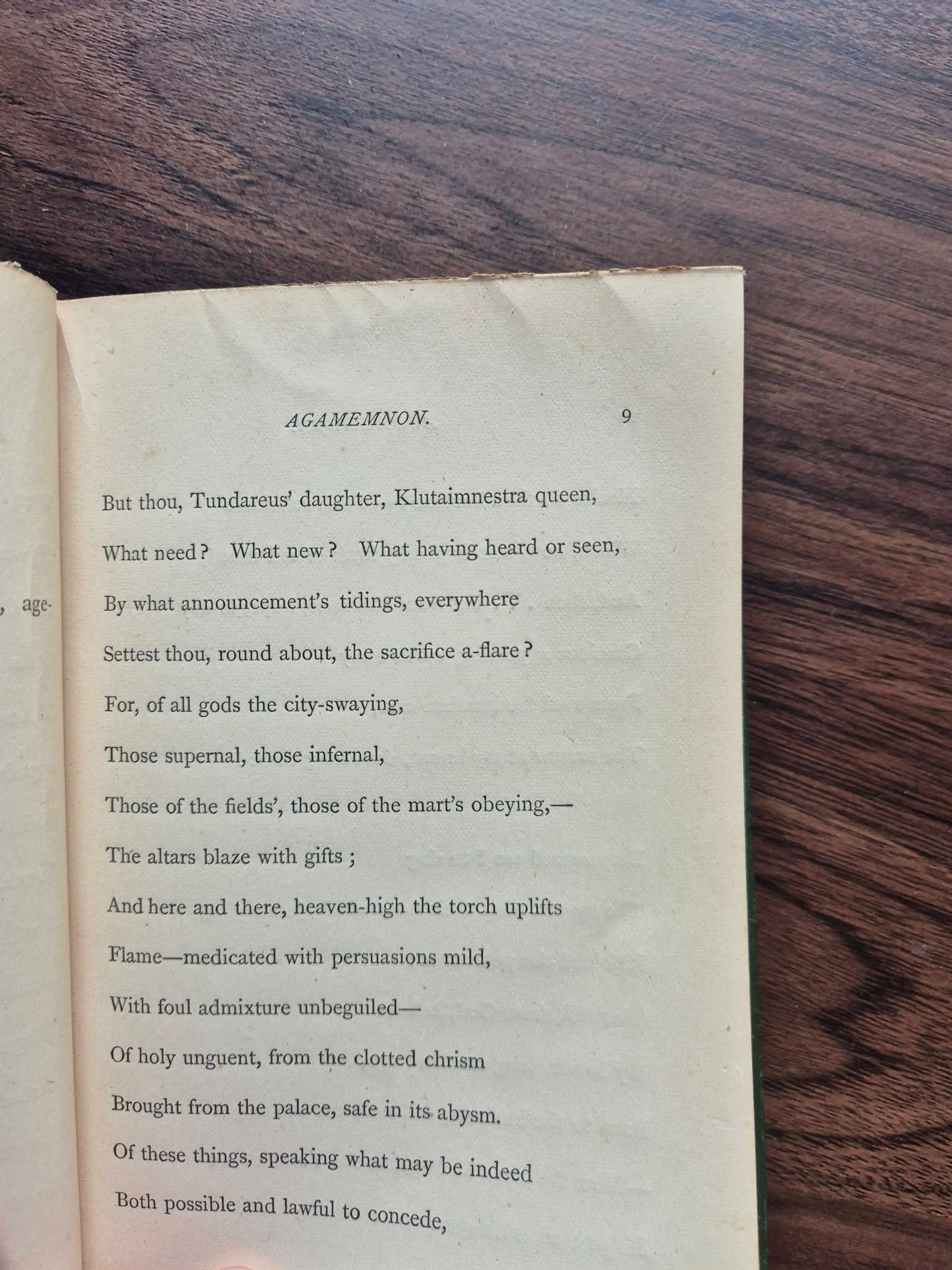
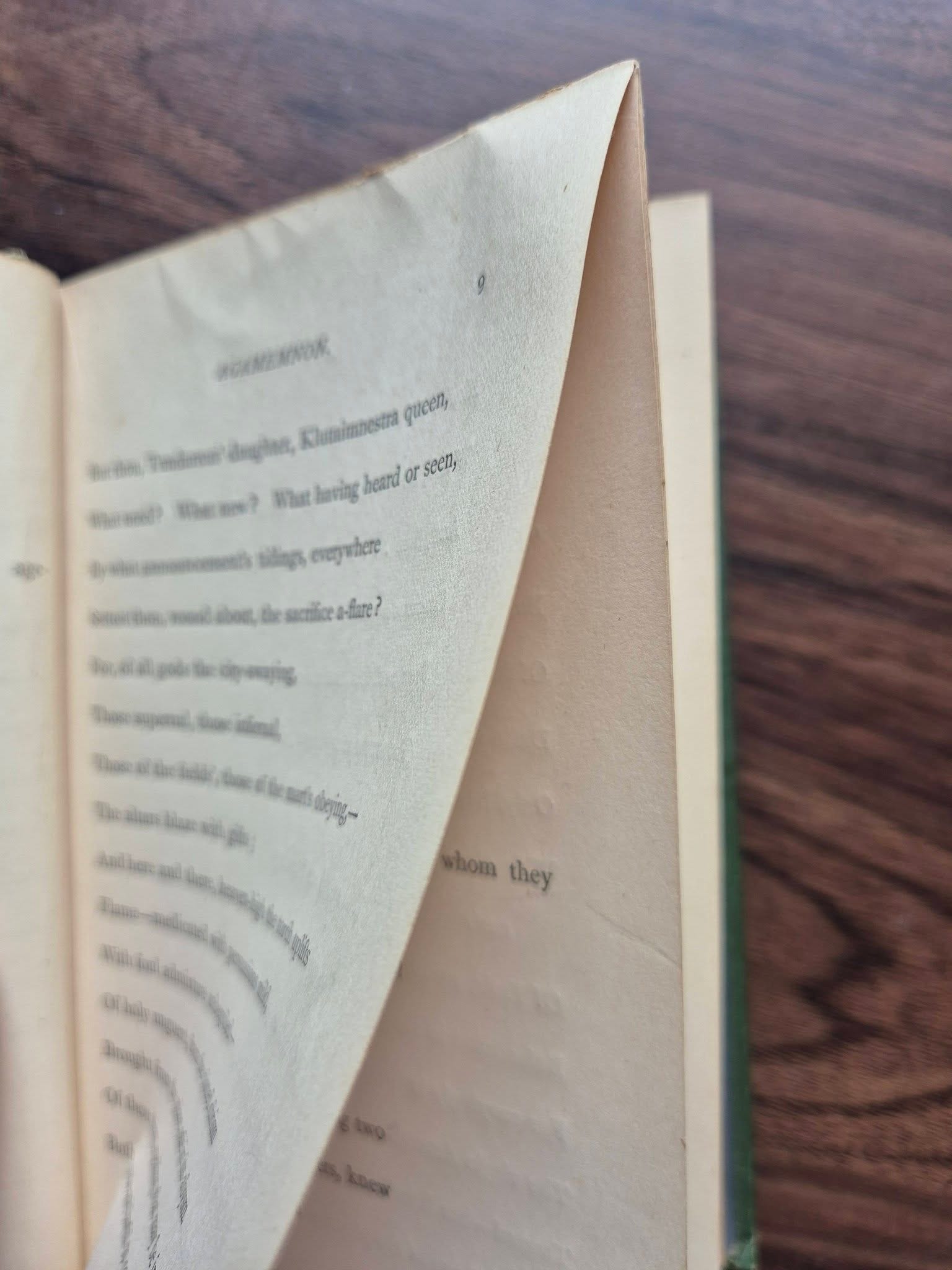
None of the subsequent pages are cut. Thus far and no further, Robert Gibberish Browning!
It’s written in easily comprehensible blank verse and tells an engaging story (based on true history), into which it folds a smoothly narrated retelling of one of Euripides’ most accessible plays.
Prins, ‘“Violence Bridling Speech”: Browning’s Translation of Aeschylus’ Agamemnon’, Victorian Poetry, 27:3/4 (1989), 151. Prins’s article is easily the best thing written on Browning’s Agamemnon, though my own ‘A Source for Browning’s Agamemnon’ in the same journal [Victorian Poetry, 29:2 (1991), 180-183], a much inferior piece of work (although one that did identify that Browning, rather than actually translating Aeschylus himself, leaned heavily on F A Paley’s prose crib of the poem) at least led to the two of us becoming acquainted. We went on to co-edit Balaustion’s Adventure, Aristophanes Apology and the Agamemnon as vol 10 of the Oxford Poetical Works of Robert Browning project. This volume, I can add, has not yet been published. Though Yopie and I completed it in the mid-1990s, to (I can say) a high standard, it has fallen into a strange abeyance, to do with the passage of General Editors of the series, and other querulities and obstructions of academic publication. We put a lot of work into this volume, for neither money nor the prospect of money, and it’s been an ongoing irksomeness in my life that, so far, there is nothing to show for it. It’s possible now, with a new General Editor, and with me looking down the barrel of a whole year’s sabbatical, that something might yet happen.
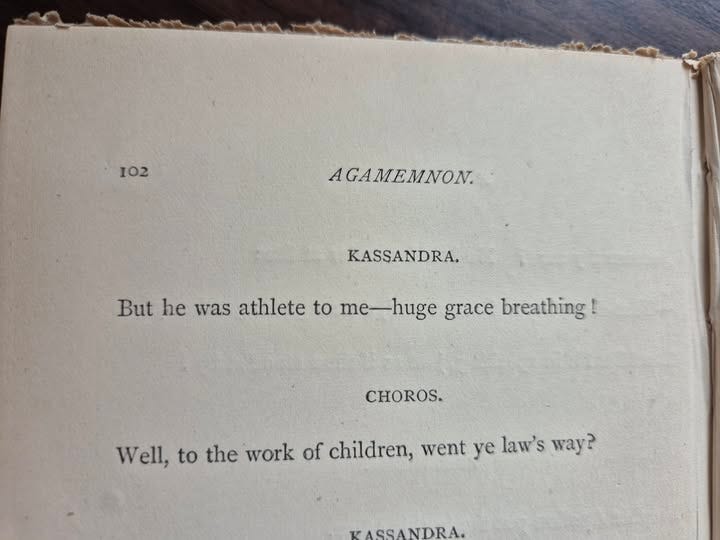
The subtitle to this substack is Browning’s rendering of one of Aeschylus’s Cassandrian lines. The prophetess, famously, had been ravished by Apollo, who had in return for her sexual favours granted her a great gift—the ability to see the future—but with this typically tricksy Greek Gods rider: that nobody would believe her. The Chorus quiz her, whilst unable to believe her predictions. Why did she sleep with Apollo? In Greek, she replies: ἀλλ᾽ ἦν παλαιστὴς κάρτ᾽ ἐμοὶ πνέων χάριν, in the Loeb rendering: ‘oh, but he struggled to win me, breathing ardent love for me.’ Far superior, Browning has his Cassandra say, with simply extraordinary poetry:
I’ll be honest: my conscience twinged sufficiently for me to consider approaching the woman behind the till and saying: you’re selling this for four quid!—stick it on eBay and you’d get twenty times that! It is for charity, after all. Years ago I chanced upon a 1st-ed of Mervyn Peake’s illustrated Ancient Mariner in a Staines charity shop for a quid and, instead of buying it, I approached the till and said, rather pompously, that they shouldn’t be selling this rare good-condition first edition so cheaply. The woman behind the till grunted, took the book off me and, for all I know, sold it online for a fortune. Which would be great for their charity! But I came away feeling not virtuous but depressed. I didn’t do the same with this Browning, but will assuage my conscience by donating fifty quid to Oxfam.
The internet suggests that this individual was ‘August Friedrich Stender’, a German national who was later—quite a bit later—interned as a P.O.W. in Knockaloe Camp, Isle of Man, from the 14th April 1918 onward. Either he was in his late 50s at this point, which is not impossible, or this August Stender is the other one’s son. [Or, as commenter Jeff says below, he was a young man in 1918 and bought this copy after the war, second hand. It’s possible the bookplate dates from 1940]. At any rate, here is his bookplate:
Oh, Henley! I volunteer at our local Oxfam bookshop, with the specific job of pricing and listing books for online shop – which is to say, pricing and listing *valuable* books for the online shop. Seeing that Agamemnon priced at £3.99 gives me physical pain. "Twenty times" is a bit toppy but not by much; Abebooks has a couple of copies at £75 or thereabouts. (Our rule of thumb is to undercut Abebooks, but by as little as possible.)
My father used to tell the story that the first line of Sordello was
"Who would shall hear Sordello's story sung"
and the last line
"Who would has heard Sordello's story sung"
and that everything in between was completely incomprehensible. Which made me more curious about it if anything. In the event I never read it at university, but I did get as far with the narrative poems as Mr Sludge the Medium (which is rather wonderful). Reading that much pentameter had an odd effect on my own writing; I found on reading Browning that I could/(without much effort – no, without much thought)/express myself in metre more or less/at will, should opportunity arise,/an unsuspected fluency unbraked/by sentence length conventions, common sense/or any other tenets or constraints/that might rein in this fluid, sprawling verse. There was a (brief) period when my career goal was being a Famous Poet, specifically through the medium of narrative poetry. (I was quite young. Coincidentally(?), it was around this time that I wrote a poem featuring the phrase "rocks old on a hillside scattered huge", in which (I'm sure you'll agree) it's perfectly clear that 'old' qualifies 'hillside'.)
Great article. I've only recently explored Robert Browning, and picked up his complete works of poetry. It's not my normal form of interest (I love prose classic literature), but I'm really trying to broaden my horizons.