
Punching Pynchon's Ticket
Shadowy

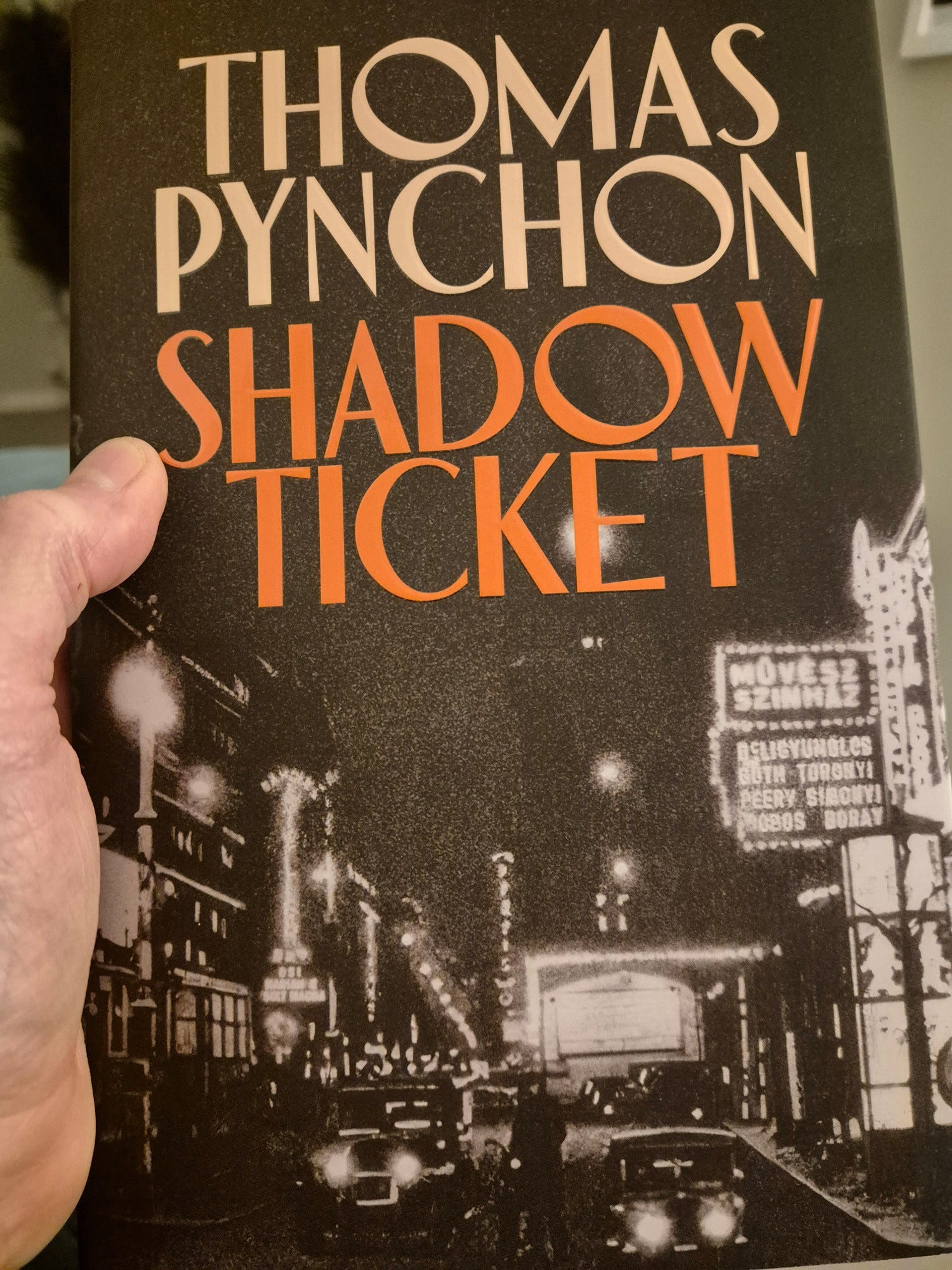
I didn’t get to Shadow Ticket when it first came out, last October, so had a sense of mild belatedness reading it in 2026. Perhaps that influenced my nonplussedness. Is this good? What is good about it? There’s probably a law—if there’s not, let’s name it after Pinter: ‘The Harold Pinter Law’—that all writers who develop an exciting new voice and style in youth calcify and pastiche that style in old age. Young Pinter? Brilliant, revolutionary. Late Pinter? Reads like somebody who doesn’t much like Pinter parodying Pinter. There’s something of that in this novel, written as it is by an 80-something author: caricature, melodrama, sprawl, stupid outré names, goofy song-lyrics disposed into the text (sans music, necessarily) at random, pinball-machine bounceabout plotting, sentences that lounge, and stumble, and stagger. This is a book written in riffs rather than paragraphs, and the riffs are pastiche-Pynchon not the echt-stuff.
Is it good? No, it’s not. It’s structurally bitty, the wiseguy period dialogue seeping into the descriptive prose to deleterious effect. The plot is daft, nothing very much is at stake and the story doesn’t really go anywhere. But then it’s possible that my bounce-off judgment is, simply, skew-whiff, that this novel will come in time to be considered a masterpiece. John Lancaster, by no means an idiot when it comes to critical judgment, greeted Vineland with these words in 1991: ‘when Thomas Pynchon finally broke his silence to publish Vineland two years ago, there was a strong sense of anticlimax, of a man having performed an act of vandalism on his own reputation’. And yet now, in the guaranteed-Oscar glow of Anderson’s One Battle After Another, it looks like Vineland has been scooped into the warm bosom of Pynchonian masterpieces. Maybe Shadow Ticket will be too.
The thing is, I love Pynchon. I like Vineland fine, and Mason and Dixon, and I love Lot 49, Gravity’s Rainbow, Against the Day (his greatest work I think). When Library of America get their shit together and issue a complete set of Pynchon I will, I promise, buy the lot. And I appreciate that the things I am criticizing in Shadow Ticket are, to one degree or another, present in these novels. But I do feel that what worked in those earlier books—the centripetal plotting of Gravity’s Rainbow and Against the Day (less so the other titles), the stylistic extravagance of all these works, the mixture of absurdity and (in this case, attempted) profundity, the music-hall performativity, the sprawl and indulgence—doesn’t work here.
Take style. It’s not that sentences sprawl and indulge themselves, it’s that they repeatedly stumble: miss their verbs, comma-splice multiple clauses together into ungainly clusters, and—this really irked me—over-and-over end with prepositions. Don’t end your sentences with prepositions, people! Don’t!
‘The kind [of milk] you drink from a bottle is more expensive than the kind they use to make butter and cheese and ice cream out of.’ [15]
‘A break at least from the cement mixers she usually finds herself out tripping with.’ [18]
‘Presently he found himself falling into the strange habit of stepping between strikers and strikebreakers, if he was cranked up enough by then from the day’s activities it didn’t seem that much more dangerous, just an added direction to be jumped on from.’ [33]
‘Although knowing what men are thinking about doesn’t take supernatural powers, still it has often put a certain kibosh on her social life, which she doesn’t mind complaining about.’ [39]
‘There is rumored to be an ex-Mrs. Lew Basnight, living on the Near North Side, remarried back in early Prohibition to an Outfit subcontractor whom Lew still considers himself under obligation to protect her from.’ [44]
‘She’d eaten six cubic feet of popcorn and was using his tie to wipe the butter off her fingers with.’ [47]
‘Accompanied by Bensonhurst, a small shaggy mutt, that Hughes was supposed to drown as a puppy but couldn’t bring himself to.’ [52]
I could go on. This is the kind of writing up with which I will not put.
There’s humour, but it’s recycled stuff. The line, attributed to George Bernard Shaw, ‘dancing is the vertical manifestation of a horizontal desire’ gets rehashed (‘“Well, dancing is vertical whoopee, Boss.”’ [50]). A character says ‘Abyssinia’ for ‘I’ll be seeing you’ [95]. Krav Maga is described as ‘Jew-Jitsu’ [227], a joke so old it has its own Wikipedia page. A character called Bruno Airmont, a bigwig on the Wisconsin Cheese Exchange, is ‘known in the industry as the Al Capone of Cheese’. Pynchon then has this individual meet yer actual Al Capone.
“Yeah! Yeah I’m the Al Capone of Cheese, see? Il Al Capone di Formaggio.”
“Pleasure to meet you—in fact I happen to be Al Capone.”
“Hep to that my paisan! And what is it you’re the Al Capone of again?” [87]
This ought to be funnier than it is. After a hundred pages of Prohibition-era Milwaukee gumshoe storyplot the novel takes us to Europe and the rise of fascism: Hicks is trying to recover the daughter of the Al Capone of Cheese, who has perhaps been kidnapped, and the plot branches through a bewildering delta of events, encounters and nonsense. I am, believe me, not a Pynchon hater—but I hated this novel. Pinch— —off.
I found some of it, especially the recognition that the Klemzer band wouldn’t be playing music anytime soon in Europe, moving. And I laughed at the bit about the pig. But I haven’t read peak Pynchon.
I completely agree with you that Against the Day is his best work and Shadow Ticket is his worst.