

Hensher’s huge book provides a history of the novel in Britain from 1700 to 2000. It is fluently put-together, and avoids devolving into a list of titles and summary of plots: individual novels are briskly summarised, and quite lengthy quotations are included to give a sense of style, and analysis of what works and what doesn’t, according to Hensher’s rather stringent sense. Hensher is Professor of Creative Writing at Bath Spa University, but he writes here as a ‘practictioner-critic’ rather than as an academic: as the author of a dozen well-regarded novels, with a working writer’s eye to the technical business of putting a novel together: there is a lot here on style, interiority and exteriority, the materiality of fictional creation and how much specific detail to include, form, focalisation. He engages only a little with the vast secondary literature on the novel, citing some critics, though not many, and with a preference for older works: Leavis, Gilbert and Gubar’s The Madwoman in the Attic , John Carey (he also quotes E J Clery and takes issue with Stefan Collini in a footnote). This is a personal history of the novel, with Hensher setting his own parameters for discussion: only Britain, with Irish writers only discussed if they were publishing before 1922, when the Irish Free State was granted Dominion status (so no Ulysses or Finnegans Wake—pretty hefty omissions) and other important novelists working in English only if they naturalised themselves in the country.1 He only goes up to 2000, considering novels published in the last quarter century too recent to be able to judge them properly. He starts late, too: Aphra Behn is mentioned, but the History starts with Defoe, and does not consider prose fiction published before 1700 properly to be novelistic.
Extended pieces of fictional prose have always existed, but attempts to describe all such things as ‘novels’ damage the dignity and purpose of the novel. The novel in English as a literary form begins around the beginning of the eighteenth century. That is the view that has been agreed upon by the vast majority of practitioners and historians throughout the history of the form. The energetically expressed view of some non-practitioner scholars in the last fifty or so years, that novels in English had been written for centuries before that, runs counter to the awareness of what very many distinguished practitioners have thought they themselves were doing. The Victorian novelist Anthony Trollope, for instance, was very clear that he was not writing the same sort of book as an Elizabethan writer of a dreamy pastoral romance. It is unwise to haul a practitioner of that distinction out of his grave to tell him that he is mistaken.
The deference Hensher expects us to pay to ‘practitioners’ of writing is irksome. Of course, he is himself a practitioner. But then so am I, and I do not consider Trollope (a writer of whom Hensher thinks very highly) an authority on the overall history of the form. In my unwisdom I haul him out and say: your definition of the novel—‘a picture of common life enlivened by humour and sweetened by pathos’—is too restrictive, and excludes most of what makes the novel important. Nor do I accept it does any damage to the dignity or purpose of fiction to treat it more expansively than this.
That’s what Hensher goes with, though. One weakness of A History of the Novel in Britain is its, sometimes inconsistent but largely held, exclusion of books that are not part of one, rather narrow realist, mimetic and domestic tradition. Realism is great, and many realist novels are important, but there’s a lot more to fiction than that. This leads, despite the great many novels that are included, to patchiness of coverage. There is no mention of Bunyan’s Pilgrim’s Progress, an extraordinary omission. No mention of Barclay’s Argenis or Thomas More’s Utopia—indeed, nothing on utopia as such, although it has had a long and prolific life in the novel. Melville’s Moby-Dick was a much bigger seller in its UK edition (it was published first in Britain, and afterwards in the US) and had a manifest influence on British writers, but is not mentioned at all. John Berger is not mentioned. There’s no Lorna Doone, no Lud-in-the-Mist, no By Grand Central Station I Sat Down And Wept, no Watchmen or From Hell. Some omissions presumably mark the fact that writers, big in their day, have dropped off the radar—there’s nothing here on Barry Unsworth, Bruce Chatwin or Tom Sharpe (The White Hotel is dismissed from discussion with the judgment-in-passing that D M Thomas is ‘patently untalented’). In other cases, major novelists are omitted for reasons of genre: no Brian Aldiss or Christopher Priest, no Eric Ambler or Len Deighton. No Enid Blyton—one of the twentieth century’s best-selling novelists—because the novels she wrote were read by children. Richard Adams’ Watership Down, a major novel, is likewise not here.2
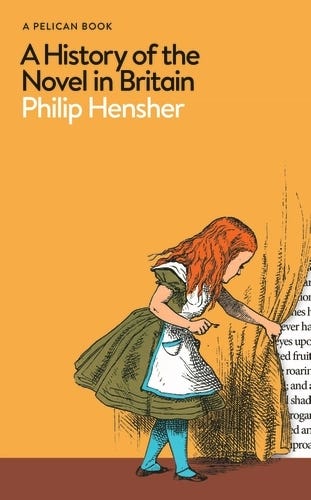
In fact Hensher disavows Children’s literature altogether. He omits Robert Louis Stevenson, one of the greatest and most influential novelists of his century, with this bizarre dismissal: ‘Stevenson, a great writer, must lie outside the scope of this book. Treasure Island and Kidnapped are children’s novels; Dr Jekyll and Mr Hyde and the masterly The Beach at Falesá are works of short fiction.’ [682] Hensher provides a detailed reading of Charles Kingsley’s Yeast and Alton Locke, but doesn’t mention Kingsley’s best-selling and most influential book, The Water Babies. To contradict himself, he does discuss Lewis Carroll’s Alice books (and an illustration from Wonderland graces the cover), which makes the omission of these others more baffling.
Where genre can’t entirely be avoided, it is given a shrift that cannot be called long. Clarke’s Childhood’s End is praised as good enough to escape ‘the borders of [its] genre’ [463], which is a backhanded sort of compliment. Hensher doesn’t stint on Doris Lessing’s repeated engagements with SF (though it’s The Golden Notebook that he considers her major achievement). He includes The Lord of the Rings in his history, grudgingly—‘we may as well admit that it is part of our literature’ is how he puts it—but doesn’t rate it. He seems innocent of the large body of Tolkienian criticism that now exists (‘nobody considering the history of fiction seems to write about it; it has hardly ever been taught in institutions or promoted by authorities’ [465]—none of this is true) and admits he hasn’t read The Silmarillion, a book he calls ‘impenetrable’. Tolkien’s ‘manner of writing’ is ‘ absolutely frightful’, his style ‘a matter of tawdry Edwardian mock-biblical’. There is no attempt to understand why Lord of the Rings has been as enduringly beloved and influential as it has, no account of the vast river of Fantasy texts influenced, sometimes heavily, by it.3
Again, Hensher is immensely dismissive of Agatha Christie (‘it is fair to remark that, of all the novels I read in preparing this history, Murder on the Orient Express was by some distance the most stupid’) without any attempt to understand why she is the single best-selling writer of fiction, globally. Georgette Heyer is dismissed as a ‘historical specialist’ rather than an author, who managed ‘to make a long, profitable career out of [her] terrible novels.’ This is unfair: Heyer’s oeuvre is variable, but a good many of her books are very good, and she was and remains highly popular. Hensher consider’s Stoker’s Dracula ‘nonsensical’:
Nonsensical because the vampire converts a human to a vampire by biting him or her, and the new vampire then goes on to convert further humans. The growth in the number of vampires must be exponential, and the human race extinguished in a few weeks. The subject has been an area of fierce controversy since two Austrian mathematicians, Richard Hartl and Alexander Mehlmann, published a paper entitled ‘The Transylvanian Problem of Renewable Resources’ in the operations research journal RAIRO (vol. 16, February 1982, pp. 379–90).
You want to say to him: you know this isn’t real, don’t you Philip? The mindset that can only apprehend novels as if they are windows into a real world is not going to grasp the force of science fiction and fantasy: fundamentally metaphorical modes of art that aim to represent the world without reproducing it.
Conversely, Hensher has some favourites—George Moore, Ronald Firbank, Rosamond Lehmann, Elizabeth Taylor (the novelist, not the film star)—who get a lot of attention, and somewhat overbalance the whole.
I don’t want to suggest that A History of the Novel in Britain is defined by its omissions. It’s not. There’s a lot here, and, especially in the early chapters (though I might wish Hensher had started earlier than he does) a solid and useful account of the development of the form is provided. He is careful to include and discuss a lot of female novelists, and pays attention to writing from the Commonwealth. He is particularly good on the novel’s relation to sexual expression, and traces the appearance and development of representations of same-sex desire. The first chapter has good accounts of Sarah Lennox, Sarah Fielding and others, though it is mostly about Defoe—the first proper novelist, according this book’s thesis—and then Richardson and Fielding: these latter two being compared and contrasted insightfully. Chapter 2 covers Sterne’s Tristram Shandy (1759-67), the Gothic novel (again somewhat grudgingly included and dispraised),4 the novel of Sentiment, Fanny Burney, Maria Edgeworth, Jane Austen, Thomas Love Peacock, Walter Scott. There’s a puzzlingly snippy reference to Lukács as ‘the Stalinist literary critic, hereditary baron and apparatchik György Lukács’, despite the fact that Hensher agrees with what The Historical Novel (1937) says about Scott. Hensher himself is pretty down on Scott: ‘it is as well to admit,’ he says, ‘that Scott is very heavy going’, dull and mannered, liable ‘now [to] infuriate most readers.’ The actual criticism is off the mark ‘The dialogue is often impossible’—no it’s not: Scott has an excellent ear for speech, and characterises his characters very effectively through it. True, there’s a certain amount of ‘hey prithee thou varlet’ in some of the older-set novels (Kenilworth in particular), but by and large his dialogue is superb. Hensher accuses Scott of not being able to tell a story, and accuses him of ‘ making a frightful hash’ of key scenes in The Heart of Midlothian—an incomprehensible thing to say about one of the greatest novels ever written. ‘Scott’s addiction to Latinate diction and almost incredible verbosity about the simplest matters is intolerable.’ But this is simply wrong: Scott’s prosiness is his style, and though impatient modern readers may fret at it, to adjust oneself to its pace and richness is to appreciate the superbly absorbing and effective draw of Scott’s novels.5
‘There is a case to be made,’ Hensher suggests, ‘that the centre of gravity of English literature shifted decisively from poetry to prose fiction, and it shifted in 1814 when Scott did.’ [126] This is to sell Victorian poetry short. Indeed it might have been good for Hensher to include in his history verse-novels like Aurora Leigh, Tennyson’s The Princess or his Idylls, Browning’s The Ring and the Book, and indeed Les Murray’s Fredy Mercury Neptune and Vikram Seth’s Golden Gate. Presumably he does not consider such works novels.
Chapter 3 treats the Victorian novel: Bulwer-Lytton, Dickens, the Brontës, Thackeray—Hensher goes through Vanity Fair, Pendennis and The Newcombes Newcomes but not Henry Esmond (perhaps because it’s a historical novel, which is a form he doesn’t much like: although Trollope, who regarded Thackeray as the greatest writer of his age, said: ‘I myself regard Esmond as the greatest novel in the English language.’) Chapter 4, taking us up to 1890, gives a good deal of context in the shift in book-reading away from circulating libraries such as Mudie’s towards cheaper forms of publishing and the explosion in literacy levels, changing the literary landscape (he covers the ground Peter Keating’s The Haunted Study does in more detail, though Keating is not cited) and works through George Eliot and Margaret Oliphant, Trollope and George Meredith. From here into the twentieth century, and a widening of reference.
In all this, Hensher’s personal enthusiasms and dislikes predominate. The History is not theorised, and barely historicised—the changes in the praxis of publishing is traced in detail, but not much else. His perspective is not political: he doesn’t see the mode as Ian Watt does, as a fundamentally and ideologically bourgeois form of art, because his own liberal humanist priors occlude his perspective. You get no sense from Hensher’s book that, for instance, Austen was a conservative artist, and that her fiction is an articulation of her conservatism, although she was and her fiction is. He doesn’t describe the shift in political focus occasioned by 1848: Raymond Williams’s argument that the novel in Britain retreated from political radicalism after this date, with major practitioners alarmed by the revolutionary goings-on on the Continent—the way novels by Dickens and Gaskell became markedly less radical after that: contrast the agit-prop political agenda of Gaskell’s powerful Mary Barton, written before 1848, with her more conservative novel of Northern mill-town strikes, North and South (1854–1855), which both-sides the dispute and expresses much sympathy for the factory-owners. Of Disraeli’s novels, Hensher says: ‘Such clear statements of politics were easy for a particular readership to admire but remained controversial. Was this really what the novel ought to be doing?’ [185] Well: yes!
Throughout these chapters, judgment is summary and often a smack to the author’s face, presumably in the way of maintaining the dignity and purpose of fiction. Burgess’s ‘Tremor of Intent (1966) is a remarkably unsuccessful spy thriller’ [533]. I’ve read it, and it’s not. ‘Richardson’s Pilgrimage is, indeed, extremely boring’ [374]. I’ve read this too, and it’s not. Of Swastika Night author Katharine Burdekin (‘Murray Constantine’) Hensher opines: ‘though [her books] chime with current concerns, she was a simply terrible novelist.’ ‘To read [Gissing’s] novels is to be dismayed at the mechanical monotony of handling.’ [298] With this case, Hensher does at least acknowledge that many people consider Gissing excellent, which group he calls ‘a cult’ in order to repeat his denigration (‘inept novelist’).6
This high quotient of swingeing rebuke adds spice, though it sacrifices critical disinterestedness and is often mere cranky idiosyncrasy masquerading as analysis. On the other hand, Hensher is often fulsome—in the modern sense of full, but also sometimes in the actual sense of cloying—with his praise: he adores Defoe, is good on the brilliance of Dickens, praises George Eliot, Trollope, Meredith, James. And his taste is not just for Great Tradition authors: he praises Wodehouse to the skies (rightly), gives Jilly Cooper her due, loves Douglas Adams.
The closest the History comes to theorising its thesis is an occasional assertion of the ethical value of novel-reading. Novels are good for us: they teach us empathy and understanding; by engaging our sensibility they educate us emotionally and morally. This is a perfectly respectable view, one of long standing: the eighteenth-century Novel of Sentiment was premised on this notion. Hensher alludes to it several times, but he doesn’t discuss or unpack its implications. Near the end of his History he says this:
Novels probably are good for you. They needn’t run to an approved moral. Last week in London, where I live, a fourteen-year-old boy was murdered on the street; it turned out that the victim was ‘no angel’, as the newspapers put it, and as no good novelist would have done. He himself, at the time of his death, was about to be charged with carrying a machete. I doubt that anyone in this story was a habitual reader of novels. If you had read more than one novel, with attention, it would be impossible to bring a machete down upon the face of another human being without guessing what it would be like to be behind that face as the blade fell upon it. You would not do it. [576]
This is not convincing. Hensher has no idea whether this murderer, or the fourteen year old boy he attacked, read novels or not. He assumes they did not, because he is certain that no novel-reader could commit a crime of violence. Jejune reasoning, falsfied by ten thousand counter-examples.
But Hensher knows what he likes in a novel, praises it when he finds it and dismisses with some savagery writers who don’t provide it. The History is readable, and stands testament to the breadth of Hensher’s reading, which is clearly capacious. The whole is remarkably free of the kind of typos and errors that a large and wide-ranging book like this can hardly avoid: it has been carefully fact checked (by, as I understand, Hensher himself) and I spotted very few errors, fewer of substance, and no typos at all.7
One surprising argument is that Historical Fiction is doomed to obsolescence, in a way not true of realist fiction set in its time of composition. Hensher says this several times:
It is a curious fact that historical novels, with their conspicuously wielded research and their ability to defend themselves against the philistine’s claim that novels are about nothing very much, tend to experience the same fate of oblivion. From Scott until now, they are acclaimed by contemporaries, perhaps above a novelist’s other work. And then they disappear, where novels about contemporary life survive healthily. [135]
When we look at the long-term fates of historical novels since Scott, however, we have to admit that they show much less capacity of surviving to be read by future readers – there is a fundamental ephemerality. … It is quite unlikely that the historical novels of the last fifty years will, in the future, be regarded as highly as we regard them. [490]
I don’t think this is true, and again the wealth of counter-examples—as if Vanity Fair, A Tale of Two Cities, War and Peace, The Count of Monte Cristo, The Leopard, The Corner That Held Them, Endo’s Silence have fallen into abeyance—refute it. But I’m not sure why Hensher keeps pressing this point in his History. Of course it’s true that Trollope didn’t write historical fiction; but Hensher does (The Mulberry Empire is a superb novel) so this judgment seems a little self-defeating.
[Note 05/09/2026: I have corrected a number of errors in this Substack post, including a misleading reference in the final footnote: Hensher does not positively assert that the phrase ‘epistolary fiction’ never appears before the 20th century, as I implied in the original version; he wonders whether it does, and says he has only encountered it in 20th-century settings. I have changed the phrasing more accurately to reflect this. Errors in the body of the text are struck-through and corrected, and various typos have been silently amended. For clarity: page numbers cited here are to the Kindle edition, in which I read A History of the Novel in Britain, and do not correspond to the print edition.]
‘I have chosen to use “Britain” as a geographical space, and observed the sort of life that novels led within it. For the most part these are novels in the English language, written by English, Welsh, Scottish or (until independence in 1921) Irish writers. However, I have not excluded other writers on the basis of their nationality, such as Henry James or Elizabeth Bowen, if some or all of their work took place within Britain. I have, too, made a little space for novels in other languages when they made a distinct impact on the practice of the novel in Britain, such as eighteenth-century readers of Cervantes, the odd explosive enthusiasm for Jean Paul.’
These omissions are odd, given the often recherché titles that are discussed: George MacDonald’s Robert Falconer, Charlotte Yonge John Brown’s A Memoir of Robert Blincoe (1828); George Moore’s Mike Fletcher (1889), E. Phillips Oppenheim’s The Double Life of Mr Alfred Burton (1913), William Gerhardie’s The Polyglots (1925) Nevil Shute’s What Happened to the Corbetts (1938), Mittelholzer’s The Aloneness of Mrs Chatham (1965), William Trevor’s Miss Gomez and the Brethren (1971).
The couple of pages Hensher devotes to Lord of the Rings are error-prone: ‘his invented languages draw heavily on Celtic languages (the Elves) and Anglo-Saxon (the Hobbits), Hebrew in the Dwarves.’ In fact Tolkien’s two main Elvish languages draw from Finnish, and Welsh, it is the inhabitants of Rohan, not the Shire, whose language is close to Anglo-Saxon and although the ‘Dwarves’ are indeed versions of Jews, we get almost nothing of their language. ‘There is not much evidence that Tolkien had actually read many novels.’ Tolkien read very widely, in 19th-century but also contemporary fiction. And JRRT would have been angered by Hensher’s airy claim that the novel ‘is not as antiquely mythic as at first appears’, since ‘the Ring itself mostly derives from Wagner’s age-of-steam iteration in the Ring of the Nibelung’, a parallel Tolkien always denied.
‘The Gothic novel, on the other hand, perhaps does require consideration. The awkward fact is that, despite its authors being, on the whole, painfully inept, it somehow gave a lot of new technical considerations to novelists to come. In this case, it appears desirable to me to draw back from the historical phenomenon, and to say unequivocally that Ann Radcliffe, the Gothic novelist who made the biggest impact on readers at this time, was (and remains) a simply terrible writer …. There is no question: Udolpho is awful rubbish by any standards existing then, now, or in between. Almost everything in the genre it epitomizes is even worse. One example that is still occasionally read, Matthew Lewis’s The Monk (1796) is a work of inconceivable vulgarity.’ [90]
A more interesting question, which Hensher does not consider, is Scott’s development. Like almost all critics, Hensher limits himself to early Scott, from Waverley to Kenilworth, and doesn’t address the second half of Scott’s career, nor his extraordinary series of brain-destroying strokes which didn’t prevent him from carrying on writing (he needed money to clear his enormous debts), resulting in novels that are, in effect, examples of automatic writing. And yet some of his later novels are amongst most influential: The Talisman (1825; written before the strokes) is the template for so much Crusades-set fiction that follows, Count Robert of Paris (1831) proved influential not just on historical writing but Fantasy fiction.
‘There are plenty of inept novelists who have attained publication. He would not really be worth discussing, but a small and curious cult has crept up around him, based entirely on the evaluation of his subject matter – melodramas of slum life in, for instance, The Nether World (1889) and, most famously, the literary life in New Grub Street. Gissing, however, is regrettably unable to convey the quality of a good writer.’
A few small things: he is, as noted above, a little askew on Tolkien. When he calls G. W. M. Reynolds’s The Mysteries of London (1840) ‘probably the bestselling novel of the whole nineteenth century’ [xiv]—something he does twice [‘the Mysteries of London (1844–5) may be the best-selling work of fiction in the whole nineteenth century’ 175]—he presumably means bestselling British novel (it didn’t sell as many copies as Sue’s original Les Mystères de Paris, which Reynolds was copying, or as much as Uncle Tom’s Cabin, or as many copies as Bunyan across the century). He says [on p.682] that he’s not aware whether ‘epistolary novel’ is a phrase used before the 20th-century, and that he has only encountered it as a modern descriptor: in fact a review of one such novel, Cécile, ou le Passion (1827) in The Monthly Review for 1828 declares that ‘no person ever succeeded in toiling through half a volume of an epistolary novel, without being repeatedly and provokingly reminded of the defective construction of the vehicle of action.’ A rather Hensherian critical judgment, that.
I wish very much that Les Murray had written a book called Fredy Mercury, but alas you got the wrong planet (it's Fredy Neptune!). A joyous mistake!
I remember my sister (who did an English degree a few years before me) telling me about Leavis's vision of the great writers of the English tradition, all sat alongside one another in the British Museum Reading Room...
Teenage me: "They weren't, though. That's ridiculous."
Sister, sighing: "I think the idea is that if you imagine they were... No, it is a bit silly."
Hensher sounds as if he wants to be on the door.
"Gidding, was that? Gitting? No, I don't think we're expecting a Gitting. Mr Firbank, how nice to see you again, do take a seat. Ah, Professor Tolkien, always a pleasure, but as you can see we are rather busy..."
As for the Moral Value of the Novel (Specifically, As Distinct From All Other Forms Of Narrative And Types Of Writing), spare me. It was feeble sub-Arnoldian wibble in _Saturday_ and it sounds even worse here.