

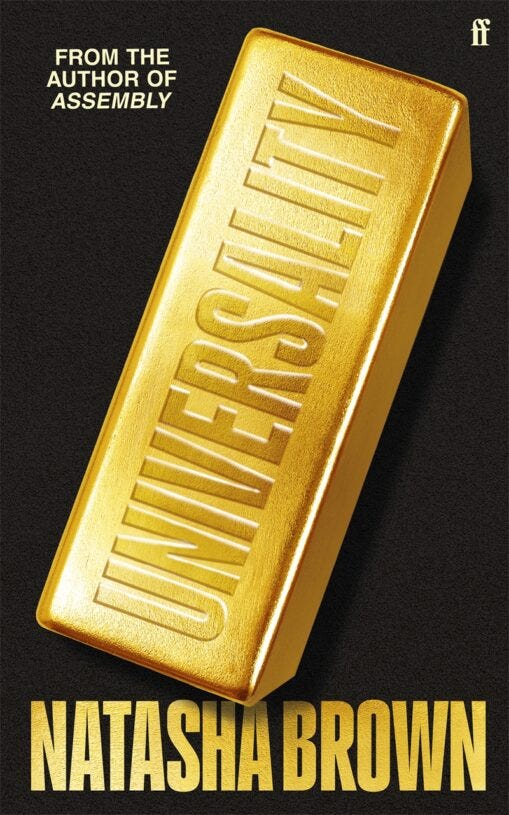
Now that the 2025 Booker Prize longlist has been announced, I thought I’d have a read through the contenders. This is the second to which I’ve gotten around.
—-
The structure of Natasha Brown’s Universality is not complicated. The book opens with a piece of faux long-form journalism: an absorbing story about an unpleasant London city trader called Richard Spenser who, having made loadsamoney, has spent some of it on an upscale Yorkshire farmhouse retreat, and also bought himself a solid gold bar—a sort of bling statement of excess—which, ostentatiously enough, he displays on the mantlepiece of his country place. But he’s not often up there, since he spends most of his time in the city, London—in the city there’s a thousand things I want to say to you and so on and so forth—adding to his obscene levels of wealth, having an affair with an intern at his city trading place, separated from his young wife and child. In his absence a group of anarchistic ‘universalists’ have squatted the farmhouse, looking to establish a post-capitalist utopian commune on the site, growing their own veg and also a small cannabis garden (‘I’d like to be/utopia-y/in a cannabinoid garden/in the shade’). One night they have a rave, after which one of the communards, Jake Leonard, not only steals the gold bar and decamps, but bludgeons the cult-leader Pegasus with the precious metal on his way out, almost killing him. Jake disappears.
We are introduced to Jake’s mother: a high-profile journalist and writer called Miriam ‘Lenny’ Leonard—a pretty patent Lionel Shriver fictionalization, this—who herself had had a fling with Richard Spenser, not a man to keep his danglies in his pants where available women are concerned, evidently. Lenny has carved out a space for herself in the mediaosphere as a soi disant ‘teller of truths’: single mothers are bad (though she herself is one), close the borders, Britain needs to pull its socks up etc. She has published a book called No Mo Woke, which has generated a lot of commentary and reaction, though not much by way of sales. Her follow-up book, Woke Capitalism, looks set to reach higher heights.
In the opening section, Brown nicely pastiches the tone of this kind of long-read journalism. The rest of the novel consists of portraits of the various characters in this story, beginning with the author of the piece, Hannah—a struggling freelance journalist, scraping by with occasional commissions and working in a shop to make ends meet. Lenny had contacted her, offering her the story of her son stealing the gold bar and walloping Pegasus as her breakthrough piece. More, Lenny helps Hannah write it up and place it. It changes Hannah’s life: not only the success of the piece, but a lucrative Netflix adaptation that follows. Now Hannah can afford a place of her own, to have her swanky friends round for a nice dinner (nicely ghastlily described by Brown). But she has her doubts about her change in fortune. It’s not too much of a spoiler to say that she comes to understand that Lenny was not acting entirely altruistically in giving her this lead, and guiding her to its publication.
Then, always readably and with nice narrative variation, we get other key players. Richard Spenser is not quite the monster the article portrays him as: the gold bar was a silly rich-person’s prop (gold painted tungsten) not an actual half-a-million-quid chunk of bullion. The affair he had was with a respected colleague, not an intern, and reflected a genuine breakdown in his marriage caused by his working insane hours—that a function of a post credit crunch climate where working all the hours was your best bet to avoid redundancy, as his colleagues dropped like flies, sacked left right and centre, and motivated not just by needing to provide for his wife and child, but the needs of his larger, less-financially-successful wider family. He still comes across as what Brown, slightly thumb-in-balance, calls him—a dick—but not the 2D grotesque of the magazine article.
We get Pegasus’s take on events (once he has woken up from the coma into which Jake’s battering sent him). And we get Jake’s feckless life and wanderings. And finally we get Lenny. The novel concludes with Woke Capitalism a huge success, and Lenny herself being feted at the country’s oldest and most prestigious literary festival, interviewed by John—a famous journalist himself, and one of Hannah’s friends, or ‘friends’ (in fact he’s only interested in her to the extent to which he can get useful stuff out of her). This finale is the best portion of the book: Lenny narrates how she navigates the pretentious and noisome organisers of the festival, and how she defangs what John has planned as a take-down slam-dunk interview. Her evisceration of the self-satisfied interviewer is exhilarating reading, even if—or, I suppose, because—we are forced to side with the character whose views we don’t like against those with whom we might otherwise sympathise. But this is the point of Brown’s orchestration of the points-of-view of the novel.
This, then, is the force of this short novel: various characters’ incompatible viewpoints coalescing into a more varied and richer sense of the original events of the magazine article. It’s not The Ring and the Book, but it’s pretty effective.
Contrasting the complexity and humanity of actual life with the goodies-and-baddies version the media serve up to us is not an original conceit: it’s what Trollope does in The Warden, for instance, and though Brown isn’t quite Trollope she reworks the venerable trope pretty well. It’s a brisk, readable and enjoyable novel. The worst you could say about it is that it is not strong on nuance, that it is uninterested in the beauty of inflections. Its main topics—state of the nation, identity politics, race and class—are all right out there, and the various characters mouth their opinions bang-bang-bang in a succession of dramatised conversations, interviews and monlogues. The Dave Spart boilerplate of the Universalists is tiresome stuff, and not convincing, though the impression I get is that Brown wants us to believe that they believe all of it. Which is not unbelievable.
I chaired the Orwell Prize judging panel that shortlisted Brown’s debut novel, Assembly, which is a way of saying that I very much like her writing. As indeed I do. I don’t think Universality is quite the arrow-in-the-gold-of-the-target that Assembly was, though I commend what I take to be her strategy of naming all her novels after words that end in -y. But for one thing the characters here aren’t altogether real. The later sections add lots of specific detail and backstory to the deliberately caricatured versions of them in the ‘Fool’s Gold’ opening piece, but accumulated detail is not in itself enough to render a character three-dimensional, to have them come alive—something the reverse, actually, as more and more data tends to press characterization flat under its weight. (there are exceptions: Ulysses gives us huge amounts of detail about Leo Bloom, but he is certainly a rounded, living piece of characterization). It is the particular, eloquent details that render characters into full vitality: the way they speak—Brown’s dialogue is too same-y from character to character, too much about conveying information and moving the plot forward, or in some cases, as with the organizer of the literary festival, too cartoony-satirical. But then again, having brightly-painted puppets knocking about under the Punch-Judy proscenium is a lively-enough way of doing satire. And as satire the book is bracing and thought-provoking.
The most notable part of the novel is the Lenny section. I suppose I had an issue with the sense that Lionel Shriver—of all people—deserves to be put so prominently into contemporary fiction. But we can say that it is not Shriver herself, with her bundle of stridently-expressed views from what used to be separate and distinct right- and left-wing magisterial—her feminism, her working-class consciousness, her hostility to immigration, and to identity politics, anti-woke, anti-pronouns anti-trans (although, interestingly, Brown does not tackle the Trans issue at all in Universality, nor import Shriver’s terfiness into Lennie’s bracing repertoire of ideological positions: too touchy a topic, perhaps)—so much as Brown using Lennie as an avatar for ‘populism’ as it currently exists. Her final interview, a snappier, more contemporary version of John Galt’s interminable monologue in Atlas Shrugged: ‘who deserves England?’ she asks.
Once I’d finished the book I found myself cogitating my slight sense of dissatisfaction. It may be that Brown’s real target—contemporary populism, Farageism, all that—isn’t best captured by this kind of multifaceted Rashomon-y narrative approach. I’m not convinced that New Populism is a narrative ideology (‘Things Were Better In The 1950s’, ‘Make Britain Great Again’, ‘Immigrants Are Poisoning Our Country’ are not narratives, or at least not interesting ones) and its appeal is precisely its monofacetedness. Which is absolutely a word. One of the main strands of contemporary Reform-esque reaction is hostility to immigration, which is not a topic Brown encompasses in this novel (although interestingly Shriver, when she lived here, was an immigrant: I understand she is living in Portugal at the moment). New Populism is a hostility to otherness, to difference, and Brown, as a good novelist, is naturally fascinated by variety difference and imaginatively hospitable to it. But perhaps this is my misapprehension of the contemporary political situation. Universality ends on Lenny promising to fight for the ‘ordinary hard-working British families’ whose existence is a key shibboleth for the new right—but, having finished the novel I realized, the key thing is that she is promising to fight. That’s how the novel ends. What-for is less important. When Trump was nearly assassinated on the 2024 campaign trail, the bullet shredding his magically-regrowable ear, his immediate reaction, as the lifts tumbled from he insides of his shoes and Secret Service tried to cover him and hurry him away, was to raise his fist and shout ‘fight! fight!’ Against whom? Already executed registered-Republic would-be assassins? Democrats? Foreigners? Doesn’t matter. The point isn’t whom. It’s that. Universality gets that, in its memorable and vivid main character, Lenny. A very good novella.
I wonder why Brown wrote this novella whose target as you say is rightwing populism, when we can assume that, as you imply, and given the readership of literary fiction, its readers are already going to be opposed. The more interesting aspect to me was the commentary on how people seek out news and media that tells them what they want to believe is objectively true; is this text offered as an example itself? Here, take my 15 quid in exchange for a story that supports my worldview, as the story accuses me of doing generally. Probably not but that would raise my estimation of it.