
Mont Blanc (1817)
Metacosmos mountain

‘Mont Blanc’, Shelley’s mighty poem, was written after the poet visited Chamonix in 1816, and saw the mountain with his own eyes. Coleridge’s ‘Hymn before Sunrise in the Vale of Chamoni’ (1803) was written without him ever setting eyes on the place, extrapolating from written accounts, illustrations and Coleridge’s imagination. The preface to the first place of publication, Mary Shelley’s History of a Six Week Tour (1817), said that the poem was ‘composed under the immediate impression of deep and powerful feelings’ and ‘an undisciplined overflowing of the soul’: the rest of the volume, measured and considered prose accounts of the European tour, is not like this, or so the preface implies.
Richard Holmes thinks ‘Mont Blanc’ was an atheistical response to Coleridge’s ‘Hymn’: but I don’t think this is right. The ‘Shelley was an atheist’ pedal gets pressed rather too emphatically by some, in particular where the Richard Dawkins et al ‘New Atheism’ cause is involved. Shelley, I am confident in saying, would have had no truck with Dawkins. Of course it’s true that Shelley was sent down from Oxford for publishing the pamphlet The Necessity of Atheism. It’s true that he used to sign the guests books at the pensions and hotels where he stayed ‘Shelley, Atheist’. It’s true that, meeting Benjamin Haydon, Shelley opened the conversation with: ‘As to that detestable religion, the Christian——’1
At the same time, Shelley could write to Thomas Jefferson Hogg (3 January 1811):
I think that the leaf of a tree, the meanest insect we trample are in themselves arguments more conclusive than any which can be adduced that some vast intellect animates Infinity. I think I can prove the existence of a Deity, a first cause … Oh! that this Deity were the Soul of the Universe, the spirit of universal, imperishable love!
Not the God of conventional Christianity, but a God, a universal principle, which Shelley, in his writings, called ‘Power’ (capital-P) or sometimes ‘Necessity’ (capital-N). And I am going to argue that it is to God that Shelley’s mind turns when he stands in Chamonix, the valley of the Arve flowing past him, and Mont Blanc towering above him.
Shelley’s poem is 144 lines divided into five sections. He does not call it an ode (although it has many elements of an odic structure)—it is ‘Lines’ (‘Lines Written in the Vale of Chamouni’) and that lineation, or linearity, is important to the point the poem is making: the line that connects the heights to the depths, that pours forth potency in a direct delineated transmission. The first, briefest, section of the poem—11 lines, stopping just short of the dozen lines that might suggest (144 being a dozen dozens) a more considered structure—is not about the mountain, although the river mentioned in line 10 is the Arve. The poem opens by rendering the process by which we apprehend the universe: how perception works. Shelley says that our sensory experiences of the world flows through the mind, like a mighty river flowing through its banks, fed by the sublime heights of the splendid mountain, varying (dark, glittering, ‘reflecting gloom’):
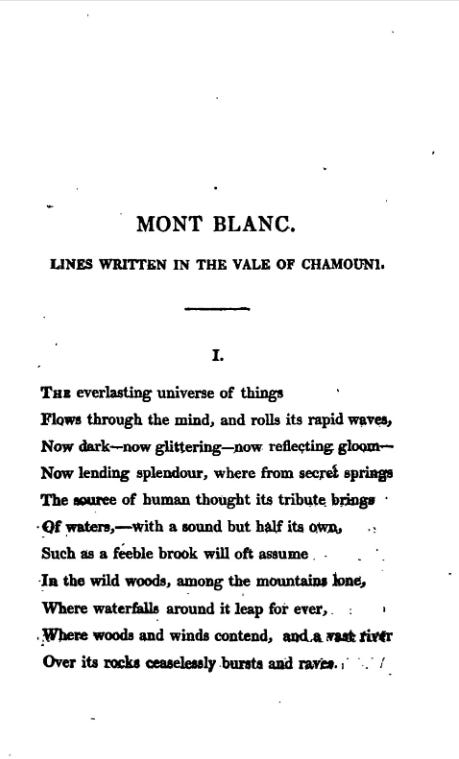
I.The everlasting universe of things Flows through the mind, and rolls its rapid waves, Now dark—now glittering—now reflecting gloom— Now lending splendour, where from secret springs The source of human thought its tribute brings Of waters,—with a sound but half its own, Such as a feeble brook will oft assume In the wild woods, among the mountains lone, Where waterfalls around it leap for ever, Where woods and winds contend, and a vast river Over its rocks ceaselessly bursts and raves.
The sibilance of that last line onomatopoeically renders the gush of the river rushing past; the rhymes—abcaadcdeeb—eddy and swirl, moving on. This is life, experience, our being in the world. Then, in the next section, Shelley specifically describes the scene where he is: the river Arve rushing past: the ‘thus thou’ at the beginning identifying the previous verse-paragraph as a kind of epic simile:
II.Thus thou, Ravine of Arve—dark, deep Ravine— Thou many-colored, many-voiced vale, Over whose pines, and crags, and caverns sail Fast cloud shadows and sunbeams: awful scene, Where Power in likeness of the Arve comes down From the ice gulphs that gird his secret throne, Bursting through these dark mountains like the flame Of lightning thro’ the tempest;—thou dost lie, Thy giant brood of pines around thee clinging, Children of elder time, in whose devotion The chainless winds still come and ever came To drink their odours, and their mighty swinging To hear—an old and solemn harmony; Thine earthly rainbows stretched across the sweep Of the ethereal waterfall, whose veil Robes some unsculptured image; the strange sleep Which when the voices of the desart fail Wraps all in its own deep eternity;— Thy caverns echoing to the Arve’s commotion, A loud, lone sound no other sound can tame; Thou art pervaded with that ceaseless motion, Thou art the path of that unresting sound— Dizzy Ravine! and when I gaze on thee I seem as in a trance sublime and strange To muse on my own separate phantasy, My own, my human mind, which passively Now renders and receives fast influencings, Holding an unremitting interchange With the clear universe of things around; One legion of wild thoughts, whose wandering wings Now float above thy darkness, and now rest Where that or thou art no unbidden guest, In the still cave of the witch Poesy, Seeking among the shadows that pass by Ghosts of all things that are, some shade of thee, Some phantom, some faint image; till the breast From which they fled recalls them, thou art there!
I’d say the rhyme ‘influencings/wandering wings’ is a flub, but that aside this is hugely powerful writing: it is an awful scene—a scene full of awe—of sublime potency and scale and variety. The Arve is not a river, Shelley says: it is actually ‘Power’ flowing down from its source, the heights of Mont Blanc, taking on the likeness of the Arve, descending (in a brilliant image) like a bolt of lightning striking down through stormy skies. The ‘thou’ in line 19 could be addressing the river, the ravine, or the mountain itself: I think it’s the ravine that is addressed, with its attendant congregation of ancient gigantic pine trees growing around it, ‘children of elder time’, its winds and rainbows, its echoing caverns, its dizzying plunge. Invoking the ravine causes Shelley to reflect upon his own consciousness, his mind. This is ‘passive’, as the momentous experiences flood through it, although in the next line it seems both active and passive: his mind ‘renders and receives’: both receiving the universe and passing out (rendering) it. Shelley is thinking of Wordsworth’s ‘Tintern Abbey’, and that poem’s insistence that the human mind in perceiving ‘all the mighty world’ by ‘eye, and ear’ both ‘half-creates’ and ‘perceive’. And of course Shelley does render his experience as much as he takes it in: the poem itself is such a rendering. That’s why the last lines of this section mention ‘the Witch Poesy’, and the strange, unreconciled image of dead people—ghosts, shades that have departed their mortal bodies—swarming around before, in a Frankensteinian strangeness, they return to those bodies, with the implication that they are reanimating them: ‘till the breast/From which they fled recalls them.’ Is this the magical force of poetry-as-witch? Resurrection? At any rate, Shelley’s thoughts are diverted into considerations of death and its sister sleep, in the third section. Now the ‘thou’ is definitely being addressed to the mountain, not the ravine (although perhaps we could say that the ravine is part of the mountain)
III.Some say that gleams of a remoter world Visit the soul in sleep,—that death is slumber, And that its shapes the busy thoughts outnumber Of those who wake and live.—I look on high; Has some unknown omnipotence unfurled The veil of life and death? or do I lie In dream, and does the mightier world of sleep Spread far around and inaccessibly Its circles? For the very spirit fails, Driven like a homeless cloud from steep to steep That vanishes among the viewless gales! Far, far above, piercing the infinite sky, Mont Blanc appears,—still, snowy, and serene— Its subject mountains their unearthly forms Pile around it, ice and rock; broad vales between Of frozen floods, unfathomable deeps, Blue as the overhanging heaven, that spread And wind among the accumulated steeps; A desert peopled by the storms alone, Save when the eagle brings some hunter’s bone, And the wolf tracks her there—how hideously Its shapes are heaped around! rude, bare, and high, Ghastly, and scarred, and riven.—Is this the scene Where the old Earthquake-dæmon taught her young Ruin? Were these their toys? or did a sea Of fire, envelope once this silent snow? None can reply—all seems eternal now. The wilderness has a mysterious tongue Which teaches awful doubt, or faith so mild, So solemn, so serene, that man may be But for such faith, with nature reconciled; Thou hast a voice, great Mountain, to repeal Large codes of fraud and woe; not understood By all, but which the wise, and great, and good Interpret, or make felt, or deeply feel.
Shelley’s conceit in this poem that the summit of Mont Blanc, piercing the infinite sky, is an absolutely inaccessible ‘throne’, the seat of Power untroubled by humans (except when an eagle ‘brings some hunter’s bone’ and drops it there, having eaten the meat from it) looks odd: Horace Bénédict de Saussure’s ascent of the mountain in 1787 was famous (he was preceded in conquering the mountain by two locals, Michel Paccard and Jacques Balmat, who gained the summit in 1786). Shelley must have known about this, but he prefers to style the mountain as inviolable, inaccessible, transcending human concerns. What’s odder is that the poem specifies that this Mountain, the throne of ‘Power’, can intervene in human affairs, correct social inequality, overthrow tyranny: can ‘repeal/Large codes of fraud and woe’—that legislative term repeal strikes an odd note, as if this giant mountain is going to table a white paper for legal reform in the House of Commons. And yet Shelley is insistent: like Marx (who much admired him) he sees the point not just to interpret the world but to change it. The force that flows down the mountain is not merely physical power, or spiritual power, but quite specifically political power. What the poem doesn’t give us is the precise mechanism by which this cosmic, sublime Power will flow into the social and political structures to effect change.
IVThe fields, the lakes, the forests, and the streams, Ocean, and all the living things that dwell Within the dædal earth; lightning, and rain, Earthquake, and fiery flood, and hurricane, The torpor of the year when feeble dreams Visit the hidden buds, or dreamless sleep Holds every future leaf and flower;—the bound With which from that detested trance they leap; The works and ways of man, their death and birth, And that of him and all that his may be; All things that move and breathe with toil and sound Are born and die; revolve, subside, and swell. Power dwells apart in its tranquillity, Remote, serene, and inaccessible: And this, the naked countenance of earth, On which I gaze, even these primæval mountains Teach the adverting mind. The glaciers creep Like snakes that watch their prey, from their far fountains, Slow rolling on; there, many a precipice, Frost and the Sun in scorn of mortal power Have piled: dome, pyramid, and pinnacle, A city of death, distinct with many a tower And wall impregnable of beaming ice. Yet not a city, but a flood of ruin Is there, that from the boundaries of the sky Rolls its perpetual stream; vast pines are strewing Its destined path, or in the mangled soil Branchless and shattered stand; the rocks, drawn down From yon remotest waste, have overthrown The limits of the dead and living world, Never to be reclaimed. The dwelling-place Of insects, beasts, and birds, becomes its spoil; Their food and their retreat for ever gone, So much of life and joy is lost. The race Of man, flies far in dread; his work and dwelling Vanish, like smoke before the tempest’s stream, And their place is not known. Below, vast caves Shine in the rushing torrent’s restless gleam, Which from those secret chasms in tumult welling Meet in the vale, and one majestic River, The breath and blood of distant lands, for ever Rolls its loud waters to the ocean waves, Breathes its swift vapours to the circling air.
This fourth section opens on an enormous, 12-line sentence, that piles up multifarious subjects, postpones the verb until the very end (‘are born and die). The point is to contrast this busy variety and churn with the remote sublime steadiness of the mountain (‘… and this ….’) which does not die or pass or change. Now it is not the fast-flowing Arve, but the slow-moving river of glaciers that occupies the gorge of Chamonix, not a lightning blast but something massively serpentine: ‘the glaciers creep/Like snakes that watch their prey, from their far fountains,/Slow rolling on.’ Here, from 1902, is a photograph of wealthy tourists making their way over the Chamonix icefield.
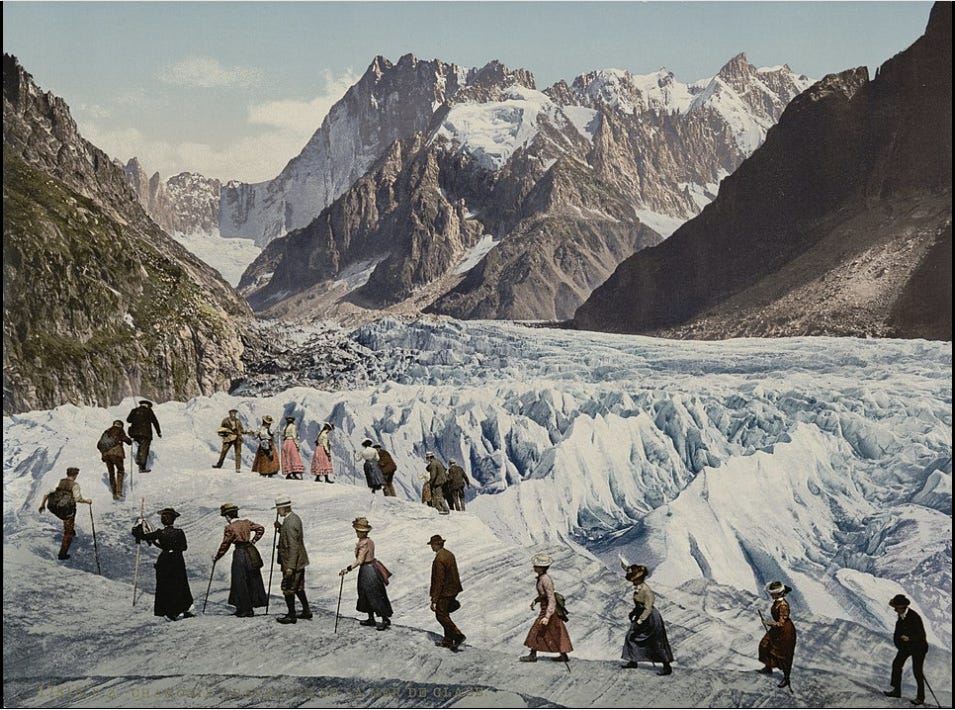
The monumental iceberg constitute not a ‘city’ but a ‘flood’, slow but certain: devouring the land as it goes, chewing-up ‘vast pines … in the mangled soil’ that now ‘branchless and shattered stand’, grinding the rocks, swallowing ‘the dwelling-place/Of insects, beasts, and birds.’ Violent, implacable, History as such. Then the final 18-lines of the poem: the fifth section returns the focus to the mountain, and ends with a question that I take to be rhetorical.
VMont Blanc yet gleams on high:—the power is there, The still and solemn power of many sights, And many sounds, and much of life and death. In the calm darkness of the moonless nights, In the lone glare of day, the snows descend Upon that Mountain; none beholds them there, Nor when the flakes burn in the sinking sun, Or the star-beams dart through them:—Winds contend Silently there, and heap the snow with breath Rapid and strong, but silently! Its home The voiceless lightning in these solitudes Keeps innocently, and like vapour broods Over the snow. The secret strength of things Which governs thought, and to the infinite dome Of Heaven is as a law, inhabits thee! And what were thou, and earth, and stars, and sea, If to the human mind’s imaginings Silence and solitude were vacancy?
I am not sure whether the shift from capital-P ‘Power’ at the start of the poem to the lower-case reiteration at the end (‘the power is there’) is asking us to consider the potency of the mountain in a different light. The main burden of this last section is: the summit of Mont Blanc, where snow silently accumulates, glittering in the starlight, glowing red at sunset, is beyond the reach of man, a place of silence that contrasts with the mighty roar of the Arve with which the poem opens. This sublime height is where ‘the secret strength of things/Which governs thought, and to the infinite dome/Of Heaven is as a law’ lives. Can we call this God? The Power/power leads us to the final question and its ambiguous phrasing: for although (it seems to be saying) this is a place of absolute silence, a place absolutely solitary, it is not a vacancy. If it were, if there was nothing behind the phenomena of the universe, this various, forceful, sometimes overwhelming barrage of inputs, then what? No: the obliquely-phrased terminal question is a way for Shelley to insist upon the radical presence of something, of God, ‘Power’, as the ground of all this sublime experience.
+++
Am I right, contra Holmes, to read this as a poem about, in essence, God? Not everyone would agree with me. Harold Bloom’s Shelley’s Mythmaking and Earl Wasserman’s Shelley: A Critical Reading take the ‘Power’, here to be basically God (Bloom has a rather ornate and idiosyncratic Gnostic take on Shelley’s quote-unquote ‘religion’ which I don’t think is right, but still). Other critics have tended not to see this as a religious poem. Angela Leighton, (Shelley and the Sublime: An Interpretation of the Major Poems) thinks the Power is not God but ‘the original impulse to write’. Spencer Hall thinks the Power ‘not a transcendental absolute of any kind, but rather a hybrid concept made up by Shelley out of diverse, even incongruent, emotions and ideas’.2
Go back to Horace Bénédict de Saussure (great-grandfather of the famous linguistic philosopher), and to Michel Paccard and Jacques Balmat, and their successful climbs of Mont Blanc. Shelley certainly knew about this, but he writes them out of the history of the mountain as he tells it. Why?
I take ‘Mont Blanc’ not as an atheistical riposte to Coleridge’s ‘Hymn’, but quite specifically a Lucretian poem. Shelley ‘studied Lucretius deeply’, and was reading him at the time he wrote ‘Mont Blanc’. Here’s Paul Turner:
In The Classical Tradition Gilbert Highet sums up the relationship between Shelley and Lucretius as follows: ‘The epigraph of Queen Mab is from Lucretius: otherwise there is little trace of his influence in Shelley’ (pp. 421-2). If true, this would be rather odd, considering how highly Shelley thought of Lucretius, and how much he studied him. Having made his first acquaintance with the De Rerum Natura at school, he reread it in 1810, 1816, I819, and 1820. According to Medwin, he ‘studied Lucretius deeply’ and ‘considered him the best of the Latin poets.’ In a letter of 6 July 1817 he wrote: ‘I am well acquainted with Lucretius. . . . The 4th book is perhaps the finest. The whole of that passage about love is full of irresistible energy of language as well as the profoundest truth.’ In the Preface to The Revolt of Islam he described himself as ‘following in the footsteps’ of ‘the wise and lofty-minded Lucretius’, whose ‘doctrines are yet the basis of our metaphysical knowledge, and whose eloquence has been the wonder of mankind.’3
As Turner notes, phrases and lines from the De Rerum Natura appear and reappear in Shelley: in Mont Blanc (line 86) ‘daedal earth’ is daedala tellus (De Rerum Natura 1:7)—(the phrase also occurs in Shelley’s ‘Ode to Liberty’ (line 18), and ‘Hymn of Pan’ (line 26). The tenor of ‘Mont Blanc’ reproduces in English some of Lucretius’s effects.
Proinde licet quamvis caelum terramque reantur
incorrupta fore aeternae mandata saluti:
et tamen inter dum praesens vis ipsa pericli
subdit et hunc stimulum quadam de parte timoris,
ne pedibus raptim tellus subtracta feratur
in barathrum rerumque sequatur prodita summa
funditus et fiat mundi confusa ruina.  [De Rerum Natura, 6:577-607]
Let humanity believe as much as it likes that heaven and earth will attain eternity, forever exempt from decay; but at the same time urgency of danger presses terror upon them: the earth sinking under our feet, falling down into an abysmal canyon, the sum of the universe would collapse and meet it leaving a jumbled wreck of a world.
This follows Lucretius’s ‘explanation’ for earthquakes (the word is in inverted commas, since the Lucretian account, which is that quakes are caused by giant underground winds blowing, is bonkers), but states a larger theme of his poem: that our atomic world, subject to its vast reverses and swerves and violence, is inevitably prone to decay and doomed to death. Human bodies are made of atoms, and so degrade and fall-apart; human souls likewise—Lucretius thinks our souls are made of a particularly rarified type of atom, but they are atomic, and are therefore mortal. The gods are otherwise:
omnis enim per se divum natura necessest
immortali aevo summa cum pace fruatur
semota ab nostris rebus seiunctaque longe;
nam privata dolore omni, privata periclis,
ipsa suis pollens opibus, nihil indiga nostri,
nec bene promeritis capitur nec tangitur ira. [De Rerum Natura 1:44-9]
For by its nature divinity must of necessity enjoy immortal life accompanied by the greatest peace, far removed and separated from our affairs; for without any pain, without any danger, itself mighty by its own resources, needing us in nothing, divinity is neither moved by benefactions nor touched by anger.
This is a striking contradiction, that has puzzled scholars for generations: ‘Epicurus, followed by Lucretius, held that the gods did exist, beings peaceful and without care, who dwelt in the interspaces between one system of worlds and another (μετακόσμια, intermundia) and that they were eternal. This belief is not consistent with atomism, and we do not know how it was justified’ [W H D Rouse].
I think this is what Shelley is doing in Mont Blanc: describing the mountain as a μετακόσμος, as a divine realm apart from the turbulent mortal world. That’s the sublime distance and inaccessibility he is describing. Although, at the same time, there is something that connects this metacosmic remoteness and our world, some line that can be drawn—hugely, icily, the mighty flood of the Arve itself—from there to here. The existence of this sublime connection is the burden of the poem, and the mysterious articulation of that for which Shelley elsewhere hoped: cosmic power, the order and force of the cosmos, being ‘the Soul of the Universe, the spirit of universal, imperishable love’.
Haydon, a devout Christian, responded: ‘I looked astounded … Shelley said the Mosaic and Christian dispensations were inconsistent. I swore they were not, and that the Ten Commandments had been the foundation of all the codes of law in the earth. Shelley denied it.’
Spencer Hall, ‘Shelley’s “Mont Blanc”’ Studies in Philology, 70:2 (1973), 199
Paul Turner, ‘Shelley and Lucretius’, The Review of English Studies, 10:39 (1959), 269
I remember telling a friend, when I was even younger than Shelley was in 1816, that my commitment to radical political change on one hand, and my commitment to express whatever it was I was trying to express in poetry on the other, were equally real to me, and that I hoped one day to bring them together. (Hey ho.) PBS seems to have taken a more direct route, or rather assumed one.
Just reacquainted myself with Coleridge's Hymn - it's not *bad*, but as with a lot of later Coleridge I found I could see what he was doing after a while and started skimming. I don't think it's in the background of this extraordinary and frankly bonkers work. What I do hear, in verses II and IV especially, is (the extraordinary and frankly bonkers) Kubla Khan. I mean, look at it -
Thy caverns echoing to the Arve’s commotion,
A loud, lone sound no other sound can tame;
Thou art pervaded with that ceaseless motion
Measurable, are they, these caverns? Or not, hmm?
But Kubla Khan - although composed in 1797, way back when Coleridge was good - was only published in 1816, a couple of months before Shelley started work on Mont Blanc. I don't know if anyone's written seriously about that apparent influence, but proving it was possible (or that it wasn't) would be an interesting bit of literary detective work.