
Laestrygonians
Time/flies? I can't they move too fast.

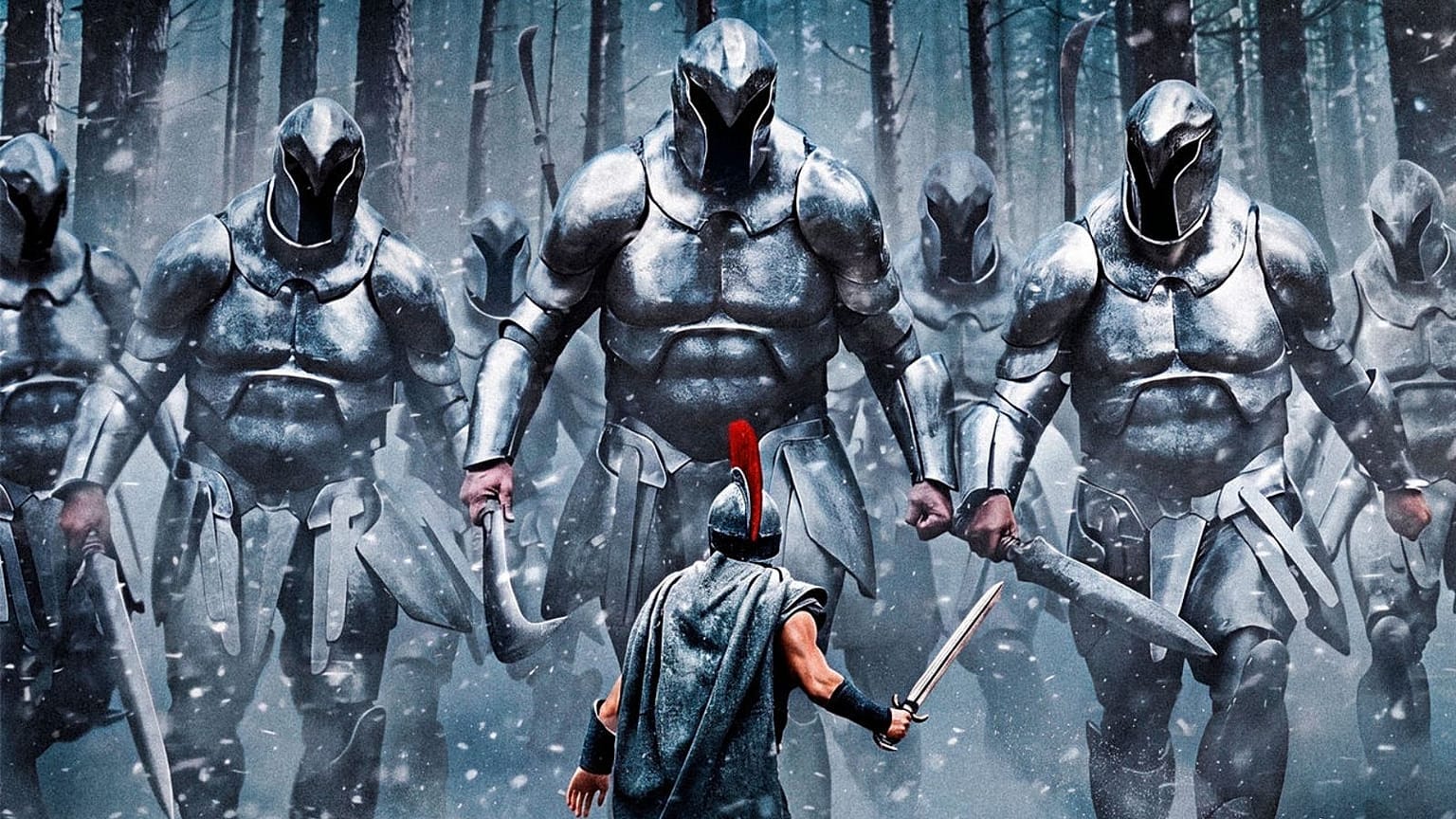
A pendant to this post. Above you have Nolan’s versions of the Laestrygonians: cannibal giants who kill a number of Odysseus’s men and destroy several of his ships. The original giants, unarmoured, appear in Odyssey Book 10:
For six days we sailed, night and day alike, and on the seventh we came to the lofty citadel of Lamus, even to Telepylus of the Laestrygonians … when we had come thither into the goodly harbor, about which on both sides a sheer cliff runs continuously, and projecting headlands opposite to one another stretch out at the mouth, and the entrance is narrow, then all the rest steered their curved ships in, and the ships were moored within the hollow harbor close together; for therein no wave ever swelled, great or small, but all about was a bright calm. But I alone moored my black ship outside, there on the border of the land, making the cables fast to the rock. Then I climbed to a rugged height, a point of outlook, and there took my stand; from thence no works of oxen or of men appeared; smoke alone we saw springing up from the land. So then I sent forth some of my comrades to go and learn who the men were, who here ate bread upon the earth—two men I chose, and sent with them a third as a herald. Now when they had gone ashore, they went along a smooth road by which wagons were wont to bring wood down to the city from the high mountains. And before the city they met a maiden drawing water, the strong daughter of Laestrygonian Antiphates, who had come down to the fair-flowing spring Artacia, from whence they were wont to bear water to the town. So they came up to her and spoke to her, and asked her who was king of this folk, and who they were of whom he was lord. And she showed them forth with the high-roofed house of her father. Now when they had entered the glorious house, they found there his wife, huge as the peak of a mountain, and they were aghast at her. At once she called from the place of assembly the glorious Antiphates, her husband, and he devised for them woeful destruction. Straightway he seized one of my comrades and made ready his meal, but the other two sprang up and came in flight to the ships. Then he raised a cry throughout the city, and as they heard it the mighty Laestrygonians came thronging from all sides, a host past counting, not like men but like the Giants. They hurled at us from the cliffs with rocks huge as a man could lift, and at once there rose throughout the ships a dreadful din, alike from men that were dying and from ships that were being crushed. And spearing them like fishes they bore them home, a loathly meal. Now while they were slaying those within the deep harbor, I meanwhile drew my sharp sword from beside my thigh, and cut therewith the cables of my dark-prowed ship; and quickly calling to my comrades bade them fall to their oars, that we might escape from out our evil plight. And they all tossed the sea with their oar-blades in fear of death, and joyfully seaward, away from the beetling cliffs, my ship sped on; but all those other ships were lost together there. [Odyssey 10:80-132]1
So that’s the Laestrygonians, and you can see how Nolan adapts the scene for his moviefilm.
But I want to concentrate on another detail from this episode. On arriving at the bay of the Laestrygonians, Odysseus (who is narrating) says this:
ἑξῆμαρ μὲν ὁμῶς πλέομεν νύκτας τε καὶ ἦμαρ,
ἑβδομάτῃ δ᾽ ἱκόμεσθα Λάμου αἰπὺ πτολίεθρον,
Τηλέπυλον Λαιστρυγονίην, ὅθι ποιμένα ποιμὴν
ἠπύει εἰσελάων, ὁ δέ τ᾽ ἐξελάων ὑπακούει.
ἔνθα κ᾽ ἄυπνος ἀνὴρ δοιοὺς ἐξήρατο μισθούς,
τὸν μὲν βουκολέων, τὸν δ᾽ ἄργυφα μῆλα νομεύων:
ἐγγὺς γὰρ νυκτός τε καὶ ἤματός εἰσι κέλευθοι.
So for six days we sailed, night and day alike, and on the seventh we came to the lofty citadel of Lamus, even to Telepylus of the Laestrygonians, where herdsman calls to herdsman as he drives in his flock, and the other answers as he drives his forth. There a man who never slept could have earned a double wage, one by herding cattle, and one by pasturing white sheep; for the out goings of the night and of the day are close together.
What does the line about earning double wage by herding at day and night ‘because the goings of the night and day are so close together’ mean?
There are two theories, one of which is fantastical, one mundane—as per my discussion of the balance of these things in Nolan’s adaptation. The fantastical interpretation of the line is that Odysseus has strayed far beyond the Eastern Mediterranean in his voyaging and into fantastical territories. J A Davidson reads this episode as an actual memory of exploration beyond the Med. What’s being described here, says Davison, is a land of fjords, cannibalism and the Midnight Sun—Scandinavia, in other words. Homer, or ‘Homer’, is aware of these travellers’ tales which seem fantastical to him, and that’s what he composes: a place so distant that night and day are no longer distinguishable, the people are gigantic cannibals who nonetheless (unlike the Cyclops) live in magnificent palaces, and huge boulders are used as weapons of mass destruction. Nolan leans into this by adding-in additional magical elements: the steel armour (in a bronze-age world), the power the Laestrygonians to move trees by, it seems, telepathy, trapping Odysseus’s crewmates inside tree-cages and killing them. Davidson’s point is that ‘there is much evidence (see, for example, A. Lesky, Thalatta, 1947, pp. 15I ff., and G. Germain, Genese de l’Odyssee, 1954, pp. 5I1 ff.) that most of Odysseus’ wanderings are to be understood as taking place outside normal geography altogether.’2
That’s the fantasy hypothesis. In reaction against it is the thesis that everything described in the Odyssey is Mediterranean, and is grounded in reality, gods and monsters notwithstanding. One critical tradition stresses how precisely observed and mimetic Homer’s descriptions are and, going through the whole poem locating its episodes in actual places. L G Pocock thinks that most of the scenes in the Odyssey are actually real locations in Sicily and the North African coast west of Sicily.3 He reads this episode of the Laestrygonians mimetically, as reflecting practises of Sicilian herding.
The swarms of gad-flies there made it dangerous for the cattle to feed except after sundown; while the sheep, being protected by their woolly fleeces, could pasture during the day. My own limited knowledge of livestock and insect pests led me to [write] to Professor M. M. Burns, and received from Mr. L. J. Dumbleton, Lecturer in Entomology, in Canterbury Agricultural College, information to the following effect: ‘Even in England and Scotland it is often desirable or even necessary to stall cattle during the heat of the day to prevent them being worried or stampeded by gadflies. ... Horses, cattle and man are most affected: sheep are not mentioned, but I believe they would be pretty well immune. In hot climates a good deal of feeding is done by cattle at night .... Pasturing at night would have no disadvantage as far as obtaining food is concerned and if gadflies were present there would be an additional advantage in night pasturing.’ In South Africa, while cattle are frequently grazed at night and brought in in the day-time, sheep-even in very large numbers are, in certain districts at any rate, brought in and counted every evening, as being more liable to molestation both by beasts of prey and by man.4
This, says Pocock, is the meaning Homer’s line: livestock are pastured both in sunlight and moonlight, with cattle being taken out at night to avoid the gadflies—so an enterprising herdsman could earn twice the regular pay, provided of course he was prepared to do without sleep. In this reading ἐγγὺς γὰρ νυκτός τε καὶ ἤματός εἰσι κέλευθοι, ‘for here the roads of the night and the day are close together’ would only mean that the flocks of cattle and sheep would pass one another as day ends and night begins. The Laestrygonians would be taller than average Greeks, but not actual giants (the queen is not literally the size of a mountain: that’s just hyperbole).
Is this line a reference to time—the midnight sun, the superposition of day and night—or about flies? This is a larger question than merely herdsman in Laestrygonia. It is, fundamentally, as whether we read the Odyssey as fantasy, or not. On the one hand we could say: how could we not, whe it contains so much magic and so many marvels, gods and monsters, witches and giants? Well, we might note that many of the most fantastical elements in the story are part of Odysseus’s narration of his own adventures (books 9-12), a story without corroboration (his crew are all dead) and Odysseus is a notorious trickster and liar. Gods appear throughout the poem of course, but the Greeks believed literally in gods, so that does not move the work into fantasy on its own. Perhaps the Odyssey is a masterpiece of mimesis, and not Fantasy at all.
This is Samuel Butler’s translation, with one alteration: Butler renders Θυγάτηρ ἰφθῑ́μη [106] as ‘goodly daughter’; but ἴφθῑμος does mean ‘strong, stalwart’—it’s usually used to describe male warriors and heroes, but is here clearly used to indicate that the girl is of above normal size.
Davison quotes Chadwick’s The Heroic Age (1912) for a Norwegian parallel: the story of Ormr who voyages from Iceland, and puts it at an island called Sauðey off the coast of Norway. This is inhabited by the monster Brusi and his mother who had the form of a black cat, who try to eat Ormr and his crew. Chadwick notes the affinity with Beowulf, and adds: ‘in its original form the tale was probably only a specialised variety of the type familiar to us through Jack the Giant-killer. Stories of this kind seem to have been particularly popular in Norway—a fact due perhaps in part to the survival of isolated savage communities among whom cannibalism may not have been entirely unknown. We meet with them sometimes in quite unexpected places. Thus in the account of Thóroddr Snorrason's mission to Jemtland in St Olaf's Saga (Heimskr.), cap. 151, we find a graphic and circumstantial story of a female monster who killed and devoured eleven merchants in the inn where the envoy was resting.’
L. G. Pocock: The Sicilian Origin of the Odyssey: a Study of the Topographical Evidence (Wellington: New Zealand University Press 1957)
Pocock, ‘Gadflies and the Laestrygonians’, The Classical Review n.s 8:2 (1958), 109
Very interesting.
I did bore my wife when I saw the giants, in their steel armour, telling her that this was like science fiction to the bronze age warriors, technology from a thousand years in the future.
The tree herding, in a most non-tolkien manner, was more like magic of course.