
Keats's Melancholy Ode
A new reading

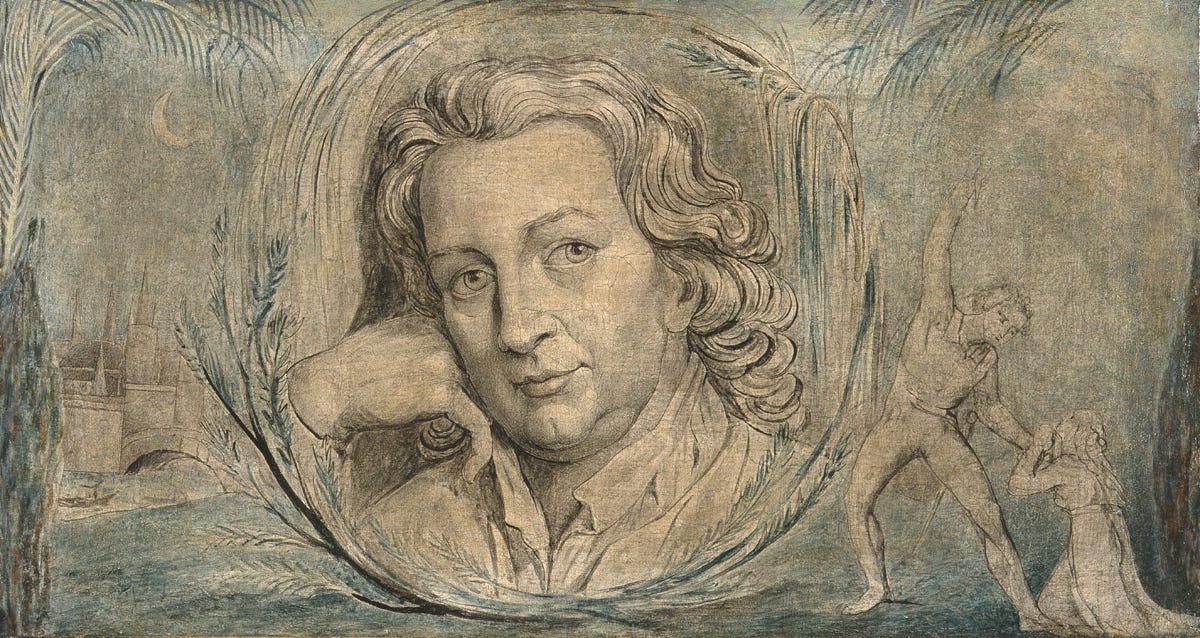
[William Blake, ‘Portrait of Thomas Otway’ (c.1800)]
.
John Keats’s six mighty odes (“Ode to a Nightingale”, “Ode on Melancholy”, “Ode to Indolence”, “Ode to Psyche” “Ode on a Grecian Urn” and “To Autumn”, all written during his ‘great year’, 1819) must be amongst the most discussed short poems in the canon. There’s very little prospect of adding anything new to the libraries-ful of critical and personal reaction and reading to these magnificent works. Yet in my hubris here I am, proposing a new take on ‘Ode on Melancholy’.
So: Thomas Otway (1652 – 1685) was a minor Restoration dramatist and poet. His first play, Alcibiades, a tragedy in heroic verse, was produced at London’s Dorset Garden Theatre in 1675 and was a bust, very bad—in the stringent words of Hugh Chisholm, it was ‘saved from absolute failure only by the actors’, one of whom, Elizabeth Barry, was the lover (one of many) of John Wilmot, 2nd Earl of Rochester. Despite the badness of this play, Rochester recommended Otway to the Duke of York (later King James II) and his career flourished. Otway, it is claimed, was desperately in love with Elizabeth Barry, who did not return his affections, which broke his heart.
Two of his plays were best known at the time, and for a century and a half afterwards. First The Orphan, or The Unhappy Marriage (1680), a blank-verse tragedy that wrung prodigies of pathos out of its ‘doomed young lovers’ story. A hit, Otway followed it with Venice Preserv'd, or A Plot Discover'd (1682), his most famous play. I talk about this play (which was often quoted by Walter Scott) here.1
Otway is wholly forgotten now, and quite right too—his plays are bad, derivative, the plots illogical, the writing over-the-top and clanging. But during the Romantic period he was very popular, widely performed, read and quoted. Scott considered ‘the talents of Otway, in his scenes of passionate affection’ to ‘excel those of Shakspeare’ (he claimed: ‘more tears have been shed for the sorrows of Belvidiera [in Venice Preserv’d] and Monimia [in The Orphan] than for those of Juliet and Desdemona’).2
In particular Otway was taken by the Romantics as a figure for Melancholy, partly because there’s so much sorrowful pathos in his plays, and partly because of his life story—for despite the success of The Orphan and Venice Preserv’d, Otway died young (thirty-three) in penury. Actually, recent scholarship has challenged the stories of his poverty—he was paid well for his plays: £100 a piece for the Orphan and Venice Preserv’d, with an addition £51 for the copyright of the latter, a lot of money back then. But the Romantics believed he ended his life in extreme financial distress. Dryden is supposed to have said that Otway ‘tho fat, starves’. He enlisted in the army and fought in the Netherlands, but when the troops were disbanded at the end of the campaign he was left to find his own way home and, having been paid with depreciated paper, returned to London poorer than he left, ragged and dirty. He tried to earn money as a tutor (he tutored Nell Gwyn’s son, apparently) but ended up a beggar on the streets. The story of his death, as reported by Theophilus Cibber, is probably untrue, but (again) it was believed by the Romantics. Otway was begging for bread on Tower Hill. A passer-by, learning his name, and being an admirer of his plays, gave him a guinea. Otway rushed to the nearest baker’s shop, bought quantities of pastries, gobbled at them too hastily, choked and died. He was buried on 16 April 1685 in the churchyard of St. Clement Danes.
For the Romantics, the pathos of Otway’s writing and the story of his life became the object of sentimental focus. At the head of this post is William Blake’s portrait of Otway, looking out at us soulfully and mournfully.3 Byron (in English Bards and Scotch Reviewers) praised Otway as part of a lost golden age of theatre—‘Then Congreve’s scenes could cheer, or Otway’s melt/For nature then an English audience felt’—that has been superceded by ‘feebler bards’ (‘taste and reason with those times are past’). Charlotte Smith wrote a number of sonnets about Otway, inspired by the river Arun (Otway’s childhood was spent near Midhurst). Here’s one:
Sonnet XXXII. To Melancholy Written on the banks of the Arun, Oct. 1785.When latest Autumn spreads her evening veil, And the grey mists from these dim waves arise, I love to listen to the hollow sighs, Through the half-leafless wood that breathes the gale: For at such hours the shadowy phantom, pale, Oft seems to fleet before the poet’s eyes; Strange sounds are heard, and mournful melodies, As of night wanderers, who their woes bewail Here, by his native stream, at such an hour, Pity’s own Otway I methinks could meet, And hear his deep sighs swell the sadden’d wind! O Melancholy!—such thy magic power, That to the soul these dreams are often sweet, And sooth the pensive visionary mind!
Coleridge’s ‘Monody on the Death of Chatterton’ (1790)—Chatterton was another locus of Romantic sentimentality and pathos, of course—includes the lines (30-32):
Pity hopeless hung her head,
While mid the pelting of that pitiless storm,
Sunk to the cold Earth OTWAY’s famish’d form!
And this brings me to Keats.
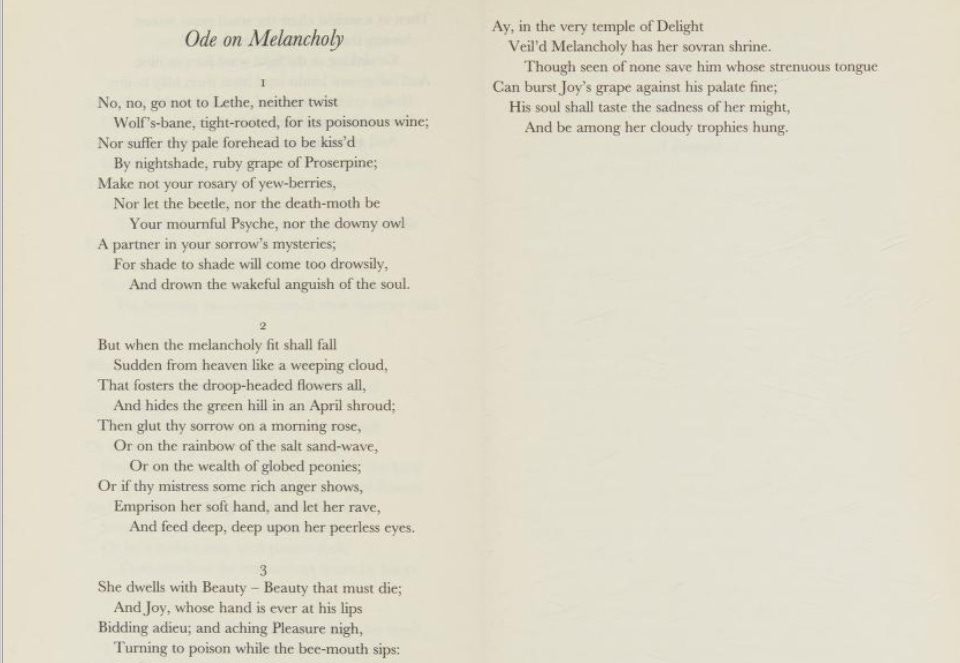
Keats’s poem is usually taken as being a product of him reading the Classics in translation (in Tooke’s Pantheon and Lempriere’s Classical Dictionary) and the poem is certainly full of classical references—Psyche, Lethe, Proserpine—as all the great odes are. But this is the only one of the odes to address somebody directly. The addressee is not named. But here’s the nub of my argument: I think it is Otway, or more precisely, I think the poem started as an ode addressed to Otway as Melancholy.
It hasn’t hitherto been noticed that this image from stanza two of Keats’s poem:
But when the melancholy fit shall fall
Sudden from heaven like a weeping cloud,
That fosters the droop-headed flowers all,
And hides the green hill in an April shroud;
...
Or if thy mistress some rich anger shows,
Emprison her soft hand, and let her rave,
And feed deep, deep upon her peerless eyes.
… reworks lines by Otway, from Venice Preserv’d, of ‘melancholy’ as a weeping April raincloud (this is from one of Pierre’s speeches, addressed to Jafeir: Act 1 sc 1):
Thy Beauteous Belvidera came weeping forth,
Shining through Tears, like April Sun’s in showers
That labour to orecome the Cloud that loads ’em,
Whilst two young Virgins, on whose Arms she lean’d,
Kindly lookt up, and at her Grief grew sad,
As if they catch’t the Sorrows that fell from her.
And the final lines of that stanza—
If thy mistress some rich anger shows,
 Emprison her soft hand, and let her rave,
 And feed deep, deep upon her peerless eyes.
—have some relationship to the scene in The Orphan where Polydore, in love with Monimia, presses his suit. She rebukes him angrily for his ‘ill-natur'd purpose’ (that is, seduction) telling him ‘talk not of love, my lord, I must not hear it’, and urging him that there are plenty of women out there to seduce: ‘where you may court, and ruin/A thousand more, why need you talk to me?’ In response Polydore clasps her hands and gazes into her eyes, describing his actions:
… Thus
Eternally admiring, fix, and gaze,
On those dear eyes. [Otway, Orphan, 1.i]
Monimia is subject repeatedly to ‘the melancholy fit’, wherein she refuses to be consoled (‘Polydore: What mean these sighs, and why thus beats thy heart? Monimia. Let me alone to sorrow’).
Keats’s draft of the Ode contained an additional, opening stanza:
Though you should build a bark of dead men's bones,
And rear a phantom gibbet for a mast,
Stitch shrouds together for a sail, with groans
To fill it out, blood-stained and aghast;
Although your rudder be a dragon's tail
Long sever'd, yet still hard with agony,
Your cordage large uprootings from the skull
Of bald Medusa, certes you would fail
To find the Melancholy—whether she
Dreameth in any isle of Lethe dull.
He was right to cut this egregious Gothicism, with its outré grisliness, bones and blood and shrouds ill-fitting the somber classicism of the rest of the poem. But it is very Otway-esque. In ‘The Poet’s Complaint of His Muse’ (1680) Otway describes the poet (himself) miserable, wandering through a landscape of exaggerated melancholy: a ruined town in whose ‘untrodden streets unwholesome grass/Grew of great stalk, its colour gross,/And melancholic poisonous green’. He encounters not a bone-ship, but a bone-cottage, though a magic one that can move and has travelled ‘by magic art thither from afar’. This house is ‘built of men’s bones, slaughter’d in civil war’ and inside it lives a witch who brings curses and sorrow with her. Where Keats’s poem invokes ‘the beetle, nor the death-moth’, Otway’s bone-cottage ‘harboured beetles and unwholesome bats’. And ‘melancholy’, ever-present in Otway’s plays, often assumes this manner of Gothic trappings. The Orphan [4.1]:
A heavy Melancholy clogs my Heart,
I droop and sigh, I know not why. Dark dreams,
Sick Fancy’s children, have been over-busy,
Methought I heard the Mid-night Raven cry,
Wak’d with th’imagin’d Noise, my Curtain’s seem’d
To start, and at my Feet my Sons appeared
Like Ghosts, all pale and stiff: I strove to speak
But could not: suddenly the Forms were lost
And seemed to vanish in a bloody Cloud.
Unlike Charlotte Smith’s sonnet, Keats does not name Otway directly in his ‘Ode on Melancholy’. But the second-person addressee, the devotee of the goddess Melancholy, could be him.4 And the poem is saturated in Otwayesque touches, imags and vocabulary.
A summary: Jaffeir is a noble but impoverished young Venetian, married to the beautiful Belvidera. He is persuaded by his bosom-friend Pierre to join a rebellion against the corrupt and autocratic Venetian Senate. As pledge of his fidelity to the revolutionary cause he hands his wife, Belvidera, over to the revolutionaries, surety for his loyalty. One of the group, the villainous Renault, attempts to rape Belvidera. She escapes, tells her husband what has happened, and persuades him to betray the rebellion to the authorities. Though outraged by the way the revolutionaries have treated his wife, Jaffeir doesn’t want his best friend Pierre executed as a rebel. Belvidera tells him he can use his information about the plot as leverage, make his intelligence conditional upon the Senate sparing Pierre’s life. This, however, goes wrong: Jaffeir does betray the rebellion, but when the Senate requires Pierre to confess before sparing his life, he refuses. So it’s to the gallows for Pierre. Jaffeir is driven to distraction by the thought that he has been the cause of his friend’s death; although actually Pierre is stoic in the face of his execution, regretting only that he is to expire shamefully at the end of a rope, and not honourably in battle, as a soldier should. Jaffeir, driven to distraction by the impending death of his friend, draws a dagger on his wife, convinced that if he threatens her severely enough she can somehow get the Senate to alter its judgment on Pierre. This drives Belvidera mad. As Pierre is brought up to the scaffold Jaffeir rushes in, stabs him—to give him the soldier’s death he craves—then stabs himself. Belvidera dies of grief.
Quoted from Margaret Ball, Walter Scott as a Critic of Literature (Columbia University Press 1907), 57
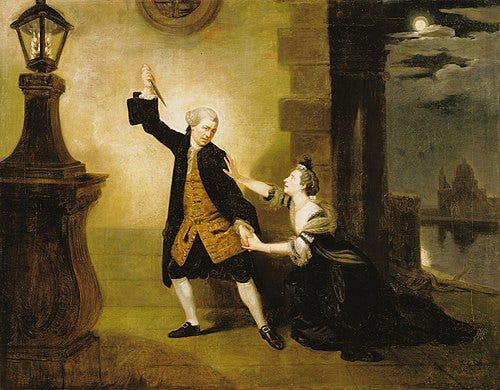
Blake’s image shows Otway flanked by his native Midhurst on the left, and on the right a scene from Venice Preserv’d: this portion of the picture is drawn from Johan Zoffrey’s painting of David Garrick as Jaffeir. Belvidera is played by Susannah Maria Cibber:
It’s not all Otway naturally. The celebrated image of the grape burst upon the palate by ‘strenuous tongue’—that joy is only present in its departure—shows that Keats had recently read Marvell’s ‘The Garden’ (‘The luscious clusters of the vine/Upon my mouth do crush their wine’). And ‘temple of delight’ is from Aphra Behn’s amorous-allegorical Land of Love (1684): ‘I the lovely Virgin would invite/To the so worshipp’d Temple of Delight’.
plausible. "Through the half-leafless wood that breathes the gale" is a great line.
This is fascinating, and convincing. But good lord, Belvidera is a *terrible* name for a character. Mezzanina! Columnia! Pedimenta! Rhomboida!