

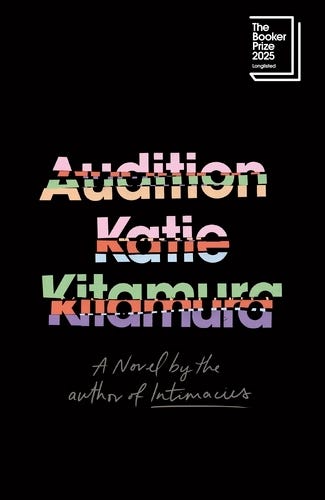
Now that the 2025 Booker Prize longlist has been announced, I thought I’d have a read through the contenders.
—
In Katie Kitamura’s Audition (2025) a woman in her late 40s, a stage and screen actress of small fame (whose name we never learn) meets a much younger man (Xavier) in a Manhattan restaurant. She is hesitant about doing so, and is hyper-conscious that the other diners in the establishment—and her husband, Tomas, who unexpectedly comes into the venue and then rushes out again—will assume she is having an affair with the handsome young bloke. In fact she’s not: he contacted her because he has something to tell her and she, intrigued, accepted the invite. The thing is this: he, Xavier, was adopted as a baby, and never knew his birth mother. Having read in a magazine interview that she, the protagonist, had had a baby and given it up for adoption, he wondered if he might have been that child. This, it seems, cannot be: although the two look alike, with handsome symmetrical faces as well as what Kitamura rather evasively calls ‘the racial thing’ in common, she never had a child. In her youth she had an abortion, and later a miscarriage: in a magazine interview she mentioned the former fact, but the journalist interviewing her ‘softened’ the detail and as printed the interview quoted her as having ‘given away’ a child. Hence Xavier’s belief that he might be her son. The protagonist abruptly leaves the restaurant and returns to her husband.
The novel switches to part 2: in this version of reality, the protagonist did not have a miscarriage but carried her child to term—Xavier—and raised him, with Tomas. In adulthood they had a falling out (or perhaps didn’t: the point is deliberately rendered uncertain) and he moved away, but the meat of the second portion of this short novel is him moving back into her and Tomas’s New York apartment, with his girlfriend Hanna. It’s not just the ‘sliding doors’ premise of the protagonist now being a mother that sets this second half of the novel apart: other things are different too. In Part 1, she is an actress, but little known; now she is successful, internationally renowned, and taking the lead in a staggeringly successful Broadway play written by the most brilliant young dramatist of the age. A significant part of this portion of the story concerns her attempts to make performative sense of a key scene in this play. Her problem is that her character seems to be a different person at the end of the scene to who she was at the beginning. In time, she finds a way of ‘playing’ this, and it contributes to the success of the play. In this Kitamura is, I suspect, making a virtue of necessity, or attempting to inoculate her own writing against charges of delinquency—because, in terms of characterization, her novel is remarkably inconstant. Characters are neither recognisably the same from start to finish, nor do they evolve in a Bildungsroman-y way: instead they read like different people given the same name: Tomas is an utterly different individual at the end of the novel to who he is at the beginning, Xavier is never the same person from section to section, Hanna is three quite different people in, as the phrase goes, a trench coat. This stuff about the play is, perhaps, Kitamura presenting this fact as the point of her piece: that character, human subjectivity, is in some sense, radically intermittent, inconstant. I’m amenable to this, as an idea in fiction (it’s what Proust does: though with far more subtlety, resonance and range): but I don’t think Kitamura achieves it convincingly in this book.
That’s not my main problem with Audition, though. Rather I was struck by a different incompetency: Kitamura’s prose. This is surprising, since it is specifically as a writer of prose that she is most often praised by critics and reviewers, her writing routinely described as ‘beautiful’. ‘luminous’ and so on. But I found the prose to be, well, bad throughout. It is a mixture of banality (simple declarative stuff, a fair bit of cliché, ‘the shoe was on the other foot’ and so on) and complexity, fond of fancy words and Jamesian circumlocutions, or at least attempts at Jamesian subtlety. The prose is not very well done, in a nuts-and-bolts sense. Sentences are tautological, repetitive, read as if no editor has touched or improved them. Towards the end of the book the narrator says: ‘I was holding the stem of my wineglass by my fingers’. The final three words here are redundant and should be cut (how else is she going to be holding the stem of her wine-glass? By her toes?) The prose is like that all the way through.
This may strike you as me being picky, or overly pedantic. But I was repeatedly bounced out of the story by the slackness and stumblingness of its expression. Kitamura is a big star in contemporary writing, widely praised, award-garlanded and as here, Booker longlisted: we can expect better of her actual writing.
To concentrate just on the first chapter of Part 1 (so as not to go on at too wearying a length). The writing manifests a repeating as-if tic, where, having shown something, it cannot rest until it has fully explained and told the reader what is going on. Show, don’t tell is not a principle this book recognises. Xavier, waiting in the restaurant, has been given a table ‘between the kitchen and the bathrooms, caught in a stream of constant traffic.’ People coming and going repeatedly jostle it. He is anxious about the meeting he about to have. The narrator says: ‘I saw him take a deep breath.’ That’s enough: the situation has shown his state of mind. But the sentence rolling ‘tell’ingly on: ‘I saw him take a deep breath as if trying to collect or steady his thoughts.’ There are dozens and dozens of places where an as if adds a tell to a show moment in this novel.
It is noisy inside the restaurant. ‘The din pressed against me, crowding the inside of my head so that it was hard to think, difficult to locate my thoughts amidst the noise.’ The last eight words of this sentence are redundant.
‘He was still smiling, from the start I had noticed his natural charm, his charisma.’ That comma-splice after smiling is ungainly—throughout, indeed, Kitamura is uglily prone to the comma splice (‘he wiped his mouth with his napkin, he had very good table manners, he had been nicely brought up’).
Her similes are often strained, distractingly peculiar. ‘I asked how his classes were and he apologized for how he had behaved the last time we met. His words drowned out my questions, the shore of ordinary conversation rapidly receding.’ Are they both on a metaphorical boat, sailing away from ‘the shore of conversation’? Why is conversation only possible on the shore? Couldn’t they talk on the boat? Or is she on the boat and he on the shore, and his speaking is pushing the boat out to sea? Perhaps because his locution is so forceful its breath fills the sails of the boat of mutual communication blowing it out upon the sea of silence? I feel sure I have now spent longer thinking about this metaphor than Kitamura did composing it.
‘I looked at the menu and said that we should order. I wanted to eat and I wanted to have a drink.’ So that’s why she said they should order! I see!
‘I asked if he already knew what he wanted and he said he wasn’t particularly hungry. I have no appetite, is what he said.’ What is the point of repeating this detail? It looks as if it is advancing a subtle Jamesian nuance, but in fact it is simply replicating itself. In this manner a piece of writing of short-story magnitude can be inflated to the length of a short novel: ‘I knew the details of the fantasy he had created, the castle he had built in his mind, he had shared its private architecture with me.’
A gift from her father, she tells us, ‘represented to me the definitive end of my girlhood and the start of the long stretch of what is called womanhood.’ The whole second part of this statement is implicit in the first (also: what is called womanhood? Why not just ‘womanhood’?)
At this point the narrator’s husband, Tomas, enters the restaurant: ‘it must have started raining, he carried an umbrella and carefully shook the water off it as he entered, his movements deliberate’. The last three words are implicit in carefully and so redundant, and the whole tottering sentence staggers on that comma splice after raining.
‘He had his hands in his coat pockets and he began rummaging inside, as if looking for something—his phone or his wallet, perhaps, or his keys.’ This itemization of the kinds of things one might keep in one’s pockets is superfluous: it’s not as if the narrator is likely to say ‘he began rummaging inside his pocket, as if looking for something—his life-size bust of Napoleon or the concept of a priori reasoning, perhaps, or Bilbo’s magic ring.’
Tomas then rushes out of the restaurant. ‘I felt, in his departure, a feeling of regret so pronounced it seemed to exert a gravitational pull, it seemed to pull me to the ground.’ That is what gravitational pulls tend to do, yes: pull you to the ground.
I could go on, chapter by chapter, but I have gone on long enough. At the end of the novel—this is a spoiler, I suppose, although Audition is not really the kind of novel that can be plot-spoiled—the whole is revealed to be a dramatic monologue written by Xavier for his mother to perform. This, I think, does not excuse the slackness, repetitiveness and clumsiness of the prose: rather the reverse.
Hubbard is dead, the old plumber.
Who will mend our burst pipes now?
The tap that has dripped all the summer
Testing the sink's overflow.
- thus the first verse of "Elegy for Arthur Hubbard", one of a batch of poems which (we and the teachers were warned) were going to be used in one of our GCE papers, and which consequently got a lesson each. At fourteen I was something of a know-all on this topic, having been writing poetry, never mind reading it, for several years. I thought a lot about scansion and metre; I'd already gone from free verse to pentameter to sprung rhythm, and was now on my way back again. I could not believe how *bad* "Elegy for Arthur Hubbard" was. Was the first line in dactyls or iambs (with an initial reversed foot) - was it "HUB-bard is DEAD the old PLUMB-er" or "HUBbard is DEAD the OLD plumbER" (surely not!). Line three posed the same problem - and either way, what the hell was happening in lines two and four? I took up about three-quarters of that lesson by airing my objections to that poem's existence - let alone its imposition on us as part of the curriculum - and gradually winning round the rest of the class, most of whom had initially just wanted to do some exam prep and/or have a quiet life. Finally - his pleas that we should at least look at the poem, which might after all come up in the exam, having fallen on deaf ears - the teacher suggested that the irregular rhythms of the poem might be a deliberate attempt to mimic speech patterns. Oh, like that bit in the Waste Land? I said. Interesting! I was quite prepared to spend the rest of the lesson expounding this perspective on the poem and winning the rest of the class back round, a la Hancock's Twelve Angry Men, but the teacher (probably wisely) shut me up.
Anyway, I'm sure there are people out there who rate "Elegy for Arthur Hubbard" (I'll probably find out it's by Seamus Heaney or something now*). But once you've noticed bad writing, you've noticed bad writing, and it's very hard to un-notice - however many people maintain it's actually a different kind of good writing. I'm also reminded of the review of Ocean Vuong, and the subsequent correspondence, in recent LRBs.
*It's "Elegy for Alfed Hubbard" (I'd also misremembered a couple of lines & have corrected them), and it's by Tony Connor - who's published with Anvil and Carcanet, and presumably knew what he was doing when he wrote this one. But be doing with it I could not.
It felt like an attempt at a Stefan Zweig novella, but it came off as a boring, bougie Fight Club.