

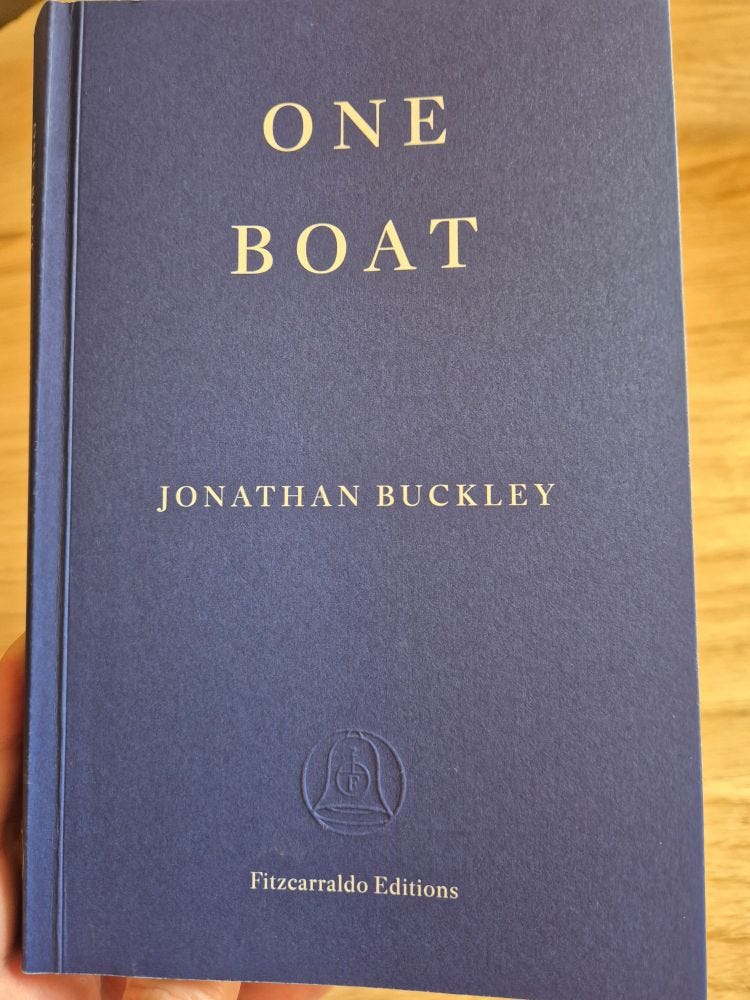
[Continuing my read-through of the 2025 Booker longlist: previously on this very stack: thoughts on Katie Kitamura’s Audition, Natasha Brown’s Universality, Andrew Miller’s The Land in Winter, Benjamin Wood’s Seascraper, David Szalay’s Flesh, Ben Markovits’s The Rest of Our Lives, and Maria Reva’s Endling]
.
Buckley, a writer, writes about a writer. Not a professional writer—Teresa, the narrator of One Boat is a lawyer—but one who writes in notebooks and records the doings of her day, large amounts of which writing are quoted in the story. I wasn’t entirely sure what to make of these quoted passages. In one sense, because she is the narrator, the conceit is that the whole of One Boat is written by Teresa. Indeed, the very last chapter is her discussing the book we have just been reading with another writer, who offers suggestions as to changes she (that is, in reality, Buckley) could make to the work to render it more effective as fiction, more commercial—ideas she (that is, Buckley) ignores. But the passages Teresa writes in her notebook struck me as stylistically different, markedly so, indeed worse, than the rest of the prose that constituted the story. Perhaps this is deliberate on Buckley’s part. Perhaps it’s not and I’m being over sensitive. If Buckley is characterizing Teresa as a ‘bad’ writer—a self-obsessed, pretentious, purply writer (tricky this: I am reminded not for the first time of the people who were impressed by how badly Laurence Olivier sang, playing the third-rate end-of-the-pier man Archie Rice in The Entertainer (1960), believing it took great skill for a talented singer to pretend to be so crap, when the truth was, as Olivier himself repeatedly said, he simply was that crap)—then we are left with the problem of how ‘she’ wrote the rest of the book so well. But perhaps this writing is not meant to be bad writing! Maybe Buckley believes, and his readers accede, that it is ‘beautiful’ writing! In that case the problem may be me.
The story itself tells how Teresa—a beautiful, statuesque, rather chilly Englishwoman—returns to a Greek coastal resort, a place she had visited nine years previously. The occasion for the previous visit was: separation from her husband (who had run off with another woman) and the death of her mother, a maths-genius academic, from whom Teresa inherited her chilly emotional stand-offishness. On that first visit Teresa made friends with beautiful Xanthe, a waitress in a harbourfront café, met eccentric animal-lover Petros, a car mechanic, and had sex with beautiful young Niko, a diving instructor. As regards this sex-scene, Buckley opts not to put himself at risk of a Bad Sex Award (unlike, I might note, some other of the Booker prize longlistees this year): ‘there can be no description of what occurred,’ Teresa tells us, somewhat primly. ‘Representation of the gymnastics would be ridiculous, of the sensations impossible.’ Buckley, or his narrator, make one concession to your porn-addled lubricious curiosity, O reader: ‘some adjectives could be deployed: “wonderful” would be one.’ Since ‘some’ implies multiple adjectives, the reader is then disabused: ‘my language fails’ [95]. Otherwise: Teresa swims in the sea, sunbathes, explores the picturesque town and its fort, walks the countryside, explores an archaeological dig, reads a translation of Homer’s Odyssey, eats fine food, drinks wine, and generally has a lovely holiday.
It’s not all fluffy. Teresa also meets a fellow Anglo, John, whose life has been scarred—his sister, abused as a kid, having gotten herself involved with a string of unsuitable blokes, sank into alcoholism and death when her son, John’s nephew, was punched in a pub car park fight, and died. The puncher hadn’t intended homicide, and after two years he got out of prison and left the country—emigrated to Greece, John says, and is now living under a new identity. John has followed him to the country, for revenge. It is obvious that one of the characters with which Teresa has become acquainted is the puncher, and though I won’t spoil the narrative by saying which one, it’s pretty obvious from early on. So much, so plotty.
Now it’s nine years later, and, following her father’s death, Teresa is back in the picturesque Greek village. She reconnects with the people she met before: Xanthe is now married, a mother, and owner of, rather than just waitress at, the café. Beautiful Niko is still beautiful, but also married. Petros, who suffered a concussion after falling into the pit of his garage, is a little madder, but basically the same. This time round there is no John. The novel gives us more tourist-brochure-y descriptions of the town, the sea, the surrounding land, the archaeological sites and so on. It’s still lovely and sunny. One shouldn’t underestimate the commercial draw, or blame writers that look to tap-into the appeal, of that sub-genre of fiction in which middle-class people meander around sunsplashed Southern-France or Mediterranean locales, so pleasant to read when one is a middle-class Englishperson on holiday in sunsplashed Southern-France or Mediterranean locale: Peter Mayle’s A Year in Provence, Captain Morelli’s Sodding Fucking Bleeding Mandolin (not the official title of this bestselling novel of course), Mamma Mia! and so on—though set in a different time period, something about One Boat reminded me of Barry Unsworth’s Greek set Pascali’s Island (1980), a novel I do like (perhaps Unsworth’s earlier, contemporary-set Mooncranker's Gift [1973] is closer). I don’t know. To read such a book, even when not on holiday, is to partake somewhat of the pleasures of holidaying.
When the novel is telling its story it is well, clearly, often vividly written. Buckley is particularly good with dialogue; he draws and differentiaties his characters effectively, he works backstory into the ongoing story deftly. But when Teresa is writing in her journal the quoted passages are just crashing, jarring: much purplier, fruity, reminiscent—I don’t mean this as praise—of Lawrence Durrell (the Durrell of his over-egged poems and the pretension-clotted Alexandria quartet, rather than of the witty Antrobus books, or the charming travel memoir Bitter Lemons). It's the exoticized descriptions of the Mediterranean for which Durrell goes so all-in: ‘the sea is high again today, with a thrilling flush of wind. A sky of hot nude pearl … glittering in the mauve-lemon light of the fast-fading afternoon … waxen skins turning citron-yellow or melon-green in the naphtha-flares’ and so on (Justine, there, of course). This kind of Durrellian stuff:
Glittering in the mauve-lemon light of the fast-fading afternoon. Landscape-tones: pearl ground with shadows in oyster and violet. Accidie. On the lake gunmetal and lemon. Summer: sand lilac sky. Autumn: swollen bruise greys.
I mean, a little of this goes a long way, it seem to me. You want to compare Mediterranean skies to citrus fruits and pearls? Knock yourself out. Greece as a land and sky of ‘bitter lemons/Where the moon’s cool fevers burn/From the dark globes of the fruit’, sure. But also, lest we forget, a land of beautiful and sexually-accommodating women:
Helen but doomed to spoil:
Under her thighs roll the capital rivers,
Flowing like oil
Here’s Buckley’s Teresa:
I made a note of the sunset’s colouring: Water almost motionless, oil-like—a superfine oil—so many colours in the surface: violet, indigo, peach, brass, dark jade. The more one looks the more there are. The sun, sliding behind the long, jagged, narrow island that formed the outer wall of the bay, was for a moment a red-hot ball bearing, in a socket of rock. [Buckley, 13]
I quite liked the hot ball-bearing image, and might have liked it more if I’d been able to banish the image of Buckley, on holiday, complacently jotting it down into his writer’s notebook with an ‘I’m sure I’ll find a place for that in my next novel’ smugness. Did you say brass?
Sky smoke powder-blue and soft brass
The puma swoons among the silken candles. [Durrell, ‘Five Soliloquys’ (1938)]
… indigo you say?
Pathways with shadows mounted on them:
Enigma and Indigo, which rumbled through like a wind. [Durrell, ‘High Sierra’ (1943)]
… and did you say … —but, look I may have made my point. Here’s more from Teresa’s notebook:
A thin summary of what was seen: shallow pools of mist at the base of the mountain, and apricot clouds above—gold on the lagoon and on the slope below me—the sea lightly roughened: scribbles of white on the blue-black—mauve shadows behind the walls and thousands of small purple flowers. [Buckley, One Boat, 123]
(Some Durrell: ‘bleak and apricot anonymity … the lemon-skinned, the gold, the half-aware … deepens the gold thirst of the noons … wine-dark, blue, and curious, the metaphoric sea … Rocks hanging, sea shining … the mauve street swallowed,/The harps of flame among the shadows’). I could go on. Do I go on? On. From One Boat: ‘the light in the late afternoon struck so many colours on the water. I fixed my gaze on one place and the wavelets changed with every second: various intensities of lilac; tin; obsidian; tangerine.’ [Buckley,150]
The loutish sea/Lying windless under a sky of lilac. [Durrell, ‘The Sirens’ (1951)]
‘The sea, phosphorus, shining like tin’ [Durrell, Justine, 248]
‘The sea was laying down its successive washes of prussian blue and violet, and thinning them out as they touched sand to green and citrons and the innocent yellows you can see on the ripening skins of tangerines. [Durrell, Reflections on a Marine Venus, 108]
I don’t want to labour the point. When she writes in her notebook, the text-within-the-text, Teresa writes like that. When she writes the book published under the title One Boat she writes like this.
A poster in the window advertised excursions around the bay and beyond, and I was reading, not deliberating, when a voice behind me said ‘'we go out every day’ … [Niko] pointed out the boat in the harbour and informed me of the various excursions and dives on offer, their degrees of difficulty. Something for everyone, he said. There was some discussion of relevant experience. [53]
Is this deliberate? The writing-within-the-writing is, by any measure, over-writing. One reason it jars is that, in her UK professional life, Teresa’s skill is in legalistically pinning down the bare unburnished facts of the matter. When John tells her of his nephew’s murder, and his desire for revenge, her instinct is to unpack the facticity out of the welter of John’s emotions and urges. Her husband left her, she suspects, because she was too coolly factual and intellectual and precise, not caught-up in the sexual whirl and passionate mush of humanity. Petros, though a car-mechanic, has published a collection of poems that are, when Teresa decodes them with her English-Greek dictionary, bare imagist listings:
The bay
lid of black cloud
in one place cracked
below in light
one boat
Glory [Buckley, 163]
But for her own journal entries, for herself as a writer, Teresa scrambles for the adjectives. It doesn’t seem consistent, characterisation-wise. Here is Michael Wood on Durrell’s (and in passing, on Conrad’s) addition to adjectival qualifiers:
‘At night,’ Roland Barthes once wrote, ‘the adjectives come back.’ It’s an eerie and sobering thought for writers who have been trying to clean up their act during the day, but for Lawrence Durrell, as for Conrad, adjectives don’t come back because they never left. If there is a mystery in Conrad it’s inscrutable, if there’s a tangle in Durrell it’s inextricable. And to stay with the latter: if there’s a treasury it’s inexhaustible, creatures of habit are inveterate, dusk is blue, shadows and trams are violet, dawn is mauve – but then so are voices and a mosque. And yet these adjectival writers are anything but confident about the language they lay out so lavishly. On the contrary, they seem to be caught between a desperate hope that one more word will do the trick, catch the reality or name the mystery, and the reluctant belief that nothing at all is going to work.
Conceivably this is what Buckley is doing by giving his narrator these Durrellisms: the point of this adjectival affectation, or addiction, is to characterize her as someone groping, somewhat desperately, for expression, or the impossibility thereof (the sex-scene quoted above: ‘my language fails’). The simple mysteries of the narrative of One Boat are, simply, resolved. The fantasy by which a posh English person is taken immediately into the bosom of a small Greek village, the beauty of the narrator and her romantic interests, the lovely scenery, pulls against verisimilitude, and the horrors of John’s backstory. The novel also raises some philosophical questions, in a direct, somewhat sophomorphic way. Here is Teresa remembering a holiday in Monmouthshire as a child, talking with her academic astrophysicist/mathematics mother
We drove to Usk reservoir. We walked down to the water from the car-park, my mother leading, my father beside me. ... This sky was something we could never see from London--wherever I looked, the lights multiplied in the blackness as I counted them. My mother directed my gaze, translating light-years into miles, and the fearfulness of those distances was thrilling. It was unimaginable--so many billions of galaxies, so many trillions of stars ... [40]
— [Carl Sagan voice] billions and billions —
A cyclone of fantastic numbers and beyond the cyclone, in the deepest darkness, lay the unimaginable infinite, source of the Question of Questions. I asked her: 'But why are they there?' To which the answer was the Big Bang, which was not an answer, because the Question of Questions wasn't 'Why are there stars in the sky?' but rather 'why is anything anywhere?'
Deep stuff. Petros, the car mechanic and poet, is, somewhat surprisingly, a Panpsychist, and Teresa and he discuss whether consciousness is limited to humans, or whether it is shared by dogs, or whether it goes all the way down to protons and electrons. Towards the end, Teresa comes to accept that she too will die.
My extinction did not appal me. Death was not a deprivation—it would not rob me of anything that was mine. One could be deprived only of something that had been possessed, and one could not possess the years on the other side of death, because they did not and coud not exist … An awareness of discomfort brought me back to myself. I had to stand up. One leg had become numb [125]
Strange logic this: death doesn’t deprive us of non-existence (‘the years on the other side of death’) but of our continued being, our nowness, which we very much do possess. But I’m pleased for Teresa, that she has come to terms with her own mortality. Bully for her! Frees her up for doing more of this:
Start with the notebook … I attended to the immediate foreground. Sunlight flashing in the carafe. The colours of rainbow in an angle of the glass. The silver surface of the water and the tar-dregs of the coffee. [157]
and
I wrote when I got back to the hotel. Right away, I had to describe what I had seen. The sand, still all in shadow, pale violet. Spiders everywhere, some as fat as olive stones—webs lying over leaves—handkerchiefs of transparent muslin—others strung across the path, vibrating—tiny lucid beads of dew. [122]
And so, dewdropily, on.
Many thanks, Adam! As usual, I haven't read the book, but perhaps the point is that diary writing tends to become over-writing? That the attempt to narrativise the self without limits or professional purpose or a good editor, will result in the verbosity that you describe?
It took me two weeks to get a third of the way into this novel at which point I realised it had become a chore and obviously not meant for me. So I reread Marc Behm's Eye of the Beholder again, then Peter Mann's The Torqued Man, both of which reminded me that I actually enjoy books.