
Hephaestus Falls
Down, down

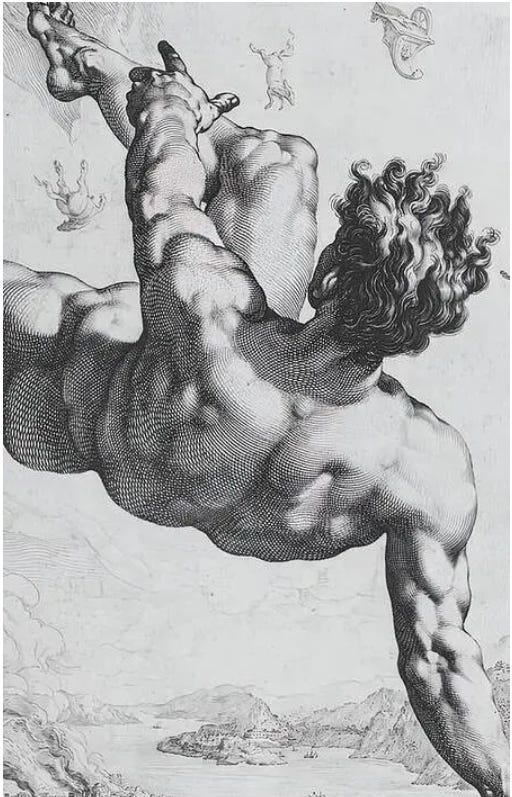
At the end of the first book of the Iliad, the goddess Thetis persuades Zeus to avenge the slight done to her son, Achilles, when Agamemnon took away his prize of war, the slave girl Briseis. Hera is annoyed that Zeus has promised this, and scolds her husband. But her son Hephaestus, the lame smith god, advises Hera to obey Zeus:
“I give counsel to my mother, wise though she be herself, to do pleasure to our dear father Zeus, that the father upbraid her not again, and bring confusion upon our feast. What if the Olympian, the lord of the lightning, were minded to dash us from our seats! For he is mightiest far. But address him with gentle words; so shall the Olympian forthwith be gracious to us.” So saying, he sprang up and placed in his dear mother’s hand the double cup, and spoke to her: “Be patient, my mother, and endure for all your grief, lest, dear as you are to me, my eyes see you stricken, and then I shall in no way be able to succour you for all my sorrow; for a hard foe is the Olympian to meet in strife.”
He recalls a prior experience he had with the anger of Zeus.
ἤδη γάρ με καὶ ἄλλοτ᾽ ἀλεξέμεναι μεμαῶτα
ῥῖψε ποδὸς τεταγὼν ἀπὸ βηλοῦ θεσπεσίοιο,
πᾶν δ᾽ ἦμαρ φερόμην, ἅμα δ᾽ ἠελίῳ καταδύντι
κάππεσον ἐν Λήμνῳ, ὀλίγος δ᾽ ἔτι θυμὸς ἐνῆεν:
ἔνθά με Σίντιες ἄνδρες ἄφαρ κομίσαντο πεσόντα. [Iliad, 1: 590–4]On a time before this, when I was striving to save you, he caught me by the foot and hurled me from the heavenly threshold; the whole day long I was carried headlong and at sunset I fell in Lemnos, and but little life was in me. There the Sintian folk quickly tended me for my fall. [A. T. Murray’s venerable Loeb translation]1
This fall nearly killed him, immortal being though he is: ὀλίγος δ᾽ ἔτι θυμὸς, ‘little θυμὸς was left in me’: θῡμός (thūmós) means ‘soul, as the seat of emotion, feeling, and thought’, ‘ soul, life, breath’, ‘ soul, heart desire, will’. It also means ‘rage, anger’: the animating passion that is at the heart of the Iliad’s drama. [Strong’s Biblical Lexicon: ‘θυμός, from θύω to rush along or on, be in a heat, breathe violently; hence, Plato correctly says, Cratylus 419e θυμός ἀπό τῆς θυσεως καί ζεσεως τῆς ψυχῆς; accordingly it signifies both the spirit panting as it were in the body, and the rage with which the man pants and swells) (from Homer down), the Septuagint often uses this word for אַף anger, and חֵמָה excandescentia; also for חָרון aestus. In the New Testament, eg Luke 4:28 ‘And all they in the synagogue, when they heard these things, were filled with wrath’.]
John Milton recalls these lines in Paradise Lost. Satan, cast out of heaven, musters the other fallen angels in Hell. Hephaestus, now not a god but a devil, builds Satan a mighty citadel in that place, ‘Pandemonium’. When still an angel, he had built ‘many a Towred structure high’ in Heaven, ‘where Scepter’d Angels held thir residence’ But, seduced by Lucifer, he had fought against God and fallen with all the other rebel angels. Now he languishes in Hell. His fall, Milton says, was recorded by the Romans (those who live ‘in Ausonian land’) and by the Greeks, as in Homer’s account of Hephaestus’ fall, though these poets are mistaken in the timing and nature of this chute, for he fell before history began. Milton calls him not Hephaestus, nor the god’s usual Roman moniker Vulcan, but instead ‘Mulciber’ (the name comes from mulceō, ‘I soften’, and refers to what an ironsmith does to metal).
The hasty multitude
Admiring enter’d, and the work some praise
And some the Architect: his hand was known
In Heav’n by many a Towred structure high,
Where Scepter’d Angels held thir residence,
And sat as Princes, whom the supreme King
Exalted to such power, and gave to rule,
Each in his Hierarchie, the Orders bright.
Nor was his name unheard or unador’d
In ancient Greece; and in Ausonian land
Men call’d him Mulciber; and how he fell
From Heav’n, they fabl’d, thrown by angry Jove
Sheer o’re the Chrystal Battlements: from Morn
To Noon he fell, from Noon to dewy Eve,
A Summers day; and with the setting Sun
Dropt from the Zenith like a falling Star,
On Lemnos th’ Ægean Ile: thus they relate,
Erring; for he with this rebellious rout
Fell long before. [Milton, Paradise Lost 1: 730–48]
Such a gorgeous piece of poetry, this — ‘from Morn/To Noon he fell, from Noon to dewy Eve,/A Summers day; and with the setting Sun/Dropt from the Zenith like a falling Star’ — though I remember reading C S Lewis’s A Preface to Paradise Lost (1942) back when I was at school, and being rebuked by the book for ‘enjoying’ these lines. This, Lewis insists, is not the point of an epic poem like Paradise Lost: ‘Milton is not a collection of exquisite little moments and images; it must be apprehended as a colossal whole, people who fixate on these moments are missing the point of’ etc etc. I paraphrase.
The Homeric account seems to me ambiguous between on the one hand ‘Zeus threw me from the top of Mount Olympus, and I went up into the air, and flew, and then came down again and crashed into Lemnos’ — like the bone thrown up by the apeman at the beginning of 2001 — and on the other ‘Zeus dropped me down, out of the highest heaven, and I fell straight down all day until I hit Lemnos.’ What Homer’s Greek says is that Hephaestus was hurled from the θεσπέσῐος (‘divine, prodigious, vast, wondrous’) βηλός (‘threshold, the bottom-most part of a doorway’), which could be either.
Eustathius, the celebrated 12th-century commentator on the poem, says: ‘Jove flung Vulcan from heaven as one would fling a hare, or some other animals of the kind, having caught it, namely by the leg.’ Charles Anton: ‘The fall of Vulcan from the skies is supposed by some of be symbolical of the lightnings descending from the clouds; and he falls on the island of Lemnos because it is a volcanic isle.’ There is, as the term is, an ‘aetiological’ element to this story: Hephaestus, unlike the other Olympians, is lame, broken. This story explains how him lameness came about.
Hephaestus’ falls, his crippling, ugliness, and pain delineate his exceptional status among the Olympians, an exceptionality that becomes even more conspicuous in the context of his spatial and temporal characteristics. One of the main features of the Greek gods is their aloofness, and their dwelling place Mount Olympus, is a symbol of both their high status and their remoteness from men. Men, in contrast, live on earth, which is a reflection of their low rank and their mortality: the dead are buried in it and their souls dwell beneath it. Of course, the Olympians have the prerogative to visit men whenever they wish, but this is merely another demonstration of their power over humans, whose mobility is much more limited: not only is Mount Olympus barred to them, but their movement on earth is much slower than that of the gods. In addition, divine visits are usually very short; most often the gods tend to return home as soon as possible.
Hephaestus, as already noted, is an exception. To begin with, there is something bizarre in his first fall to earth. In the Iliad the divine status of the Olympians is quite stable. Unlike the upheavals described in Hesiod’s Theogony, the world of the Iliad gives a more constant impression; the gods who live on Mount Olympus are presumably there forever. Yet Hephaestus is expelled from Olympus as if he did not really belong there. What is more, his fall is anything but godlike: it took him an entire day to come to earth and when he finally hit Lemnos he needed to be healed by its human inhabitants, the Sintians. This is very strange when one considers the normal swiftness of divine journeys to earth: Thetis jumps swiftly from Mount Olympus to the depths of the ocean (1.531–532); Athene sinks to earth like a bright star (4.73–79); Apollo descends like a hawk to Troy (15.236–238); while Iris goes down quickly to Troy (15.168–172), jumps to the surface of the sea, and then plunges into it (24.77–82). Hephaestus, by contrast, took a whole day. Why did he need so much time to reach the earth and why could he not stop his fall? The poet of the Iliad does not provide answers to these troubling questions. [Yoav Rinon, ‘Tragic Hephaestus: The Humanized God in the Iliad and the Odyssey’, Phoenix 60 (2006), 5–6]
Again, there are two ways of reading the length of time it takes Hephaestus to fall. One would be to say that it indexes just how far the distance is from heaven to earth — so far that a plummeting man, falling at terminal velocity, takes a whole day to cross it (‘based on air resistance the terminal speed of a skydiver in a belly-to-earth, face down, free-fall position is about 55 m/s, 180 ft/s)’ — this would mean that a twelve hour journey, from dawn to noon to dewy eve, would traverse 55 x 43200 secs = 2,376,000 metres … about 1500 miles straight down, a starting point somewhat above LEO (‘the majority of satellites orbiting the Earth do so at altitudes between 160 and 2,000 kilometers. This orbital regime is called low Earth orbit, or LEO, due to the satellites’ relative closeness to the Earth.’) The other Olympians, more powerful, graceful and celeritous, can cross this distance much more rapidly.
But another way of reading these lines would be to say that Hephaestus falls not far but slow, like that extraordinary scene in the brilliant, hugely underrated Dredd (2012, directed by Pete Travis; Karl Urban as Judge Dredd) where, intoxication with the drug ‘Slo-Mo’ leads to an experience of time as immensely elongated, such that a person thrown from the top of a tower-block feels many hours pass before they hit the ground. The sequence at the end, when Lena Hadley tumbles slowly — rapidly, in actuality, but, to her, immensely, languidly, agonisingly slowly — from the top of Peach Tree Tower to the bottom is a beautiful, terrible, extraordinary piece of cinema.
The ‘Sintians’ are something of a puzzle. Σίντιες is from σίντης (itself from σίνομαι, sínomai: “to harm, hurt”), which means ‘ravening, predation pillager, looter, spoiler’. So the Sintians are pirates or brigands, looters. Moreover they are not Aegeans, but a Thracian people, on the Greek mainland, a good 150km northwest of the island of Lemnos. You can see where they live on this map, just off the shoulder of Macedonia.
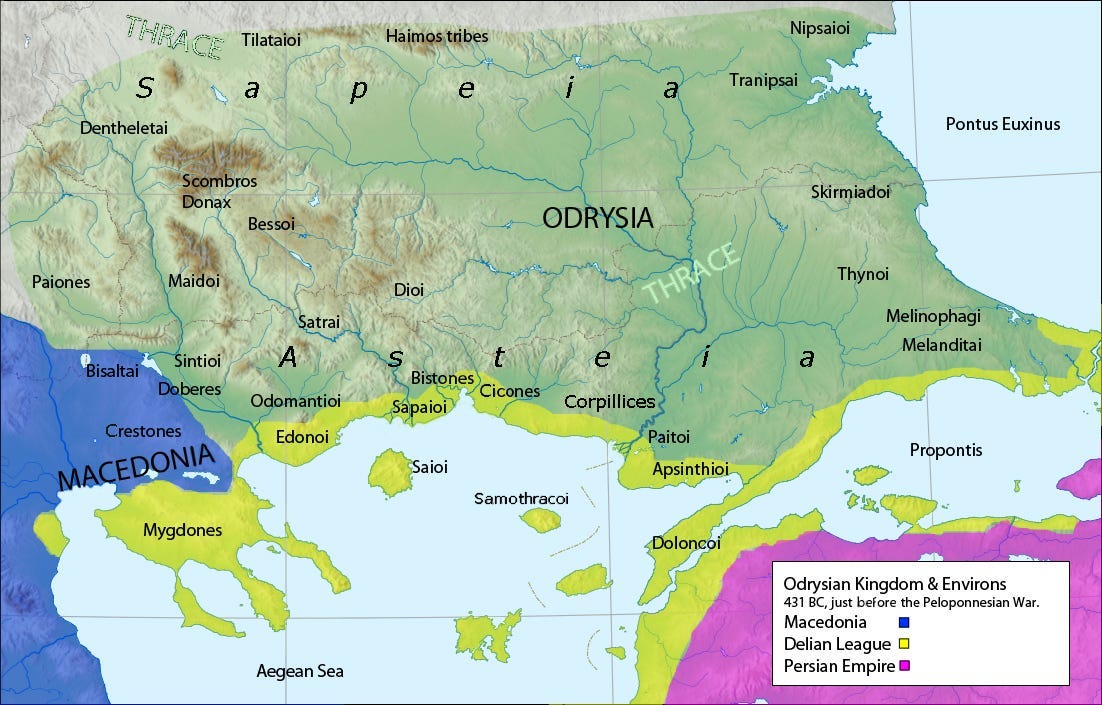
Lemnos is the ragged-edged, unnamed island at the bottom centre of the map. There are some reports in ancient mythographers that suggest the Sintians originated on Lemnos but relocated to Thrace — but this strikes me as a retcon, an attempt to explain why Homer relocates these mainland Thracians to an Aegean island in order to receive and nurse back to health the fallen Hephaestus.
There’s another wrinkle: later in the Iliad, Hephaestus reminds Thetis that he had been thrown from heaven once before, by his own mother: that Thetis ‘saved me when pain was come upon me after I had fallen afar through the will of my shameless mother, that was fain to hide me away by reason of my lameness. Then had I suffered woes in heart, had not Eurynome and Thetis received me into their bosom — Eurynome, daughter of backward-flowing Oceanus … but Thetis knew and Eurynome, even they that saved me.’ [Iliad 18: 394]
So what’s going on? There is a strange, knotted mytheme here, and it’s saying something interesting, only glancingly related to the events of the Iliad — or indeed of Paradise Lost. Why is Hephaestus lame and ugly? Because he has been cast out of heaven, hurled to the ground and broken. Why did this happen? In the first instance, it was because he was ugly and lame, his mother Hera disgusted at what she had given birth to and throwing him away. But this is to place cause and effect in reverse, for he was born ugly and lame before he was broken and lamed by the fall. Zeus’s hurling of Hephaestus from Olympus speaks to the arteficer’s challenging oof divine authority, his lawlessness; but it is only after his fall that he is taken up and raised by the lawless ones, the pirates, the Sintians. He falls onto a volcanic isle, because in popular imagination volcanoes are the smithies of the gods — hence the Roman version of his name, Vulcan — except that the Sintians are a mainland Greek population of bandits, not islanders. And in Milton the myth softens, mulcifer-mulcts, further along the lines of causality’s precession: Hephaestus falls, in the golden days of Greek myth, and tumbles slowly to Lemnos — except that he has always already fallen, before time, into a deeper abyss than a Lemnian crater. The maker, the artisan and creator, the poet, is cast out, punished for his ugliness and physical incapacity, for his lawlessness, even though it is the casting-out that causes his brokenness and lame body, that introduces him to the lawless realm, a place at once sea and land, fire and water. In this is the mystery of the artist, the poet, part of the divine world yet expelled by it, punished though innocent yet always already transgressive, to-be-broken and always already broken. The paradox of artistic creation, always both transgressively reactive to, and proactively prior to, time.
Here’s Emily Wilson’s translation of the lines:
Zeus the Olympian is very hard to challenge.
One time before, when I tried helping you
he seized my foot and hurled me from the threshold
of heaven. All day long I dropped. At sunset
I fell on Lemnos, little short of death,
The Sintians took care of me.
Here’s Fagles’ version:
It’s hard to fight the Olympian strength for strength.
You remember the last time I rushed to your defense?
He seized my foot, he hurled me off the tremendous threshold
and all day long I dropped, I was dead weight and then,
when the sun went down, down I plunged on Lemnos,
little breath left in me. But the mortals there
soon nursed a fallen immortal back to life.
As Alan Jacobs notes, Fagles avoids the difficulty of the Sintians’ identity by simply translating them as ‘mortals’.
Remember our conversation about this four years ago?
https://blog.ayjay.org/vulcanology/
Re: the beauty of the passage from PL you cite at the beginning, isn't it Milton himself who undermines it? By writing those gorgeous lines and then deflating them with "Thus they relate, / Erring," doesn't he tell us how easily we succumb to the seductions of gorgeousness, at the cost of attending to truth?
Thank you: very intereting. And I appreciate your variety: last week, you sent me back to Keats! And now Homer!