

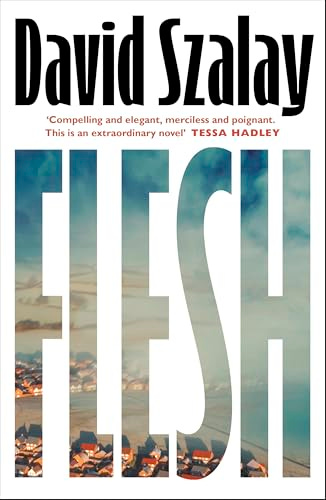
[Part of my read-through of the 2025 Booker longlist: see also Katie Kitamura’s Audition, Natasha Brown’s Universality, Andrew Miller’s The Land in Winter, Benjamin Wood’s Seascraper, David Szalay’s Flesh, Ben Markovits’s The Rest of Our Lives, Maria Reva’s Endling, Jonathan Buckley’s One Boat, Susan Choi’s Flashlight and Ledia Xhoga’s Misinterpretation]
.
Many of the Booker longlistees I’ve been reading lately have been short, novella-length pieces. At 350-pages Flesh looks more substantial, but actually reading it was the quickest experience I’ve had so far. That’s because almost all of the novel is narrow columns of dialogue, of this sort:
The lift smells of cigarette smoke.
‘You okay?’ István’s friend asks him.
‘Yeah,’ István says.
‘You look terrified,’ his friend says.
‘No,’ István says.
They leave the flat and his friend knocks on one of the doors of a flat. It’s opened by a girl of about their own age.
‘Hi,’ she says.
‘Hi,’ István’s friend says.
She stands aside for them to step inside the entrance hall.
‘This is my friend,’ says István’s friend. ‘The one I told you about.’
‘Okay,’ the girl says.
‘Okay?’ István’s friend says.
‘Yeah,’ the girl says.
The three of them just stand there.
‘Okay,’ István’s friend says.
‘Do you want to wait in there?’
‘Yeah okay.’ [3]
That’s from the start of the novel: István is a young boy, in a town in Hungary. He is visiting the girl, at his friend’s prompting, hoping for sex, but in the event she doesn’t want to have sex with him. And here from the end of the book is István, now a man, having an affair with a woman, back in the same town.
She makes coffee
‘Where’s your husband?’ he asks her.
‘He’s travelling,’ she says.
‘Yeah?’
Her husband is a truck driver. István knows that.
She says that he drives to Italy usually.
He’s normally away for a few days a week.
‘Okay,’ István says.
‘Are you working today?’
He nods.
‘What time do you start?’
‘Nine,’ he tells her.
He thanks her for the coffee.
‘That’s alright,’ she says. [341]
In between, the novel is mostly set in England, the story tracing István’s experiences there—he spends some time in the Hungarian army, then works as a bouncer at a London strip-club, then moves into the world of high-end personal security, body-guard to the ultra-rich, and then into ultra-richness himself. His path to this last destination involves an affair with his employer’s attractive, much younger wife. There’s a lot of bonking, high living, a luxury London house in Chelsea, helicopter rides to a country estate, bonking, wheeler-dealing in the world of luxury property, hobnobbing with celebrities and politicians, more bonking. Blow jobs, bonking, scheming, politicing, money, skinny-dipping, more bonking. [For clarity: at no point in this very serious novel does Szalay use a word as déclassé as ‘bonking’; that’s just me.]
This middle portion of the novel is a bit like Jilly Cooper, if Jilly Cooper were to divest herself of all her humour, charm, puckish fun and joie-de-vivre. Like a joyless Jilly Cooper. But also as if Jilly Cooper pared her storytelling down to occasional scene-setting sentences and long spools of ‘You okay?’ ‘Yeah’ ‘You’re sure?’ ‘I’m okay’ ‘Okay’-type dialogue. Okay is to this novel what fuck is to the Al Pacino Scarface. István drives Helen, the wife of his employer Mr Nyman, to Hermès on Bond Street, and she makes a pass at him.
‘You know I’ve got the hots for you don’t you,’ she says.
The directness of this does surprise him.
‘Yeah?’ he says.
‘Yeah?’ she imitates…
He smiles at her.
‘Yeah,’ she says.
‘Okay,’ he says, after quite a long silence.
‘Why don’t you kiss me?’ she says.
‘I’m not sure that would be such a good idea,’ he says.
‘That’s a really annoying thing to say.’
‘Still.’
They sit in silence for a few seconds.
‘I’m sorry,’ he says.
‘Don’t say that.’
‘Okay.’
‘Don’t say that,’ she says again.
‘Okay.’
‘Take me home.’
‘Okay.’
He drives her home in silence. [139]
They start bonking soon after this scene. And although the central bulk of the novel rides what the novel’s blurb calls ‘the twenty-first century’s tides of money and power [of] London’s super-rich, impulses of love, intimacy status and wealth’, the story is bookended by scenes very un-Jilly-Cooperish in styling, post-Soviet Hungary, material deprivation, endless cheap cigarettes and seedy sex.
In the novel’s opening chapter—the best part of the novel, this—young István is seduced by an older married woman who lives in the flat across from his mother’s flat (where he himself lives): a sort of Hungarian Mrs Robinson (sings: and here's to you Mrs Rosztóczy/ Jesus loves you more than you will know/ Woh woh woh). István, a passive and self-incurious character throughout, is as a teenager excited and randy, confused and somewhat harmed by this sexual relationship. He decides that he has fallen in love with her—I don’t know if she’s actually called ‘Mrs Rosztóczy’: the novel just calls her ‘the lady’—at which point she breaks it off, realizing his immaturity and that things have gone too far. At this István grows restive, goes to the lady’s flat, confronts her husband, an encounter that leads to István pushing, or the husband slipping and falling, downstairs. The tumble kills him, and for István it’s Off to the reformatory, Off to the reformatory, learn him with a slipper in a Hungarian young offenders’ institution, and thence into the army. This opening scene is well-done, if far from a bag of laughs: dour, grim, bleakbonking, crime and consequences.
Where have you gone, Jilly Cooper-oh?
Our nation turns its lonely eyes to you
Ooh, ooh, ooh
In an earlier substack I noted how many of this year’s Booker longlistees include blow-jobs: in Universality and The Land in Winter a blow job, somewhat fruitily described in both novels, is the only sex in the books. Flesh contains a great deal more sex than just a single blow-job, but there are plenty of blow jobs too, and that’s how the lady initiates István into the pleasures of the novel’s titular quality. One advantage of Szalay’s boiled-down style is that he is unlikely to be nominated for the Bad Sex award. There’s lots of sex in Flesh, but the utility prose in which it is all rendered is far from generating any lubricious or stimulating affect.
Then she undid his trousers and sucked him off again.
She says ‘I swallowed it.’ …
‘Okay,’ he says.
‘Will you do something for me?’
‘Okay,’ he says
She takes his hand and moves it energetically, pressing it into her. ‘Like that.’
‘Okay,’ he says. [18]
It’s a style, all this ‘okay?—okay’ dialoguing, and not, I suppose, untrue to life, howsoever dreary: and the novel is readable, as a tale of an outsider’s rise-and-fall, particularly one scattered liberally with sex, can hardly fail to be. But it is expanded polystyrene, texturally. Worse, all this dialogue doesn’t do anything, in the novel, beyond simply registering how flat and phatic most human conversation is. It doesn’t, for instance, characterise the characters, as good dialogue can do; and often Szalay is forced to add little prompts to steer the reader’s understanding. At a posh London party István gets talking to an attractive young Danish artist (‘so you’re an artist?’ he says. ‘I don’t like to say that,’ she says. ‘Why not?’ he asks. ‘I just don’t,’ she says’ and so on) and after a quantity of this back-and-forth the omniscient narrator drops in: ‘he’s enjoying talking to her’ [262]. Better handled dialogue would show that he’s enjoying talking to her, without us needing, clunkily, to be told.
+++
I’m being quite down on this novel, on account of its dour humourlessness, and its stringily-written narrative, but there are two things about Flesh I was very positively struck by. One is a narrative-twist towards the end, which I can’t elaborate without spoiling the whole story, but which (suffice to say) is one occasion when István, otherwise a creature of almost monstrous selfishness and blankness, performs a humane and selfless act that costs him, but which is the right thing to do. This is a well-handled moment in the storytelling: actually moving.
The other thing only dawned on me halfway through reading, which I’m sure says something about how obtuse I can be as a reader. So: Helen has taken István to the National Gallery, to try to introduce him to culture (he doesn’t read beyond self-help books, doesn’t listen to music, doesn’t understand art). They go round and at first all he can say is that one of the canvases shows ‘a nice arse’. She perseveres. Later, in front of a Titian, István tries a little harder.
‘I like the use of the colour blue in that one,’ István says, trying to enter into the spirit of it.
‘The Titian?’
‘That one,’ he says, pointing.
‘Yes, it’s nice,’ she says. [151]
I recognized the allusion: it’s what Ryan O’Neil’s Barry Lyndon says in Kubrick’s movie of that name, at the point when, having risen from his criminal and poverty-struck background, via a stint in the army, and ingratiating himself into the upper-classes, seducing and then marrying Lady Lyndon (and taking her name) and finding himself rich, he tries to show his breeding (which he doesn’t have). Examining paintings being offered for sale, he says ‘I like the artist’s use of the colour blue, here.’ The art-dealers, who despise him and his ignorance, bow and scrape, hoping for the big sale.
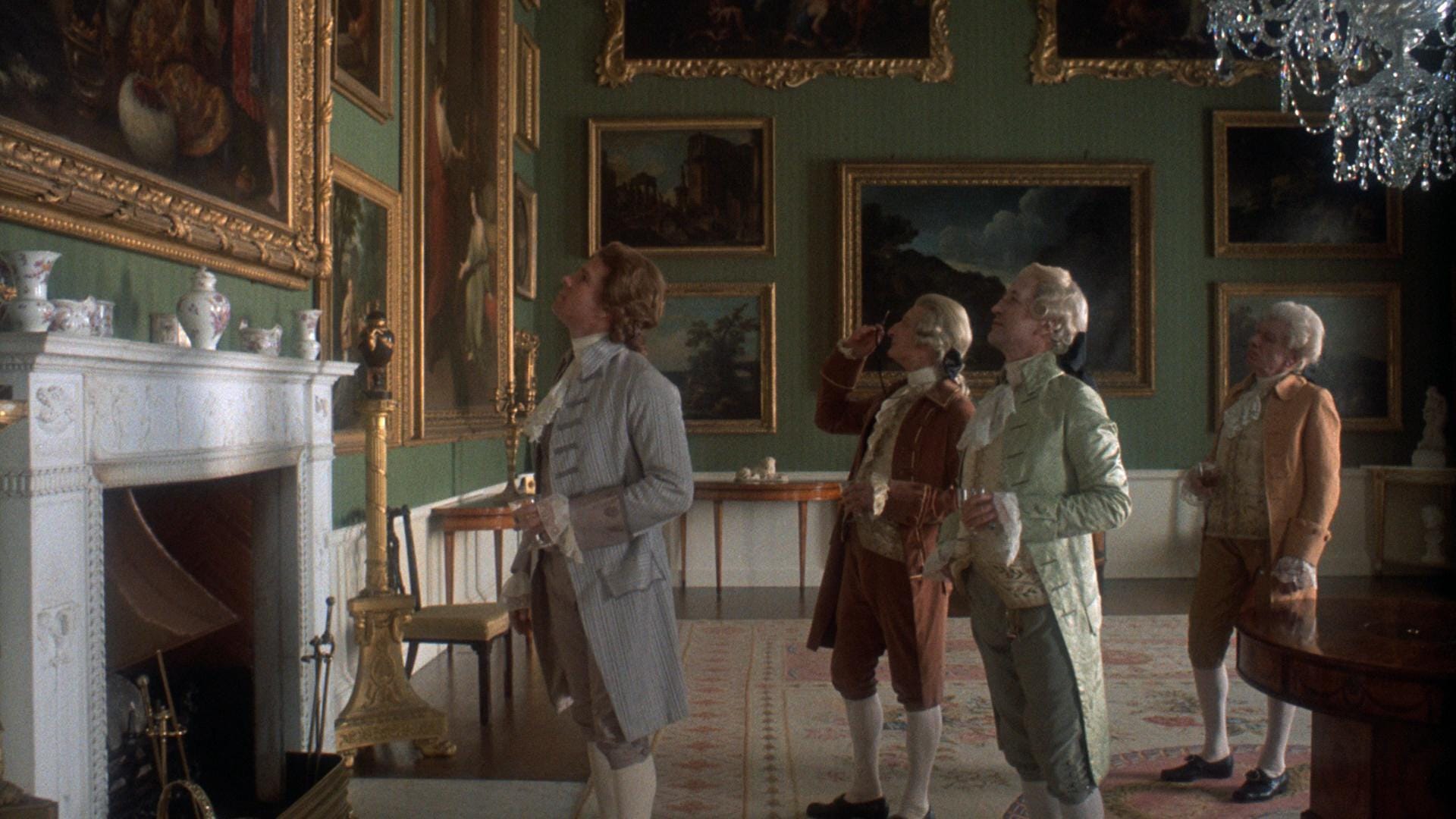
At this point, with this recognition, the schema of Szalay’s Flesh fell into place for me. The novel is Barry Lyndon in modern dress, or more precisely Kubrick’s distinctive cinematic text, not Thackeray’s scabrous, satirical, anti-Irish novel The Luck of Barry Lyndon. Like Barry, István is close to his mother, who accompanies him on his journey through the high life, and with whom he ends up living. Like Barry, he squanders his wife’s money (on property deals rather than gambling and horses); like Barry he has his own son with his wife, whom he loves, and has beef with the older stepson, his wife’s child by her former marriage—leading eventually to a showdown (a duel, of course, in Kubrick’s movie; something different but equally, for István, devastating in this novel). Realising that Flesh is a reworking of Barry Lyndon meant that, from that point of recognition, I read on anxious for the fate of Jacob, István’s own son, and for the ultimate destiny of István himself. If you know the storyline of Kubrick’s Barry Lyndon—and who doesn’t?—then you know the throughline of Flesh.
But that is striking, and makes the novel a more interesting proposition to me. Thackeray’s novel is dialogue-light, and Kubrick’s sumptuously visual movie even lighter, where Szalay has chosen to work his story mostly through dialogue. What, I wonder, is the point of the intertext? Thackeray’s novel is a satire, where I don’t think Szalay is satirising the way his humble-born protagonist is able to weasel his way into the world of the London ultra-rich exactly—but then Kubrick’s movie is not precisely a satire either. Are Eastern Europeans the new Irish, in the English imaginary? Is this a story, as per Thackeray’s original title, about the ‘luck’ of István? He’s lucky and then luckier and then even luckier, like Barry, until he’s not. I fear the dialogue-repetitive thinned-down style means that Flesh lacks the heft of a nineteenth-century state-of-the-nation novel, the vividness and energy of Thackeray, the sheer beauty of Kubrick. It’s not really saying anything about class, or society. It is, rather, saying something about blankness, disengagement, selfishness, the fleshly school. I don’t think it altogether works. Still: lots of bonking!
Your excerpts don't make it clear whether Szalay (or his narrative voice) uses the word 'bonk'. I'm quite unlikely to read this, but that might persuade me.
Affectless descriptions of sex are odd, when you think about it. I suppose Ballard's Crash is a locus classicus, but that foregrounds the oddness (repetition compulsion, mechanisation, fetishism...) But I reviewed a book with a lot of very affectless sex recently (and the author doesn't use the word 'bonk'), and in retrospect I'm struggling to think what it's doing there; the simplest explanation I can see is that the author had recently written a lot of erotic fiction and wanted to kick back a bit.
https://gapingsilence.wordpress.com/2025/06/15/the-10-box-irish-rose-beyond-apollo/
Yes, I realised the Barry Lyndon-ness of it around half of the way through. Failed to get the Titian reference but you’ve elevated the novel for me slightly by pointing out how Szalay acknowledged the debt. I did see Istvan’s act of kindness towards Thomas echoing the way the duel plays out in the film but once you get the Lyndon references out of the way I’m not sure the novel left me with much to hold onto. “Okay” and “fine” may be the meat of most conversations here which says something about our world but probably not enough frankly.