

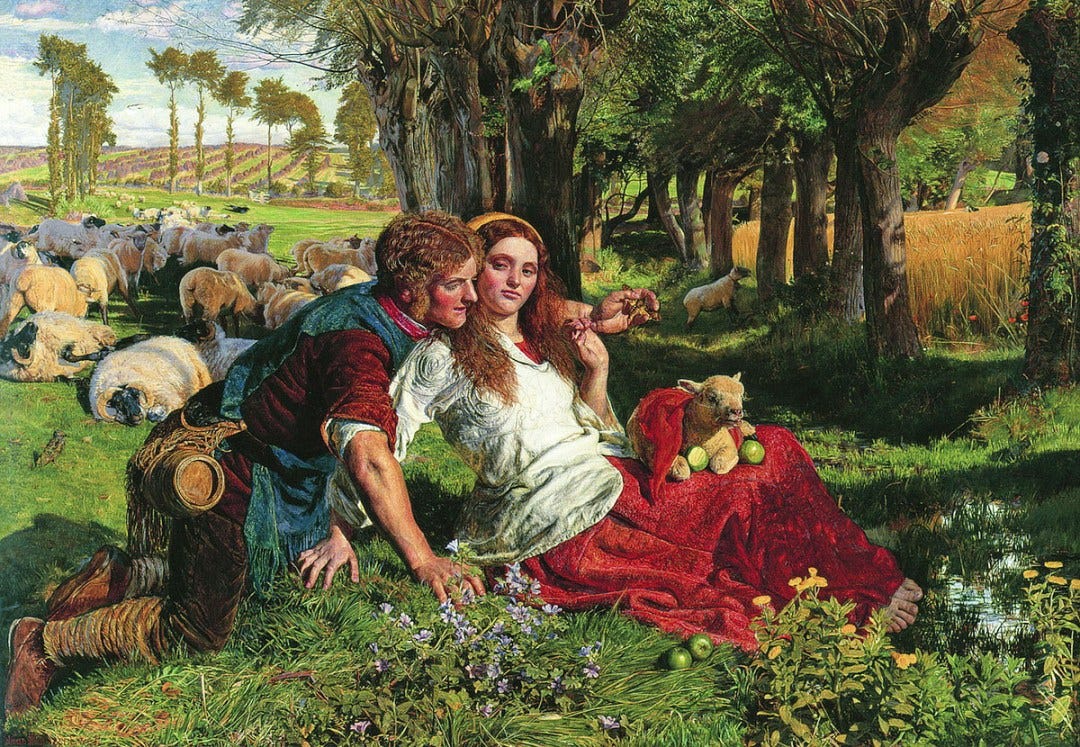
With a poem so well-known, so often anthologised, so widely quoted, reworked, so desperately famous, it can be hard to read ‘To His Coy Mistress’ with fresh eyes.
Had we but World enough, and Time,
    This coyness Lady, were no crime.
    We would sit down, and think which way
    To walk, and pass our long Loves Day.
    Thou by the Indian Ganges side
    Should’st Rubies find: I by the Tide
    Of Humber would complain. I would
    Love you ten years before the Flood:
    And you should if you please refuse
    Till the Conversion of the Jews.
    My vegetable Love should grow
    Vaster then Empires, and more slow.
    An hundred years should go to praise
    Thine Eyes, and on thy Forehead Gaze.
    Two hundred to adore each Breast:
    But thirty thousand to the rest.
    An Age at least to every part,
    And the last Age should show your Heart.
    For Lady you deserve this State;
    Nor would I love at lower rate.
        But at my back I alwaies hear
    Times winged Charriot hurrying near:
    And yonder all before us lye
    Desarts of vast Eternity.
    Thy Beauty shall no more be found;
    Nor, in thy marble Vault, shall sound
    My ecchoing Song: then Worms shall try
    That long preserv’d Virginity:
    And your quaint Honour turn to dust;
    And into ashes all my Lust.
    The Grave’s a fine and private place,
    But none I think do there embrace.
        Now therefore, while the youthful glew
    Sits on thy skin like morning dew,
    And while thy willing Soul transpires
    At every pore with instant Fires,
    Now let us sport us while we may;
    And now, like am’rous birds of prey,
    Rather at once our Time devour,
    Than languish in his slow-chapt pow’r.
    Let us roll all our Strength, and all
    Our sweetness, up into one Ball:
    And tear our Pleasures with rough strife,
    Thorough the Iron gates of Life.
    Thus, though we cannot make our Sun
    Stand still, yet we will make him run.
Three verse paragraphs, three steps in an argument, the overall thesis being: let’s have sex. The lady is coy: bashful, shy, reserved, modest. The word comes etymologically from the Latin quietus and is a doublet to quiet. And the lady is quiet, in the sense of not saying anything (there are a number of reply-poems giving her voice: but Marvell’s original silences her) and in the sense that Marvell’s speaker holds over her the prospect of Hamlet’s quietus. In the first verse-paragraph the speaker indulges her reluctance with a hyperbolic vista of deep time: the two of them courting from ‘ten years before the flood’ (Archbishop Ussher dated the flood to 2349 BC, so this gives us a starting point of 2359 BC; although Zachery Crofton’s Bethshemesh Clouded (1653) dates it to 1656 BC which, if Marvell wrote the poem in AD 1646, as he might have done, would give the reference particular point). If they were not mortal, the lady could hold out to ‘the conversion of the Jews’, one of the anticipated preliminaries for the end of the world. In between these dates Marvell’s love would expand continuously, he would spend 100 years admiring the mistress’s eyes, another 100 on her forehead, 400 years in total ogling her breasts and 30,000 years for the rest of her body: 30,600 years in total, dating the conversion of the Jews to AD 28,944, or perhaps AD 28,241, depending on whether Crofton or Ussher is right. ‘Vegetable love’ doesn’t mean, as it were, a love that grows like rhubarb or potatoes—a cabbage that over thousands of years of continual growth has come to cover the whole of the old Roman Empire’s domains with its vast, veined, green leaves—but rather invokes the Latin, vegetābilis, which adjective means ‘animating, enlivening, vivifying, able to produce and support growth’, itself from vegetō the verb meaning ‘to arouse, to enliven, to quicken’. Arouse there points to a lewd double meaning: if you don’t mind doing a Latin-NSFW search, you can look up the usage of ‘vegetat mentula’, ‘the penis becomes aroused’, in Early Modern texts. Marvell is boasting about his schlong, and imagining its slow erection swelling to the size where it overshadows human empire.
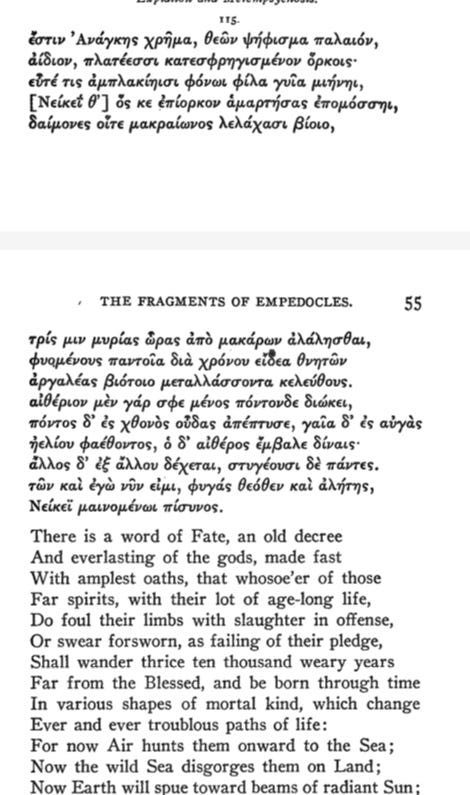
Thirty thousand years for admiring the lady’s body seems an oddly precise number. We might wonder if Marvell was aware of Empedocles, who specifies (fragment 115) that those guilty of bloodshed will incur a penality, condemned by Fate to wander as spirits (daimones), through all manner of mortal forms, exiled from the realm of the blessed, for 30,000 years, τρίς μυρίαι ὦραι. It might be nice to think that Marvell is again joking here, thinking of bloodshed not in terms of murder and assault, but in the loss of virginity. But how likely is it he was aware of Empedocles?
Editions of the fragments had certainly been published (eg. Empedoclis, Porphyrii et Guilberti Porritani, Paris 1519) and Sacvan Bercovitch notes that Empedocles’ writings were very often quoted and anthologised by Renaissance writers [‘three examples (out of many) of anthologies which quote Empedocles in Greek and/or Latin are: Konrad Gesner, Bibliotheca Instituta et Collecta (Zurich, I583); Anthologia Graeca … (Geneva, 1566); Epigrammatum Graecorum, annotated by Jean Brodeau (Frankfurt, 1600)] by way of arguing that Renaissance writers were much better acquainted with him than has been realised [Sacvan Bercovitch, ‘Empedocles in the English Renaissance’, Studies in Philology 65:1 (1968), 67-80]. So maybe Marvell knew this.
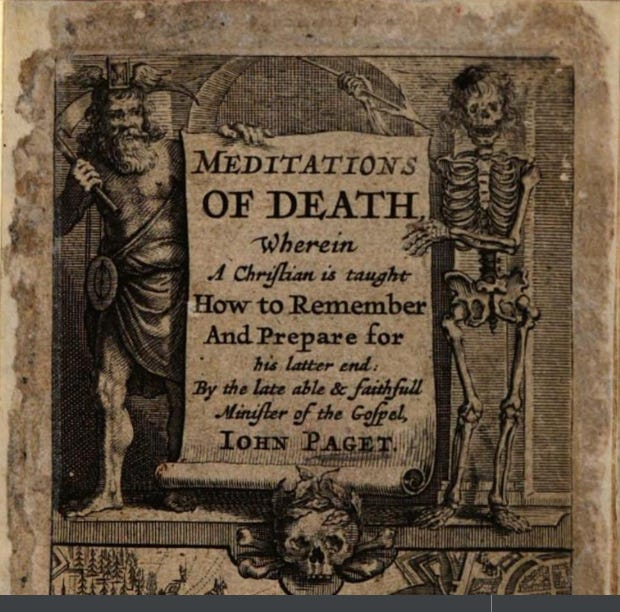
The second verse-paragraph of the poem contradicts the first: not only do the two of them not have 30,00 years, they have almost no time at all: the case is urgent, they will soon die, and what a missed opportunity that would be. The poet can hear, in a splendid image, ‘time’s wingéd chariot hurrying near’—a phrase splendid but not original, for Marvell has nicked the image from John Paget:
See how one generation goes and another comes successively, one draws on the one, and another drives on the other and there is no rest in this race, but all runne uncessantly from the Orientall gate to the Westerne porte, from the wombe to the grave … every one hastes forward, and never ceasseth till they have passed the gates of the grave … we see and finde our selves in the midst of the crowd and throne, carried on with others in the swift winged chariot of time unto the sun-setting gate of the world. [John Paget, Meditations Of Death: wherein a Christian is taught how to remember and prepare for his latter end (1639), 89]
Paget is encouraging us to piety, not trying to get into a girl’s knickers, but it’s interesting that Marvell is reading him.1
Mavell warns his mistress that her beauty shall fade, she will die and lie in the tomb having missed out on the pleasure he is offering. Some more double-entendres: worms (mortal decay, penises) will ‘try’ her ‘long preserved virginity’ and her ‘quaint honour’ (quaint meaning ‘fastidious, prim’ but also meaning queynt, which is to say cunt) shall crumble to dust.
The third verse-paragraph follows: ‘therefore’, as if seduction were a syllogism, ‘let us have sex’: whilst ‘youthful glew’ (glow, but also glue—that is, the blush of a young woman’s skin, but also the sticky secretions lubricating her ‘quaint’), her ‘every pore’ is aflame, and again there’s a double meaning: pore in English refers to the tiny openings in our skin through which we sweat, but the Latin porus can refer to any passage in the body, such as—well, you don’t need me to spell it out. The poem closes with the speaker proposing some rough sex (‘tear our pleasures with rough strife’ like ‘birds of prey’), offering to penetrate ‘the iron gates of life’, another vaginal reference (the porta vitae, the ‘gate of life’).
+++
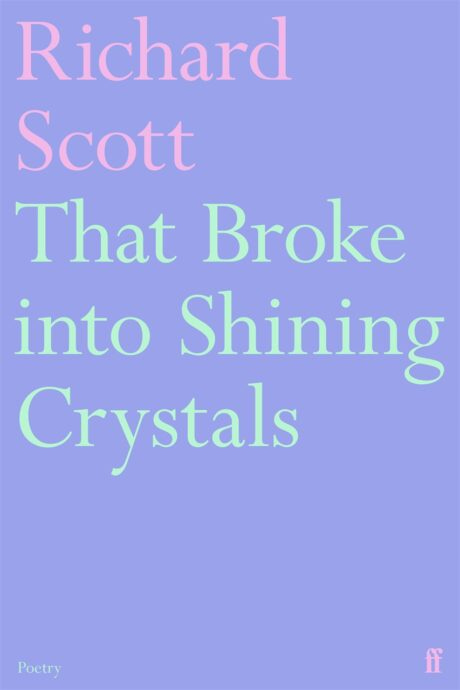
Richard Scott’s recent That Broke into Shining Crystals (Faber 2025) is a brittle, pointed, unsparing collection of poems reflecting—refracting, one might say, keeping in mind the crystalline aesthetic Scott employs—memories of being groomed, of assault and sexual suffering. The volume is in three parts: an opening section in which various still life paintings (the specifics are itemised at the end of the book) provoke poetic reaction, with Scott’s verse recording the beauty of the images, often somatically and sensuously reinterpreting them in terms of his own life-experiences, whilst also undertaking a kind of unblinking record of the raw hurt, the injury and pain, of a roughened past. The third section is stiller, designedly: a suite of poems taking the crystal lattice of the jewel as prototype, poems of form and fixity, Keatsian truthful-beauty that is also the sterility of perfection. The most interesting element in the collection is the middle piece, a reworking of Marvell’s ‘To His Coy Mistress’ called, simply, ‘Coy’.
In a note, Scott says: ‘“Coy” is a found poem, a vocabularyclept, which uses and playfully rearranges the words of Andrew Marvell’s extraordinary poem ‘To His Coy Mistress’ as first printed in his Miscellaneous Poems, 1681’. The poem’s epigraphs speak to the purpose:
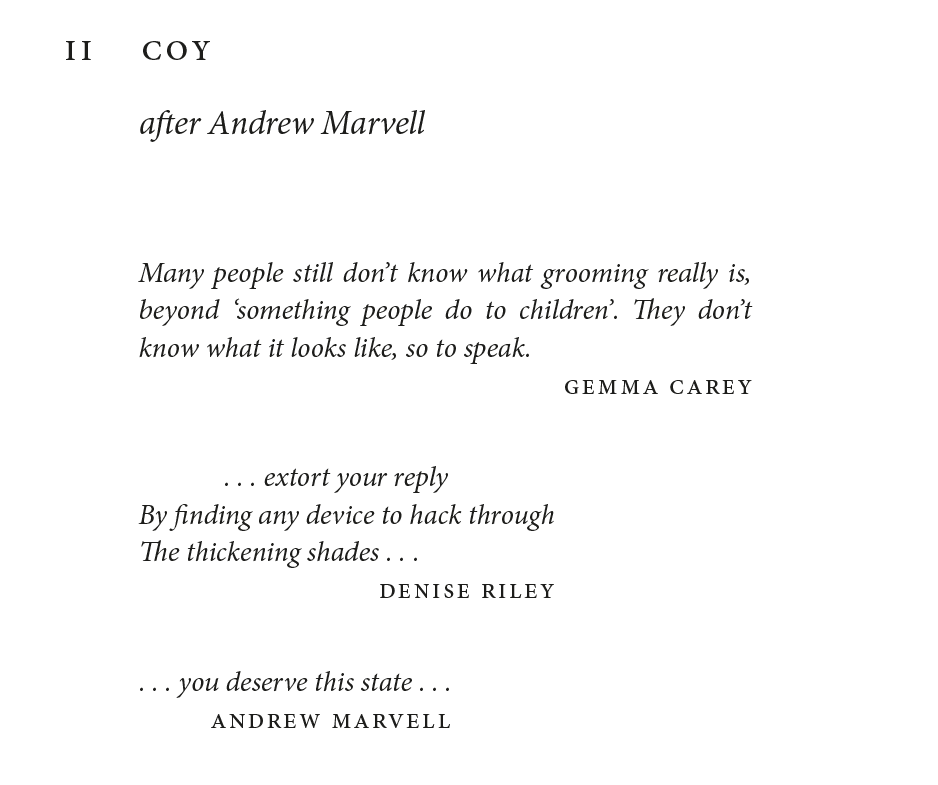
To think of ‘To His Coy Mistress’ as a playful love-poem is, arguably, to occlude the plain meaning of the text: a man who won’t take no for an answer, who refuses to accept that ‘no means no’, and is using his considerable wit, a textual correlative to his greater physical strength and insistence, to press his sexual advances upon an unwilling partner. ‘Grooming’ is one way of styling this, although ‘rape’ might be more en point. Scott reconfigures Marvell’s words with a great deal of artistry, but without contaminating the rawness of his dolorous experiential directness.
In an essay for the Poetry Society, Scott says:
I’ve always felt haunted by Andrew Marvell’s poem ‘To His Coy Mistress’. Something about the seductive speed of it. Something about how even though the implied addressee of the poem might be saying no, the reader cannot fail to be visually and psychologically penetrated by Marvell’s urgent images. Something about its epic span which stretches back to the deep time of ‘rubies’ and forward to a shocking ‘eternity’. Something about its density too – how underneath its music might lie a plethora of meanings, sensibilities and ideas like whimsy, irony, politics, wit, pleasure, annihilation, parody, carpe diem etc. I’ve always known that I wanted to write something in response to it, or in dialogue with it, and I suppose that means, on some level, I had an awareness that it brought to mind other, personal, connotations and associations. Why must the addressee of such a powerful lyric stay silent? And how do you live in the now if you might be stuck, frozen, in past hurts?
Scott calculates that of the poem’s 306 words ‘discounting repetitions, Marvell really only uses 188 distinct and different words’, which is a constraint upon expression. How to articulate what you want with so limited a vocabulary? ‘In a vocabularyclept, you quickly realise that you can’t say exactly what you want to. You’re in the service of this new language and imagery. When you try to write something it can become tortured and difficult to express almost immediately. It’s hard to speak. Sometimes I manage direct statement but mostly, I had to fracture syntax and expression to approach meaning. Often, Marvell’s song refused me. But writing a vocabularyclept is also a lesson in learning to listen. Marvell’s lexicon had things it wanted to say and often I had to just let it sing out.’
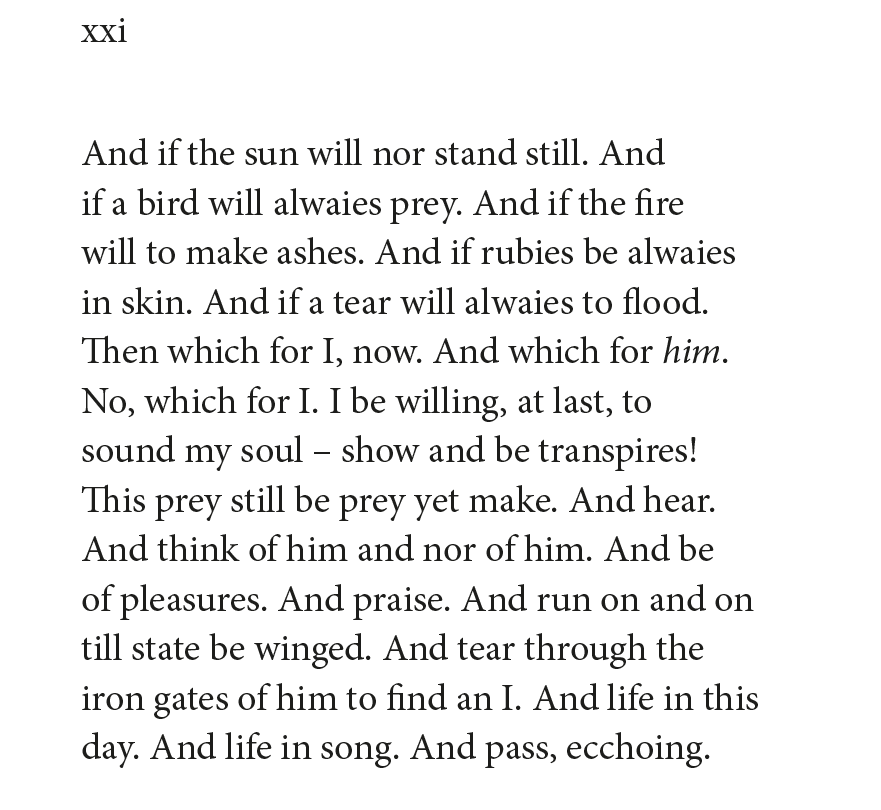
Scott’s ‘Coy’ is disposed into twenty-one sections, starting with this opening sonnet of distressed but surviving endurance:
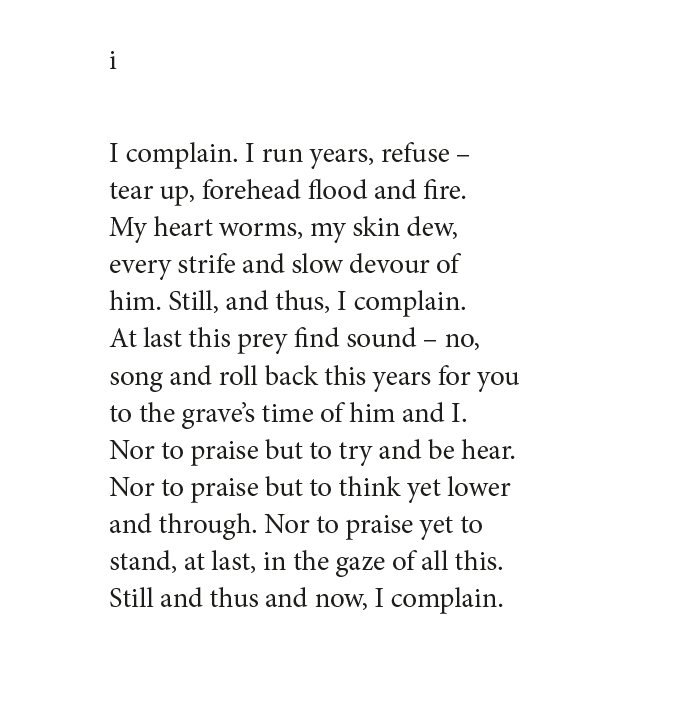
Scott knows, I think, that ‘complain’ derives from the much more physically forceful Latin root com- ‘together’ + plangere ‘to strike, beat, as the breast in extreme grief’; and he inhabits the sonnet-form with a pattern of rhymes, half-rhymes and repetitions: the opening ‘I complain’ rhymes precisely with the end of the last line (as does the line-ending ‘complain’ in line 5), the half-rhyme abab of the first quatrain ‘refuse’/‘dew’, ‘fire’/‘devour’ [of], lines 6-7, ‘dew’/‘you’/‘to’ [lines 3, 6, 11] and again 9-10 ‘hear’/‘lower’; the internal rhymes tying together line 13’s ‘gaze’ back through the poem’s chiming repetitions, ‘grave’s’ ‘[not to] praise’ ‘[not to] praise’ ‘[not to] praise’. The line that stands out is 8: ‘to the grave’s time of him and I’, marking the end of what in a conventional sonnet would be the octave: the first direct linking of ‘him’, the abuser, and ‘I’, the speaker, who is in the rest of the poem fugitive from this painful connection, this past time. The terminal ‘I’ rhymes not with any other line-ending, but only with the poem’s initial word, its starting point. It’s an intricate formal web, a looping together of affect and memory, of present and past, of trauma and aftermath.
The poems continue through representations of the (presumably) older predator: in the second section’s Emily Dickinson-esque contrasting his violent predatoriness and the victim’s youthful vulnerability:
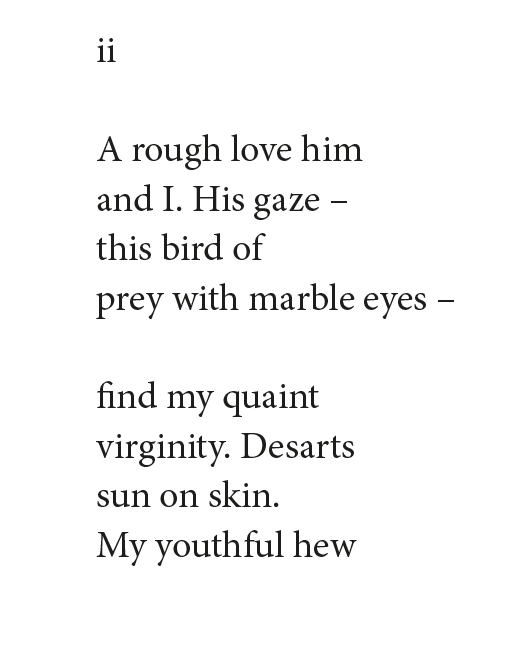
The emotional complexites of reaction thread through the whole, including the illogical sense in which a victim will blame themselves for what happened (‘Our long love’s no day but a soul on fire … The time – no, life – of iron./That which I deserve’ [4]; ‘Still, for years I find my crime … Him crime I cannot find’ [5]). Then again, the poems records how the suffering remade the victim into something rich and strange, jewelled and hard:
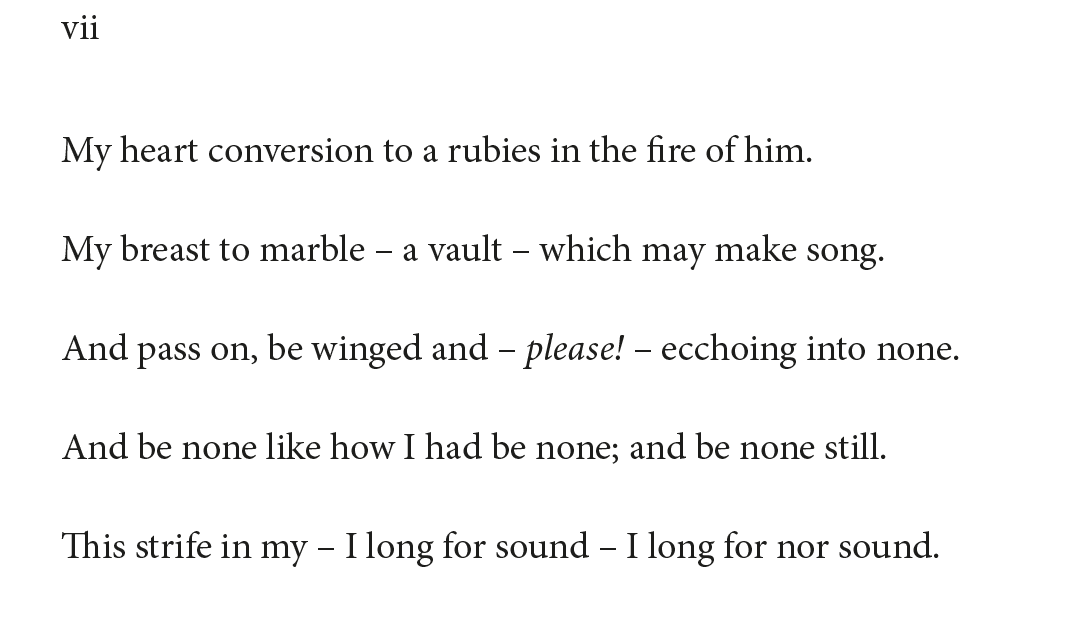
‘And be none like how I had be none’ means both: let me not be the person I was back then, when I was treated as worthless, but also (‘and be none still’) to empty himself of his suffering, to pour it out in his song: ‘I long for sound’.
Scott says: ‘the lyric poem is a kind of illumination device. It can unearth what has previously been buried. A song, in Seamus Heaney’s words, that might ‘set the darkness echoing’ with what has laid dormant or, on some level, been unknown. ‘Coy’ is concerned with difficult and excavated feelings. Andrew Marvell’s lyric language gave me a lexicon with which to speak when I was tongue-tied and uncertain. A way of stirring the darkness or touching it or connecting myself to it, again. It also pulled more out of me, via revelation, than I had previously thought possible.’ ‘Coy’ returns repeatedly to rubies as embodiments of preciousness and beauty that are also scars, like scabbed blood, markers of the places of hurt. Section 10 repeats the refrain ‘let go of/him? I cannot’; but also brings out imagery of a tide turning, and as the poem continues there is a sense of recovery through poetry: ‘I think rather I be found by this found song’ [11]; ‘No bird and no prey. None. Just still/and rest youthful. So transpires I,/my song [14]. ‘If my breast be a vault, then I gate him in –/him be the worm in my. Yet this worm do/sound and his sound ecchoing make my song/to sweetness’ [18]. I am not suggesting that the twenty-one sections trace a facile passage from traumatic hurt to healing and contentment: the hurt remains, and the later sections are as haunted by ‘him’ as the earlier. But there is affirmation via expression, and growth: ‘Grow!’ the poet tells himself. ‘At last I find/a pow’r hear:/I run to the sun./I devour the/sun. O’ [19]. The last section catches the poet in motion, no longer running away but passing on in song, not thrall to the crystalline stasis of his suffering.
It is testament to the extraordinary reach of Google Books that I am able to identify this as the likely source of Marvell’s line here. It’s not that I’m in the habit of browsing seventeenth-century sermons and chanced upon it (any more than any of the previous editors of Marvell did, none of whom mention Paget). But a quick search, within a particular time-frame, and there it is. I am struck by how few academics and scholars are aware of this powerful tool.
'tear through the
iron gates of him to find an I.'
Beautiful lines.
I meant to comment on this before now but I let it slip my mind, sorry.
Marvell uses “complain” quite often — 11 times in Miscellaneous Poems — and in varying senses. It’s sometimes legal (“Though Justice against Fate complain, | And plead the ancient rights in vain;” in “An Horatian Ode”); and Judith Haber has argued that “Remedies themselves complain” (“Damon the Mower”) is Marvell’s version of Theocritus’s pun on pharmakon, meaning both “remedy” and “poison”.
About “grooming”:
Writing a few years ago about Marvell’s “Clorinda and Damon” (a dialogue), I used “To His Coy Mistress” as a contrasting example of a poem in which we don’t hear from the woman, we just get one (masculine) point of view. I have since changed my mind: the switch from second-person singular pronouns to first person plural for the last 10 lines of the poem indicates that the pair are finally acting as one (or, possibly, that the speaker has become so desperate that he is pretending that they’re in agreement). I prefer the first alternative, while admitting that we can’t be certain about it.
https://letter.talkaboutbooks.net/2025/09/06/lady-you-deserve-this-state.html