
Arnold's Obermann
Arnold and Senancour

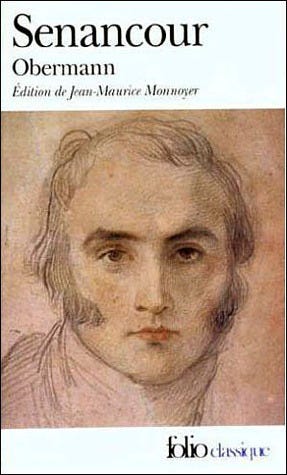
I know well, and indeed have often taught, Matthew Arnold’s ‘Stanzas: in Memory of the Author of Obermann’ (written 1849, published 1852): one of the great poems of the nineteenth-century, and well worth your time, as is Arnold’s sequel poem from two decades later, ‘Obermann Once More’ (1867). But here’s the thing: I’d never read Obermann. In fact I’d been discouraged from doing so by what I’d read about Obermann.
So: this 1804 novel by Étienne de Senancour (full name, in the glorious French stylee, ‘Étienne-Jean-Baptiste-Pierre-Ignace Pivert de Senancour’) was reputed to be (a) very long and dull and (b) only tenuously related to Arnold’s poem, said poem’s title notwithstanding. J Anthony Barnes, writing in the early 1900s, says as much:
Many who turn to Obermann in the hope of finding the haunting, elusive charm distilled from it by Matthew Arnold will be disappointed, and will agree with A. E. Waite, a recent critic and translator, that the poet presents him ‘in a kind of transfigured aspect.’ R. L. Stevenson confesses that he always owed Arnold a grudge for leading him to ‘the cheerless fields of Obermann’ in the days of his own youthful despondencies. It is perhaps the fullest expression in literature of the mood of ennui, that untranslatable word which occurs in so many of the letters. It is a diagnosis of the malady from within … Obermann is a pure and lofty soul, with fine sensibilities, and a great craving to love and to serve, but disheartened and disenchanted; chafed and repelled by the imperfections of the existing social order, he indulges in vague and beautiful dreams of unattainable ideals, only to wake to the paralyzing consciousness of his own impotence and life-weariness.
Picture my surprise when, upon actually reading Obermann, I discovered that this isn’t true at all. Arnold’s great poem turns out to be a close and indeed precise gloss upon the ipsissima verba of Senancour’s novel. Who would have thunk? Who would even have thunk to think?
Obermann certainly meant a lot to Arnold, who read it repeatedly and took it with him on his various late-1840s holidays to the Alps. It’s not a novel in which much happens by way of plot. Rather its many letters, addressed by the titular character from Switzerland to an unnamed friend in France, give voice to a great many introspective, melancholic thoughts, observations on Alpine scenery and nature, construing a kind of reflective ‘solitary wanderer’ character of the sort to which Arnold was often drawn (the Scholar Gipsy, Empedocles etc). Senancour himself repaired to Switzerland as an exile during the French Revolution: born into a wealthy family he lost all his fortune to the Revolution, married a Swiss woman with whom he was, it seems, unhappy (they had two children, and then she died) and afterwards returned to Paris, broke, struggling to make end meet as an author. He was hamstrung by his extreme diffidence and an incompetence of self-promotion, but wrote a number of books that were later rediscovered and celebrated, not least by Arnold. He held mildly progressive views on sex-relations, which got him into trouble, and when one of his books (1827’s Résumé de l’histoire des traditions morales et religieuses) described Jesus as ‘a youthful sage’ and a moralist worthy of respect’ he was prosecuted under France’s blasphemy laws and faced a huge fine and 9-months in prison (his conviction was overturned on appeal). He died, in 1846, three years before Arnold wrote his poem.
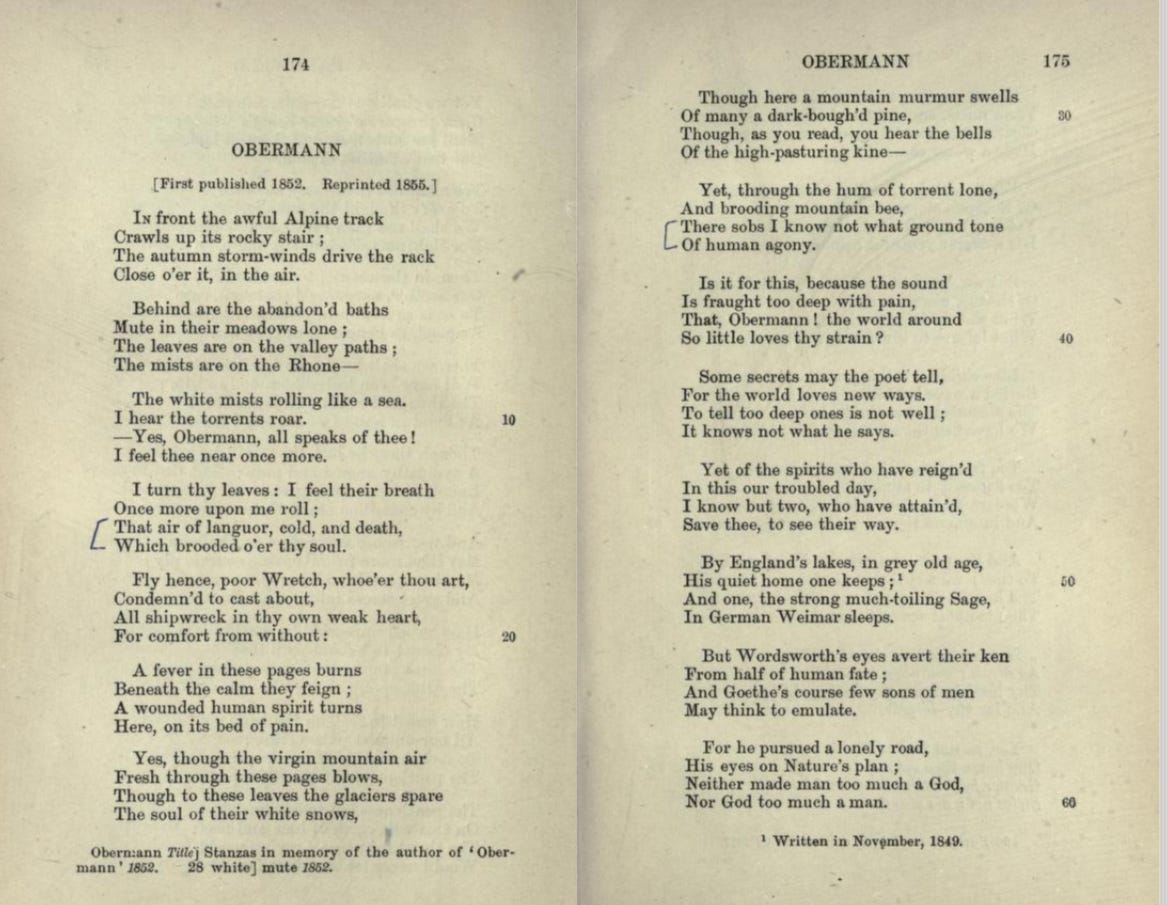
This is how Arnold’s 184-line poem opens:
STANZAS IN MEMORY OF THE AUTHOR OF OBERMANN.
November, 1849.
In front the awful Alpine track
Crawls up its rocky stair;
The autumn storm-winds drive the rack,
Close o’er it, in the air.Behind are the abandoned baths
Mute in their meadows lone;
The leaves are on the valley-paths,
The mists are on the Rhone,—The white mists rolling like a sea;
I hear the torrents roar.
—Yes, Obermann, all speaks of thee;
I feel thee near once more.I turn thy leaves; I feel their breath
Once more upon me roll;
That air of languor, cold, and death,
Which brooded o’er thy soul.…
A fever in these pages burns
Beneath the calm they feign;
A wounded human spirit turns,
Here, on its bed of pain.
Arnold himself adds a footnote identifying the ‘abandoned baths’ as ‘The Baths of Leuk’, adding: ‘the poem was conceived, and partly composed, in the valley going down from the foot of the Gemmi pass towards the Rhone.’ But the imagery and moments of the poem are from the ‘leaves’ of Senancour, rather than from Arnold’s own experiences. Or to be more precise they have to do with Arnold’s own experience, and state of mind, filtered through his reading of Obermann. This was his second holiday in Switzerland: in the first (in September 1848) he met ‘Marguerite’, a Swiss woman whom Arnold fell for—we presume she was Swiss: the identity of the actual woman behind the Goethean name has never been established, though scholars and biographers have made various suggestions. In September 1849 Arnold returned to Switzerland, met up again with ‘Marguerite’ and thereafter never saw her again. The broad lineaments of the situation are inferred from the poems Arnold wrote, not just his best but amongst the greatest lyrics of the 19th-century: ‘Isolation: To Marguerite’ and ‘To Marguerite: Continued’ (both written in 1849, like the Obermann stanzas)—Marguerite, a blue-eyed beauty, may have been the daughter of the innkeeper of the place where Arnold stayed. On his first visit perhaps some romance was kindled; on the second it was certainly quashed. It’s likely Arnold felt the impossibility of an English gentleman marrying a foreign innkeeper’s daughter (when he did marry, a few years later, it was to the daughter of an English High Court Judge); or perhaps, in the intervening year, Marguerite herself had begun a relationship with someone else. At any rate, Arnold wrote a number of heartbroken poems about his isolation, the impossibility of connecting with the beloved one. Why? Fate, divine command, the nature of the universe.
Who order’d, that their longing’s fire
Should be, as soon as kindled, cool’d?
Who renders vain their deep desire?—
A God, a God their severance ruled!
And bade betwixt their shores to be
The unplumb’d, salt, estranging sea. [‘To Marguerite: Continued’, final stanza]
I’ll come back to this poem later (it may be Arnold’s greatest, actually, and it turns out to be very much Obermanly.)
Early in Obermann de Senancour’s protagonist meets a beautiful French woman travelling with a party of other Frenchies. Because Obermann is himself French, though exiled in Switzerland by the revolution (it’s striking that at no point in his novel does Senancour even mention the events of 1789), he is greeted by them, and later joins them at their inn for supper. Him falling in love with the unnamed woman happens immediately (‘un instant peut changer nos affections’ as he says). He is instantly attracted: ‘sa bouche est ronde; son regard … pour sa taille, pour tout le reste, je ne le sais pas plus que je ne sais son âge: je ne m’inquiète pas de tout cela: il se peut même qu’elle ne soit pas très-jolie’ [ellipsis in original]. ‘Her shapely mouth; her eyes …’ are obviously captivating (he goes on to declare himself ignorant of anything else about her, so lovestruck is he: ‘her height, all the rest, I don’t know! I don’t even know how old she is. I don’t care. It may even be that she’s not even particularly pretty!’) But the party, and the woman, depart the next day. It does not surprise us that Arnold was drawn to this description. Here’s ‘Letter 6’:
J’ai passé le reste de la journée près du Rhône. Ils doivent être partis ce matin; ils vont jusqu’à Sion: c’est le chemin de Leuck, où l’un des voyageurs va prendre les bains. On dit que la route est belle.
C’est une chose étonnante que l’accablement où un homme qui a quelque force laisse consumer sa vie, pendant qu’il faut si peu pour le tirer de sa léthargie.
Croyez-vous qu’un homme qui achève son âge sans avoir aimé, soit vraiment entré dans les mystères de la vie, que son cœur lui soit bien connu, et que l’étendue de son existence lui soit dévoilée! Il me semble qu’il est resté comme en suspens; et qu’il n’a vu que de loin ce que le monde aurait été pour lui.
Je ne me tais pas avec vous, parce que vous ne direz point: le voilà amoureux. Jamais ce sot mot, qui rend ridicule celui qui le dit ou celui de qui on le dit, ne sera dit de moi, je l’espère, par d’autres que par des sots …
Si le temps n’était pas à l’orage, je ne sais comment je passerais la journée: mais le tonnerre retentit déjà dans les rochers, le vent devient très-violent; j’aime beaucoup tout ce mouvement des airs. S’il pleut l’après-midi, il y aura de la fraîcheur, et du moins je pourrai lire auprès du feu.
.
I spent the rest of the day by the Rhone. They must have left this morning—; they are travelling as far as Sion today, heading to Leuk, where one of the group intends to take the baths. It is supposed to be a beautiful route.
It is really astonishing—that a man, not altogether lacking in vigour, will allow his life to be consumed by depression, when it would take so little to pull him out of his lethargy. Do you think someone who dies without ever having been in love can be said to have truly entered into the mysteries of life? Can such a man say his heart is fully known to him, and that he has experienced the full scope of his existence? It seems to me his life has been held in suspension, that he has only seen from a great distance what the world might have been to him.
I am being candid with you, because I know you won’t say: see how love sick he is! Never may that stupid phrase be applied to me by any but fools—it makes he who uses it, and he to whom is said, both ridiculous. …
If the day wasn’t so stormy I don’t know how I should get through it; but the thunder is now crashing among the crags, the wind grows furious. I revel in this tumult of the elements. If it rains this afternoon it will cool things, and in any case I can read by the fire.
Arnold’s stormy Alps are the occasion for a similar reverie. As the mountains are glacial and snow-capped, so Obermann’s despair is icy:
Yes, though the virgin mountain air
Fresh through these pages blows;
Though to these leaves the glaciers spare
The soul of their mute snows;…
Immovable thou sittest, still
As death, composed to bear;
Thy head is clear, thy feeling chill,
And icy thy despair.
Arnold is thinking of this passage, from ‘Fragment 3’ (interposed between letter 38 and 39):
Le vent apporte ou recule ces sons alpestres; et quand il les perd, tout paraît froid, immobile et mort.
The wind draws in or pushes back these alpine sounds; and when it loses them, everything seems cold, still, and dead.1
Letter 21: is about growing older:
Je commence à sentir que j’avance dans la vie. Ces impressions délicieuses, ces émotions subites qui m’agitaient autrefois et m’entraînaient si loin d’un monde de tristesse, je ne les retrouve plus qu’altérées et affaiblies. Ce désir ineffable que réveillait dans moi chaque sentiment de quelque beauté dans les choses naturelles, cette espérance pleine d’incertitudes et de charme, ce feu céleste qui éblouit et consume un cœur jeune, cette volupté expansive dont il éclaire devant lui le fantôme immense, tout cela n’est déjà plus. …
Vous qui connaissez mes besoins sans bornes, dites moi ce que je ferai de la vie, quand j’aurai perdu ces moments d’illusions qui brillaient dans ses ténèbres comme les lueurs orageuses dans une nuit sinistre? Ils la rendaient plus sombre, je l’avouerai, mais ils montraient qu’elle pouvait changer, et que la lumière subsistait encore.
I am increasingly aware how much I have aged. Those delicious impressions, those sudden emotions that formerly thrilled me, that transported me far away from the sadness of the world, come back to me now only in altered and weakened form. The desire, once awoken in me by the apprehension of beauty in the external world, the vague and captivating hope, the heavenly fire which dazzles and burns a youthful heart, the overflowing ecstasy with which it illuminates the mighty phantom that stands before it, all these have passed away.
… Since you know my limitless needs, tell me: what I shall make of life when I have lost these moments of enchantment which glowed in the darkness like gleams of a storm on a lurid night? They made it darker I confess, but they showed that it might change, and that light subsisted still.
Arnold is not yet 27 years old as he writes his poem: young, but feeling prematurely aged by his experience. He summarises this Obermann letter in in two lines:
Ah! two desires toss about
The poet’s feverish blood;
One drives him to the world without,
And one to solitude.The glow, he cries, the thrill of life,
Where, where do these abound?
Not in the world, not in the strife
Of men, shall they be found. [‘Stanzas: Obermann’, 94-100]
Then we come to Obermann’s ‘eternal tongue’. Here Arnold’s provides a recension of Senancour hearing ‘accents of the eternal tongue/through the pine branches’ amongst the lengthening shadows of ‘summer days grown late’, from Letter 48:
L’homme qui travaille à s’élever, est comme ces ombres du soir qui s’étendent pendant une heure, qui deviennent plus vastes que leurs causes, qui semblent grandir en s’épuisant; et qu’une seconde fait disparaître.
Et moi aussi j’ai des moments d’oubli, de force, de grandeur; j’ai des besoins; démesurés; sepulchri immemor! Mais je vois les monuments des générations effacées; je vois le caillou soumis à la main de l’homme, et qui existera cent siècles après lui. J’abandonne les soins de ce qui passe, et ces pensées du présent déjà perdu. Je m’arrête étonné: j’écoute ce qui subsiste encore; je voudrais entendre ce qui subsistera: je cherche dans le mouvement de la forêt, dans le bruit des pins, quelques-uns des accents de la langue éternelle.
The man who works to lift himself up is like those evening shadows that elongate for an hour, becoming more vast than the objects that cast them, seeming to grow still larger as they fade, and taking but an instant to vanish.
I also have moments of forgetfulness, of force, of grandeur; I have my desires, my largenesses, sepulchri immemor! But I see the sepulchres of lost generations; I see the stone, so supple under the hand of man, which will outlast him by a hundred centuries. Then I give up all the cares of the fleeting hour and all thought of the already futile present. I stop, stunned; I listen to what yet exists, and wish I could hear the murmur of what will exist for ever; I seek in the stir of the forest and the soughing of the pines for some of the accents of the eternal tongue.
This is Arnold’s poetic version of this passage:
How often, where the slopes are green
On Jaman, hast thou sate
By some high chalet-door, and seen
The summer day grow late;And darkness steal o’er the wet grass
With the pale crocus starred,
And reach that glimmering sheet of glass
Beneath the piny sward,—…
Heard accents of the eternal tongue
Through the pine branches play,—
Listened, and felt thyself grow young!
Listened, and wept— Away!
Pretty much throughout, Arnold’s poem glosses a specific passage in Senancourt’s novel. It is remarkable to read Sennancourt’s novel and then read Arnold’s poem, most remarkable in that nobody seems to have noticed it.
Back to ‘To Marguerite: Continued’, a greater poem even than the Obermann stanzas. Consider the nightingale—taken as a Keatsian moment by most critics (and there’s no gainsaying the importance of Keats to Arnold as a poet) it is actually a direct lift from Senancourt. Consider stanza 2:
Yes: in the sea of life enisl’d,
With echoing straits between us thrown,
Dotting the shoreless watery wild,
We mortal millions live alone.
The islands feel the enclasping flow,
And then their endless bounds they know.
But when the moon their hollows lights
And they are swept by balms of spring,
And in their glens, on starry nights,
The nightingales divinely sing,
And lovely notes, from shore to shore,
Across the sounds and channels pour;
Oh then a longing like despair
Is to their farthest caverns sent;
—For surely once, they feel, we were
Parts of a single continent!
Now round us spreads the watery plain—
Oh might our marges meet again!
Who order’d, that their longing’s fire
Should be, as soon as kindled, cool’d?
Who renders vain their deep desire?
A God, a God their severance rul’d;
And bade betwixt their shores to be
The unplumb’d, salt, estranging sea.
This, in a very direct way, is Obermann’s Letter 63:
Juillet, VIII. Il était minuit: la lune avait passé; le lac semblait agité; les cieux étaient tranquilles, la nuit profonde et belle. Il y avait de l’incertitude sur la terre. On entendit frémir les bouleaux, et des feuilles de peupliers tombèrent: les pins rendirent des murmures sauvages; des sons romantiques descendaient de la montagne; de grosses vagues roulaient sur la grève. Alors l’effraie se mit à gémir sous les roches caverneuses; et quand elle cessa, les vagues étaient affaiblies, le silence fut austère.
Le rossignol plaça de loin en loin dans la paix inquiète, cet accent solitaire, unique et répété, ce chant des nuits heureuses, sublime expression d’une mélodie primitive; indicible élan d’amours et de douleur; voluptueux comme le besoin qui me consume; simple, mystérieux, immense comme le cœur qui aime.
Abandonné dans une sorte de repos funèbre au balancement mesuré de ces ondes pâles, muettes, à jamais mobiles, je me pénétrai de leur mouvement toujours lent et toujours le même, de cette paix durable, de ces sons isolés dans le long silence. La nature me sembla trop belle; et les eaux, et la terre, et la nuit trop faciles, trop heureuses: la paisible harmonie des choses fut sévère à mon cœur agité. Je songeai au printemps du monde périssable, et au printemps de ma vie. Je vis ces années qui passent, tristes et stériles, de l’éternité future dans l’éternité perdue. Je vis ce présent, toujours vain et jamais possédé, détacher du vague avenir sa chaîne indéfinie; approcher ma mort enfin visible; traîner dans la nuit universelle les fantômes de mes jours; les atténuer, les dissiper; atteindre la dernière ombre, dévorer aussi froidement ce jour après lequel il n’en sera plus, et fermer l’abîme muet.
.
8th July. It was midnight: the moon had set; the waters seemed restless; the heavens were still, the night deep and beautiful. There was uncertainty on the earth. The birches rustled, and poplar leaves fell: the pines murmured wildly; romantic sounds drifted down from the mountain; large waves rolled upon the shore. Then the barn owl began to moan beneath the cavernous rocks; and when it ceased, the waves were weak, the silence austere.
The nightingale sang here and there in the restless peace in her solitary, unique, and repeated voice, that song of happy nights, sublime expression of a primal melody; unspeakable surge of love and sorrow; voluptuous as the need that consumes me; simple, mysterious, immense as the loving heart.
Abandoned in a kind of funereal repose to the measured swaying of these pale, mute, forever-moving waves, I became immersed in their ever-slow and ever-unchanging motion, in this enduring peace, in these isolated sounds within the long silence. Nature seemed too beautiful to me; and the waters, and the earth, and the night too easy, too blissful: the peaceful harmony of things was harsh to my troubled heart. I thought of the springtime of the perishable world, and of the springtime of my life. I saw these passing years, sad and barren, of future eternity in lost eternity. I saw this present, always vain and never possessed, detach itself from the vague future its indefinite chain; approach my death, finally visible; drag the phantoms of my days into the universal night; soften them, dissipate them; reach the last shadow, devour as coldly this day after which there will be no more, and close the mute abyss.
That mute abyss, l’abîme muet, is the salt estranging sea that separates the lovers.
The passages goes on: ‘C’est le domaine de l’homme qui n’a pas d’empressement: il sort du toit, bas et large, que de lourdes pierres assurent contre les tempêtes: si le soleil est brûlant, si le vent est fort, si le tonnerre roule sous ses pieds, il ne le sait pas. Il marche du côté où les vaches doivent être, elles y sont; il les appelle, elles se rassemblent, elles s’approchent successivement; et il retourne avec la même lenteur, chargé de ce lait destiné aux plaines qu’il ne connaîtra pas. Les vaches s’arrêtent, elles ruminent; il n’y a plus de mouvement visible, il n’y a plus d’hommes. L’air est froid, le vent a cessé avec la lumière du soir; il ne reste que la lueur des neiges antiques, et la chute des eaux dont le bruissement sauvage, en s’élevant des abîmes, semble ajouter à la permanence silencieuse des hautes cimes, et des glaciers, et de la nuit.’ ‘This is the domain of the man who is not in a hurry. He walks out from under the low, wide roof, which heavy stones protect against storms; if the sun scorches, if the wind blows, if thunder rumbles beneath his feet, it’s all the same to him. He makes his way toward where the cows should be; they are there; he calls them, they gather, they approach one after another; and he comes back with the same slowness, carrying this milk destined for the plains he will never know. The cows stop, they ruminate; there is no more visible movement, not another human being around. The air is cold, the wind has ceased with the evening light; only the glow of ancient snows remains, and the falling waters whose wild murmur, rising from the depths, seems to add to the silent permanence of the high peaks, and the glaciers, and the night.
'He was hamstrung by his extreme diffidence and an incompetence of self-promotion...'
plus ça change
What strikes me reading this is how thoroughly Senancour disappears into Arnold, and how that disappearance was almost certainly Senancour's own fate in life too. A man hamstrung by diffidence, unable to promote himself, who only becomes visible when a greater poet makes him the occasion for grief. There is something unbearably fitting about that. The abîme muet wasn't just the sea between lovers. It was the silence around his own work.