

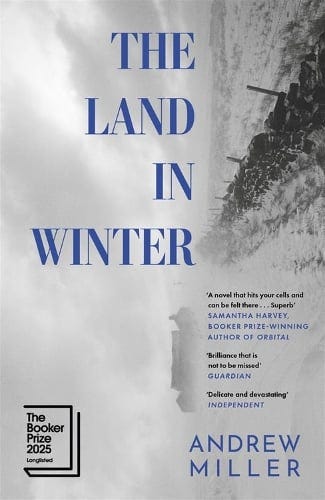
I’m reading the Booker Prize longlist for 2025 (previously on this very stack: thoughts on Katie Kitamura’s Audition, and Natasha Brown’s Universality) and, whilst I might not get through the whole fifteen (we’ll see), I have now read Andrew Miller’s Land in Winter.
I’m interested (before we get to Miller’s novel) in the distinction between a novel set at a near-remove in the past, and ‘an historical novel’. It is, perhaps, a matter of living memory. What I mean is: Dickens and Eliot’s novels are almost never set contemporaneously, but rather at a 20 or 30 year backward distance—except when they write A Tale of Two Cities or Romola and their novels are unambiguously set in the past. You wouldn’t call Bleak House or Little Dorrit ‘historical fiction’, but you would so call Barnaby Rudge and the Scott novels Dickens was imitating when he wrote Barnaby Rudge. What’s the difference? Middlemarch (1871-2) is set at the time of the First Reform Act of 1832, a momentous historical event: but you wouldn’t call it a historical novel. The ‘20 or 30 years ago’ strategy enables a degree of distance, that is to say freedom, on the novel’s subject matter, but keeps the works grounded in a world more-or-less familiar to their readership. The latter ‘1745 rebellion, English Civil War, Elizabethan England’ approach requires the whole ‘worldbuilding’ effort, the pouring-on of myriad specific detail to evoke a world not thuswise familiar, to bring the reader up to speed. Its what science-fiction does.
Miller’s Land in Winter sits on this hinge, set as it is during the ‘great freeze’, the intense and prolonged winter of 1962-63. For an elderly readership the novel might provide nostalgic promptings of memory; for most of us, though, it is an exercise in historical reconstruction—a historical novel. I once had a pleasant lunch with John Mullan in which he noted that the Booker was not likely to shortlist an out-and-out science fiction novel, or a genre-crime novel, since ‘those genres have awards of their own’. Which is fair enough, and I have no problem with the Booker as, precisely, a genre award, since ‘the literary novel’ is as much a genre as Romantasy, Noir or The Western. Except that: well, historical fiction also has prizes of its own, yet historical novels win the Booker all the time, and according to the bookies this particular historical novel may well take the prize. Not that I’m bitter, you understand. No SF, even by the most generous accommodations of what ‘SF’ might be, has been Booker-longlisted this year—although we can note that one of the main characters in Land in Winter, Rita, is a fan of pulp skiffy, and at the start of the novel she is reading Theodore Sturgeon’s Venus Plus X. Which is good to see. I mean, I suspect Miller includes this to index Rita’s immaturity (her husband, the better educated Bill, keeps trying to encourage her to read Virginia Woolf, but she prefers what she herself describes, with exclamation mark, as ‘cheap thrills!’) Miller’s novel also spends quite a lot of time on Van Eyck’s Arnolfini Marriage, which is my favourite painting: I have two separate reproductions of it in my study, which I can see, as I type this now.
Anyway: the novel concerns four characters. Eric is a young GP, a working class man from Birmingham, now working a practice in the countryside outside Bristol. Irene is his conventional, middle-class wife, pregnant with their first child. They live in a rural cottage. Their neighbours, in the farm next-door, are Bill and Rita. Bill is a young man from a wealthy parvenu family who has abandoned the possibilities of ‘money’—the playboy life in which his younger brother indulges, gentlemanly academic success at Oxford—to live the, as he sees it, more authentic existence of a dairy farmer. His young wife Rita was a ‘hostess’ at a jazz club in Bristol, pretty and vivacious and flighty, not at all what one might think of as ‘a farmer’s wife’. And yet it is the life of a farmer’s wife she is now living. She is also pregnant with the couple’s first child. She and Irene become friends across the course of the novel.
Bill struggles with his new life, not just the physical hardship of farming, made more exhausting by the winter—the book opens in December 1962, and ends in February 1963, so is narratively wholly cognate with the Big Freeze—but by his anxieties that he’s a dilletante, not taken seriously by the other farmers, by his hand-to-mouth finances. He has a dream: buying the now disused RAF base some miles from his farm and converting it to a large-scale automated beef farm. This upscaling and automatisation, he senses (accurately), is the future of farming, but to realise his dream he’ll need a significant up-front investment: £15,000. The bank won’t lend him so huge a sum, although they say if he can find half of it elsewhere they might. This means Bill returning cap-in-hand to his father, a London slum-landlord, ‘businessman’ and borderline gangster, which he really doesn’t want to do.
Meanwhile Doctor Eric is conducting an affair with an older woman. Early in the novel she writes a saucy letter to him, informing him that she’s home all alone wearing nothing at all beneath her silk kimono, and imagining all the dirty things she and Eric could be getting up to. When Eric, noting crossly that he’d previously told her not to write to the surgery, pops it into his jacket pocket, we the reader understand that it will reappear later in the storyline: Chekhov’s gun. Or Chekhov’s bonk.
The novel does not open with any of these main four, but instead with Martin, an elderly man in a nearby insane asylum. Creeping around the place at night he chances upon the corpse of a young man—Stephen—lying on a slab fully dressed except for his naked feet, his suicide note pinned to his tie. We learn soon enough that Martin is Rita’s father, sectioned under the mental health act for trying to burn down his house. The mystery of the young man’s suicide is not a main driver of the plot—it isn’t really a mystery, since suicide when the balance of his mind was disturbed is indeed the cause of his death, and such things are not unheard-of in lunatic asylums. Since he is the local doctor, Eric visits the asylum, assists at the post-mortem, signs the death certificate and then attends Stephen’s funeral.
The novel manifests an impressive amount of deep-dive research into the period: Miller was born in 1960, in Bristol, so was technically ‘around’ at the time and in the place of this novel but I would assume he doesn’t actually remember it. The danger in writing a novel such as this is that one will confabulate from what one does remember: the end of the 1960s, the 1970s I’m five years younger than Miller and remember my parents telling me about the Big Freeze of 62-63: but my memories of the London into which I was born are 1970s memories, and were I to write a novel set in London in 1962 it would be a ticklish matter disentangling the accurate from the anachronistic, to write actuality rather than confabulation. Miller, though, does this, so far as I can see, with exemplary precision and evocativeness. In addition to the period-specifics, there’s the Mad-Man pleasures of all the excesses and social delinquencies of the period: ‘everyone smoked back then! You smoked in your house, you smoked in the auditorium of the cinema, you smoked when you went to the doctor’s office! And the drinking! Hoo boy, the drinking! Everyone was drinking all the time! Swigging from bottle of gin as they barreled down the A303!’ and so on. It’s not that this is untrue, though perhaps Miller lays it on a little thickly.
The period detail, clothes and cars, fixtures and fittings, which movies were in the cinema and what the newspapers were reporting, is all carefully and copiously applied, which does generate a verisimilitude-effect. At the same time, the very scrupulousness with which Miller does this adumbrates its 1962 world of doctor’s visits, medical interventions, house-calls with his patients, not to mention the fact that two of the four main characters are pregnant, gives the novel something of the hi-def patina of an episode of Call the Midwife. Not that the novel is as cosy as that comparison suggests: there’s real hardship here, and pared-down existential bareness, to several characters’ lives, and the second half of the novel powerfully lays out the frozen desertification, isolation and threat of the intense winter storms. A Call the Midwife episode scripted by Samuel Beckett or Knut Hamsun.
Miller is careful to include people of colour in his largely white dramatis personae, since there were people of colour in post-Windrush 1960s Britain—and before (to be fair, Call the Midwife also does this). Miller has to strain his story a little to manage it: the first wave of West Indian immigrants tended to settle in cities, not in the hidebound rural farming communities of the deep country, so the novel has to keep popping into Bristol to meet Gloria, a fellow dancer from Rita’s former club, and her brother Byron, a projectionist at the cinema, both Afro-Caribbean. And though this is representationally commendable, it is not attended by the same degree of historical verisimilitude that is the currency of the novel’s other elements: for none of the White characters in A Land in Winter are racist, whereas Black people who came to the UK in the 1960s would certainly report that many White British people were indeed racist, vocally and actively so. One can understand Miller not wanting to replicate horrible racist slurs in his novel, of course; but it means that the novel is not entirely true to life.
To leaven the danger of blandness inherent in the quotidian, Miller works-in a number of things. One is the shadow the war casts over the world of the novel: both the fighting (the central four were too young to serve, but have their childish memories) and more pointedly the Holocaust, which is repeatedly invoked. Bill’s father, a Jew, escaped Nazi Europe. Eric’s partner in the GP practice, Gabby Miklos, also a Jew, has direct memories of the Shoah, and relatives lost to it. Late in the novel Bill, visiting a London tailor, notices the numbers tattooed on the arms of the men working there: ‘Göring’s telephone number!’ one of the tailors tells Bill. It’s not clear to me that the novel, with its twinned rural adultery and Archers-style farming drama storylines, entirely earns this parallel.
Again, Miller works rather strenuously, and with mixed results, to include Beckettian episodes of existential diminishment, or surreal interludes. One example: having discovered her husband’s infidelity, Irene packs a case and takes the train back to London to stay with her own parents; but the train gets snowbound outside the city and the passengers are told they must evacuate and walk across the frozen fields to a nearby school. Irene just about manages this, struggling through the sub-arctic temperatures, losing her shoes in the snowdrifts, fearing that she will lose her baby, and collapsing at the end: she wakes in one of the school dormitory beds, the other passengers having moved on, to discover that everyone in the school, including the headmistress, is blind. Miller draws this episode out somewhat: Irene moving around the rooms and corridors surrounded by blind children islanded in a wilderness of ice. It ought to be stranger, spookier, more deracinating than it, actually, is.
The book is well-written, or at least intermittently so. Which is not to say that Miller is ever a clumsy or delinquent stylist: he is scrupulous in eschewing cliché, and aims throughout for precision and vividness. At his best, his descriptive prose is excellent at the Conradian ‘above all to make you see’ thing: long sections are delicious and vivid, especially passages where Miller describes the natural world and, in the second half of the novel, the snowscapes of the heavy winter. His similes are sometimes good (cigarette butts in an ashtray like discarded pawns from a chess-set) sometimes a little more ‘eh?’: a dead body is ‘cooler than the air around, like knives in a drawer’. Knives, you say?
But Miller has a number of stylistic tics that kept interrupting my reading pleasure. One is a repeated (a repeatedly repeated) intrusion of parenthetical explanation or interrogation. ‘He had his soup (was there any difference between mulligatawny and tomato? There didn’t seem to be).’ What? ‘He opened the envelope with the paper knife (Distaval in gold on the handle) … and with his pen (a Parker 51, grey and silver, Glaxo inscribed up one side) he wrote on the blotter.’ ‘Her knitting things (red wool, size 12 needles, the beginnings of a bobble hat) …’ ‘He walked to the door of his own car (an Austin Gipsy, to his mind slightly superior to a Land Rover) and climbed in’. The Thames ‘wasn’t frozen here (it was further up) but the water was sluggish’. Why does Miller keep doing this? In what sense is ‘Charlie smoked (Kensitas)’ a better sentence than, simply, ‘Charlie smoked Kensitas’? Can dropping ‘(what is time in a dream?)’ into a sentence escape pretentiousness?
Another stylistic tic of Miller’s is his habit of scattering unanswered and rhetorical questions throughout his paragraphs. This is, I suspect, a strategy by which the third-person narration is meant to touch on the fundamental uncertainties and intermittencies of the characters’ minds without actually intruding into stream-of-consciousness, but it soon becomes irritating to the reader. Bill considers old Farmer Earle, from whom he bought the farm. ‘Earle had farmed here. To what extent was mind just circumstance? Would he begin to think like Mr Earle, to become like him? But mind must also be the history of circumstance.’ Whut?
So what was wrong with his bull? And had he been sober that day [he bought it], would he have seen it? Since the summer it had served only three of his cows (Drusilla’s calf was sired by a neighbour’s bull). Were Ayrshires not to its taste? Did it dream at night of long-lashed Jerseys? Nice big-boned Holsteins?
I don’t know, Andy. You’re the novelist, it’s your world. You tell me.
A single sex-act is described: a blow-job, which Eric receives from his mistress, or as Miller puts it ‘she made him hard and began to work the damp, smoky heat of her mouth around him’, which probably won’t, although conceivably might, trouble the Bad Sex Award judges (in Brown’s Universality, also 2025 Booker longlisted, again just one sex act is described, again a blow-job. Maybe this is a theme upon which future critics of ‘the novel in the 2020s’ might dilate).
There’s a schema apparent in the novel’s disposition of its main four characters, and it renders the characterisation somewhat schematic: Eric is too working-class to be a doctor and is somewhat self-conscious about this: conversely, Bill is too posh and too metropolitan to be a farmer—his immigrant Jewish father has made a fortune as a slum landlord, and via means less legal than that, and desired to remake his son in the image of a proper English gentleman (public school, Oxford). Their respective wives Irene and Rita are used to more repression and freedom respectively. This criss-cross patterning produces slightly by-rote characterization, which Miller attempts to complexify and vivify by adding-in other elements. Item: Rita, daughter of a father in the madhouse, hears mocking and deriding voices in her head, and teeters on the edge of madness herself. Neither of these situations quite convince: Rita’s ‘voices’ come and go as the plotting demands, and it’s never clear why her father Martin is in the bin. Which is to say, he’s there because he’s a pyromaniac: he was a war-photographer during 39-45, took pictures in amongst other places Bergen-Belsen, was so horrified and affected by what he saw there that it made him want to burn down buildings—an odd sideways insanity-shuffle, this, causally speaking. But he doesn’t seem to have succeeded in any of his house-burnings, and since then he’s had electro-convulsive therapy and his pyromania has left him. Why he is still in the asylum is not clear. And actually, Rita has enough vivacity, curiosity and energy not to need the extra swerve of her schizophrenia, which doesn’t, in the end, go anywhere very interesting in the novel.
I find, as I write up my thoughts, I am increasingly uttering, or muttering, negativities: so I’ll repeat—this is a well-written, rounded and memorable novel. It is about love
And though he was not much given to thinking about love, did not much care for the word, thought it had been worn to a kind of uselessness, gutted by the advertising men and the crooners, and even by politicians, some of whom seemed, recently, to have discovered it, it struck him that in the end it might just mean a willingness to imagine another’s life.
This doesn’t altogether escape a kind of self-regard, I think; imagining another’s life is what a novelist does, after all. Is Miller’s careful, detailed and I daresay laboriously minute recreation of the world of 1962 an act of love, amity for a lost age? Hard to think so. Would you really want to go back there? This frozen past, this dead time, this miscarrying futurity.
Sounds like a well-intentioned, box-checking book by a writer of talent rather than genius, the sort of earnest exercise that's destined to be quickly forgotten, whether it wins the Booker or not. The joke? There are probably more people reading Venus Plus X in 2025 than will be reading The Land in Winter in 2090.
My first interesting memory is of that winter; I was five, and it was much more fun to walk the very long way home from school, down by the frozen river with its confused swan.
Is The Parenthetic Device a Nabokovism? "(picnic,lightning)" and all that?