

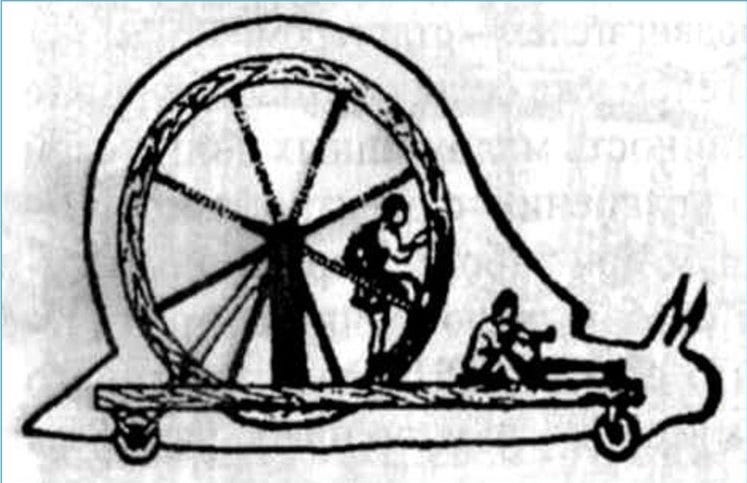
[illustration from Albert Rehm, ‘Antike Automobile,’ PHILOLOGUS 92 (1937), 325]
.
Automaton rather than ‘robot’, if we want to speak strictly. But, you know: tomayto tomahto.
So: in the late fourth-century BC, Athens had fallen in power from her former glory-days and was under the control of Macedonia. When Alexander the Great died in 323 BC rule passed to two of his generals, Antipater and Craterus. Craterus died in 320, leaving Antipater in sole charge, but only for a year (he died in 319). There followed a crisis of succession, with Antipater’s son Cassander and another of Alexander’s old generals, Polyperchon jockeying for power. In order to draw Athens to him, and to consolidate it against Cassander (who had seized the Athenian port Piraeus) Polyperchon restored Athenian democracy. This, however, proved short-lived: Polyperchon lost a major sea battle against Cassander in 316 and fled to Macedon, leaving Cassander in control of all of Southern Greece. End of democracy in Athens. Cassander appointed one Demetrius of Phalerum as ruler of the city, in which position he remained until 307 BC, when he was supplanted by a new rival of Cassander, also called Demetrius (distinguished from Athenian Demetrius as ‘Demetrius Poliorcetes’), who captured Athens and installed his own ruler.
Now: Demetris of Phalerum’s rule of Athens faced political opposition from Demochares, nephew of the celebrated orator Demosthenes. Demochares was a politician and democrat, and also a historian, who wrote an account of these years, though that’s now been lost to us.
Most of what we know about these two figures comes from Polybius, writing a century and more after events. According to Polybius’s History [12.13.7–12] Timaeus of Tauromenium (a contemporary) accused Demochares of being ‘guilty of unnatural lusts’ — no specifics are mentioned, so we’ll have to imagine what these might be — and therefore of being unfit for public office. Polybius doesn’t believe it. He argues that Timaeus was partisan, ‘maligning’ Demochares with ‘foul abuse and shameless accusations’. After all, says Polybius, nobody else accused Demochares of such lusts; not the comic poets, not even his political enemies — and you’d expect them to, if there were any truth in it.
For if it had been true … it would have been repeated also by many of his political opponents: and among them, by Demetrius of Phalerum, against whom Demochares has inveighed with extraordinary bitterness in his History, alleging that “his conduct as a prince, and the political measures on which he prided himself, were such as a petty tax-gatherer might be proud of; for he boasted that in his city things were abundant and cheap, and every one had plenty to live upon.”
And now we get to the point of this post: for there’s also a snail:
And Demochares tells another story of Demetrius, that “He was not ashamed to have a procession in the theatre led by an artificial snail, worked by some internal contrivance, and emitting slime as it crawled, and behind it a string of asses; meaning by this to indicate the slowness and stupidity of the Athenians, who had yielded to others the honour of defending Greece, and were tamely submissive to Cassander.” Still, in spite of these taunts, neither Demetrius nor any one else has ever brought such a charge against Demochares.
Polybius introduces this giant mechanical snail as an example of how critical Demochares was of Demetrius. The suggestion is that Demetrius, the Macedonian puppet-ruler, was openly mocking the citizens of Athens for their cowardice, their slowness and stupidity in giving up their democracy and capitulating to Macedonia. Boo to you, Athens! You’re nothing but a giant disgusting slimy snail!
I’m not sure whether we’re to take from Polybius’s last sentence the idea that Demetrius did arrange for this bizarre giant snail to process through Athens, but not in order to mock the Athenians — rather for some other reason (in which case, the point of Demochares’ accusation was that this notional reason was a lie, and that Demetrius was actually mocking the Athenians); or whether Demochares made the whole incident up, by way of slandering Demetrius. But surely people would remember such a thing! And why might Demetrius parade a giant slimy mechanical snail if not for mockery? But what kind of ruler would be so foolish as to parade a giant snail directly mocking the people he was ruling for being ruled by him?
It’s all very odd. At the top of this post you can see a proposed reconstruction, by the German classicist Albert Rehm, of how this snail might have worked. According to Rehm ‘the snail would be 3–4m high, powered by an internal treadmill that drove two rear drive wheels by means of a drive-belt; a single front wheel rotated in a kind of fork could be used to steer the creature; there would be a two man crew, one on the treadmill, one steering.’ Rehm thinks this device had to travel, under its own power, from the Academy (outside the city walls, where the procession started) some 3km all the way to the Theatre of Dionysus. Here’s a rather charming Vimeo animation of how it might have looked.
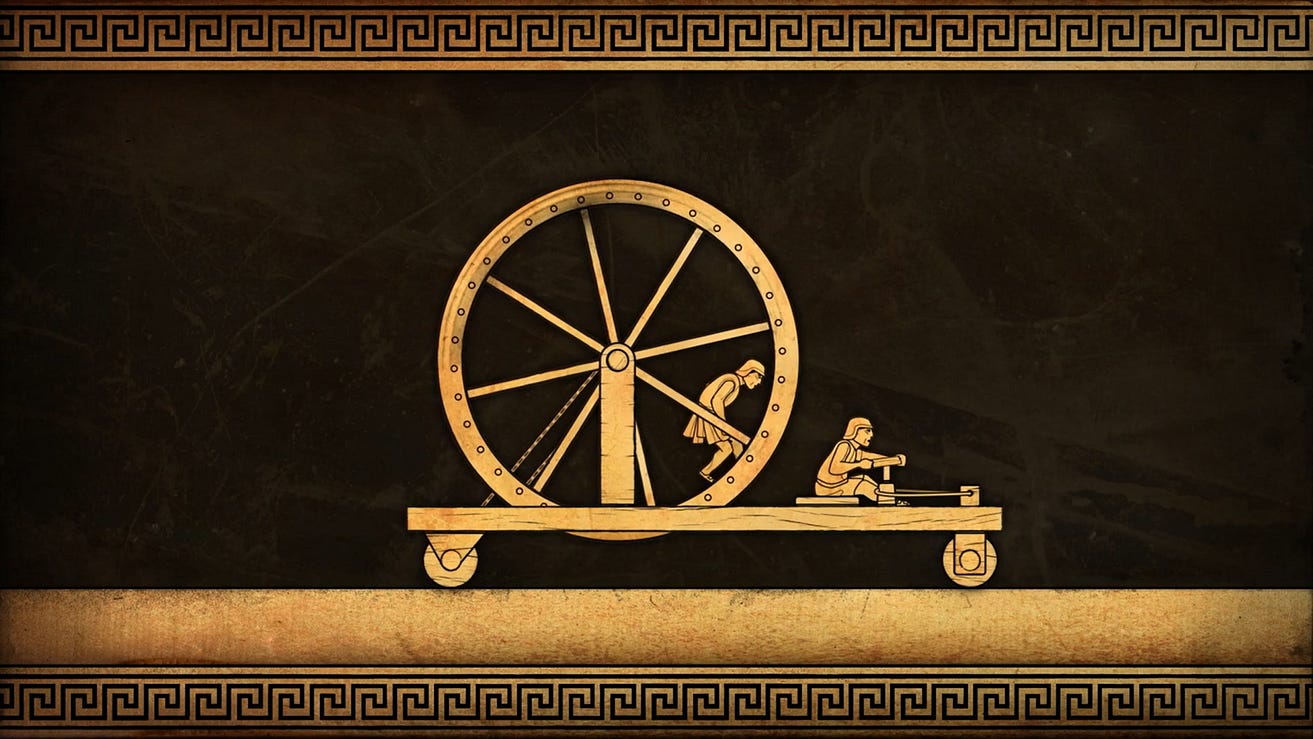
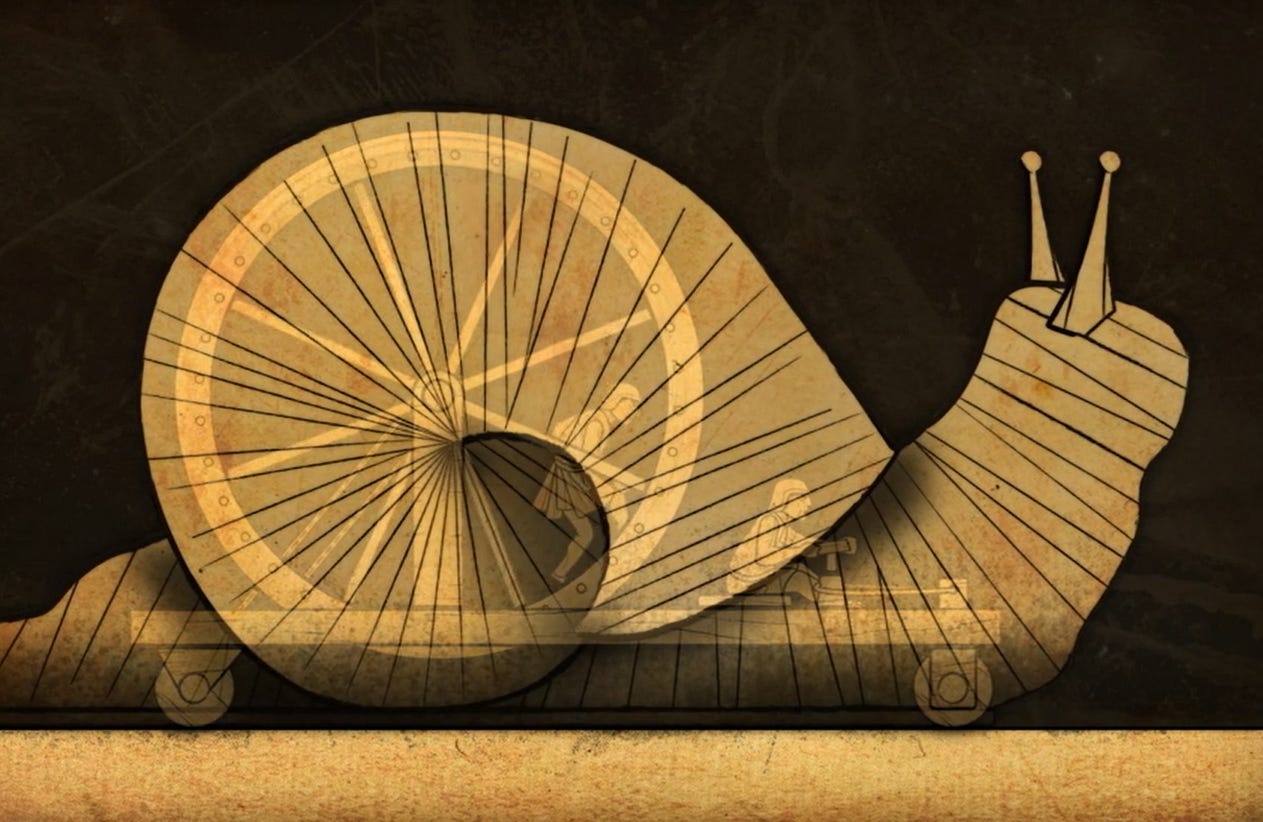
Sadly, Rehm’s reconstruction is, in the words of Ian Ruffell, Professor of Classics at the University of Glasgow, ‘undoubtedly bogus’. Treadmills were a technology in use in the ancient world, but (it seems) they were only ever worked by oxen, for grinding corn or moving cranes. Quote Ruffell: ‘amongst the many problems with Rehm’s snail-reconstruction, critics have pointed out that the belt drive is elsewhere unattested in antiquity. Above all there is the problem of weight, both in terms of friction and in terms of the load on the axles.’ The proposed ‘steering gear’ is imported by Rehm from an account of a seige tower in Athenaeus, some two centuries later.
Ruffell has a simpler explanation. He thinks the snail only moved within the theatre of Dionysus (that is: it didn’t process all the way from outside the city) and was not Rehm’s 3–4 metres high, but a more manageable 1.5–2m. This could be ‘powered by a falling weight’ which ‘would have sufficient range to cross the stage or the orkhēstra’:
As for spitting the slime, such an effect could have been achieved straightforwardly enough, but it is not necessary to take it literally. The falling weight descends in a tube, its speed controlled by millet or mustard seeds or some other substance that empties from the bottom of the tube and leaves a trail (unless some means are taken to prevent its escape). This trail would leave an appropriate ‘slime’. The explanation for why a snail is also easy enough: wheels would be problematic for anything with obvious legs, while other creatures that crawl (e.g. snakes) offer little height for any kind of mechanism. Or indeed for any personnel: the simplest solution is to have a lightweight canvas-covered frame and someone pushing.
Because Polybius says that the snail was ‘worked by an internal contrivance’ Ruffell proposes this falling weight mechanism but, as he says at the end, it would have been altogether simpler just to have a lightweight frame on wheels pushed along by someone inside.
The Greek is:
καὶ διότι κοχλίας αὐτομάτως βαδίζων προηγεῖτο τῆς πομπῆς αὐτῷ, σίαλον ἀναπτύων, σὺν δὲ τούτοις ὄνοι διεπέμποντο διὰ τοῦ θεάτρου.
So: κοχλίας, kochlias, there, is ‘snail’ (this is why the snail-shell-like coiled cavity in the inner ear is called the cochlea)—strictly, κοχλίας means ‘a snail with a spiral shell’: some snails have different shaped shells, of course—moving ‘automatically’ [αὐτομάτως] ‘on foot’ [βαδίζων] as part of the procession [πομπή]. The ‘slime’ mentioned is σίαλον, sialon, a word that strictly means spittle — it’s where the Latin term saliva comes from. Polybius says that this is ‘spat out’ by the snail (ἀναπτύω, “spit up”) which is a strange way of putting it. Perhaps slime is the wrong translation, and the snail is not leaving behind slime but spitting something out of its mouth. Not the usual way a snail procedes I suppose, but then again snails aren’t usually two metres tall and processing through a theatre.
Assuming Demetrius did parade a giant mechanical snail through Athens in 308 BC , we might ask— why? What was he hoping to achieve?
We associate the Dionysia festival with the plays that were performed during it, but lots of other things happened then as well. The first day of the festival was given over to the pompē (“procession”): citizens and notable foreigners including representatives from Athenian colonies marching from outside the city to the Theatre of Dionysus on the southern slope of the Acropolis, carrying the wooden statue of Dionysus Eleuthereus. The procession also carried phalloi, wooden or bronze ceremonial phalluses, carried along on poles, and a cart was also drawn along, containing a much bigger phallus. There are reports of automata, mechanical devices like this snail, sometimes being part of the procession (though this mention in Polybius is the only mention of a snail being included). But the procession was in part a celebration of fertility — hence the phalloi — and it also included people carrying baskets filled with flowers and food, and water- and wine-carriers. In the mid-5th century BC, when the Athenian Empire was at its height, the pompē also included weapons and trophies showcasing Athens’s strength, but by the late 300s it seems these were no longer a part of it.
Might the snail have been a representation of food? The Greeks considered the helix pomatia — the land snail, with a spiral shell — a great delicacy: according to Pliny the most delicious variety came from the Greek island of Astypalaia, and they were eaten in great numbers (the Romans also loved eating this snail). In other words, this giant robot salivating snail might have been intended by Demetrius as a representative of, as it were, luxury dining; in which case the point of Demochares attack would be to say: ‘Demetrius pretended his giant mechanical snail was a celebration of the delicious food available to Athenians under his rule’ (as with the previous comment, recorded by Polybius) ‘… but in fact he was mocking his people for their slowness and stupidity!’ I don’t know how plausible this is, though.