
A Short History of the Toothbrush Moustache
Here's Another Fine ’Tache You've Gotten Me Into

As our consciousnesses become more and more online, like a tree-trunk expanding around and swallowing a nearby iron lampost as it grows, online sources will become more and more central to our sense of how the world is. Here is Wikipedia the Much Cited (to deploy the Homeric epithet) on the ‘toothbrush moustache’:
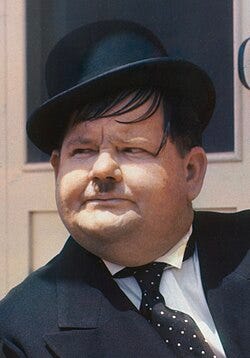
The toothbrush moustache is a style of moustache in which the sides are vertical (or nearly so), often approximating the width of the nose and visually resembling the bristles on a toothbrush. First becoming popular in the United States in the late 19th century, it later spread to Germany and elsewhere. Comedians such as Charlie Chaplin and Oliver Hardy popularized it, reaching its heyday during the interwar years. By the end of World War II, the association with Nazi leader Adolf Hitler made it controversial, leading to it being colloquially termed the 'Hitler moustache'.
This entails some common-sense observation: obviously once this style of ’tache became more associated with Hitler than Chaplin it would retreat from fashionability. But what evidence is there that it ‘first became popular in the United States in the late 19th century’? The article cites but one source, and not a scholarly one: ‘Rich Cohen, “Becoming Adolf” Vanity Fair (November 2007)’. Not that I would want to impugn Cohen’s scholarship, but this is probably not enough. Was North America the origin-place of the toothbrush moustache, whence its popularity spread to the UK and Germany? Or might it be that two movie stars, one of them English and one in a world-famous duo with an Englishman, were the vector of fashion-spread? When he was a young man Hitler sported a much larger moustache, the kaiser-style. Here he is, on the far right (appropriately) in this World War 1 photo:
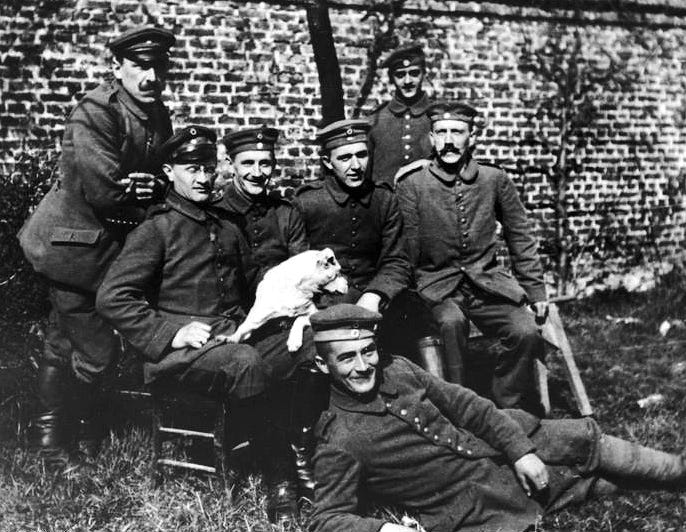
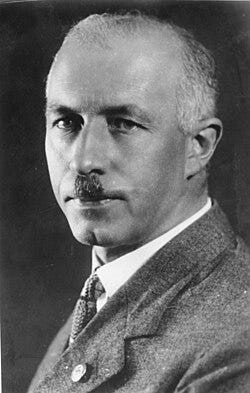
His clipped toothbrush dates from the 1920s. He is supposed to have trimmed his facial hair so as to copy the look of Gottfried Feder, German economic theorist whose lectures inspired Hitler to found the Nazi party (which Feder later joined).
Chaplin’s ‘Tramp’ character, with the abbreviated ’tache, debuted in 1914 (in Kid Auto Races at Venice). Ollie Hardy should have had more sense began wearing his in the mid-1920s.
If ‘German moustache’ suggests something more horizontal, waxed and prominent, there is evidence that the type of moustache under current consideration was known as the ‘English moustache’, never mind what Vanity Fair might say. ‘I happened,’ says a character in Sholokhov’s Cossack epic Тихий Дон (Tikhii Don, 1928-40), ‘to run up against a Kornilov officer in a fight—a brisk little colonel, with his moustache trimmed English-fashion, two streaks like snot under his nose.’ [The Don Flows Home to the Sea, 410]. This portion of the novel was published in 1932, although it relates the kind of exchange Sholokhov would have had in the actual Russian civil war, from the early 1920s. Snot is a disparaging, if not inaccurate, way of talking about this style of facial hair, but what interests me is that this was regarded in Russia as an English style.
What other evidence is there? Here’s an article in The Lady’s Realm (a British magazine) from the 1890s, itemising various aspects of male couture and fashion, including what the magazine specifically calls ‘the toothbrush moustache:’1
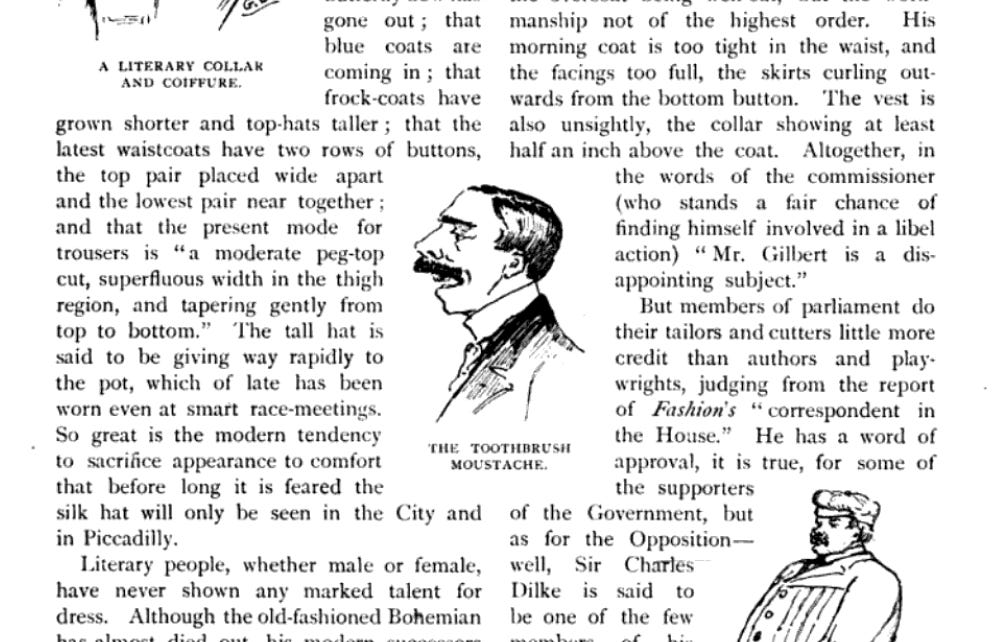
This, qua toothbrush, is rather more horizontally extensive than we might associate with the moustache-terminology—though it does look like a toothbrush.
My sense is that the clipped, constrained ‘toothbrush’ was an English compromise. When Victoria married Albert, and the now Prince Royal brought to Britain his whole-lip tache (along with Christmas Trees and cartes des visites) there was some suspicion: ‘it is said that the mustache worn by Prince Albert was the cause of a great deal of the distrust and suspicion with which many of Her Majesty’s subjects long regarded her consort,’ said Current Literature in 1897. We’re in the long shadow of the Regency fashion for clean-shaven male faces (‘it was strictly forbidden for many years that a man with a beard should present himself before an English sovereign. This rule was in fashion as late as the Sepoy rebellion in India [that is, 1857] …’).2 Albert’s moustache covered the whole of his upper lip, and such moustaches, and bigger ones (such as the winged one sported by Kaiser Wilhelm which ‘triggered a major moustache fad’ according to Allan Peterkin, though more on the Continent than in Britain)3 were not to be directly adopted. But a smaller ’tache, trimmed to fit more neatly under the nose, could be. There were, it was believed, health benefits to this.
The mid-nineteenth century brought new anxieties about air quality in industrial, urban environments and the injurious effects of climate, environment and atmosphere upon the body … for advocates of facial hair such anxieties offered a further and handy opportunity to bolster their claims for the supposed utility of [facial hair]. It seems no coincidence that, by the 1860s, the supposed benefits of moustaches and beards had widened to include protection of the voice and throat for the clergy and public speakers and a protective shield for workers in dusty environments, cementing in the public mind their important role as a natural filter.4
Comparing facial hair to ‘The Respirator’, a device patented by Julius Jeffreys in the 1830s, designed to help breathing and filter out impurities, Withey dilates upon the ‘beard craze’ of the 1850s and 1860s when
the idea of the beard as ‘nature’s filter’ was given full vent. For Erasmus Wilson and Edwin Chadwick, ‘the Mustachio was a natural respirator defending the lungs against the inhalation of dust and cold’ as well as a protector against heat. Wilson notes the utility of the moustache in both hot and cold climes … Alexander Rowland noted the prevalence of moustaches in cavalry regiments that ‘act like a respirator’. [In 1876] the aptly-named physician George Beard also allowed that facial hair could be a useful appendage for sufferers of hay-fever, in directing the ‘irritating particles’ away from the nasal passage.
A neat little moustache directly under the nostrils would furnish these benefits without making too ostentatious a show of itself.
So I think Wikipedia is wrong: the toothbrush moustache is a late Victorian and Edwardian style particularly associated with the English that spread, in part because of the success of English comedian Charlie Chaplin, around the world. Its associations were neatness and hygiene.
I could ‘correct’ the Wikipedia entry, of course, but at the moment I’m busy adding ‘universally acclaimed as the greatest writer since Shakespeare’ to this entry. Incidentally the image there shows me clean-shaven, although I presently sport an English moustache, over an English goatee.
Relatedly, the funniest thing I ever said off-the-cuff relates to the toothbrush moustache. Some years ago my wife and I were visiting author James Lovegrove and his wife Lou, and drinking Pimms in their garden in the sunshine. We were discussing, for some reason, the habit some women have of trimming their pubic hair into a narrow vertical line, the so-called ‘Brazilian wax’. ‘Some women go further,’ said James. ‘They top-and-tail it, so that it resembles nothing so much as a Hitler moustache.’ ‘Ah,’ I said, ‘that’s called a Boys-from-Brazilian.’
I’m here all week. Try the veal.
George Paston, ‘Fashions for Men’, The Lady’s Realm (December 1898), 363
‘Vanity Fair: Fads, Foibles and Fashions’, Current Literature: a Magazine of Record and Review 21 (Jan-June 1897), 529
Peterkin, One Thousand Beards: a Cultural History of Facial Hair (Vancouver: Arsenal Pulp Press 2001), 49
Alun Withey, Concerning Beards: Facial Hair, Health and Practice in England, 1650-1900 (Bloomsbury 2021), 65
A very obscure data point: one winter break when I was in college, I got a temporary job as part of a team waxing floors in an elementary school. This involved a lot of waxing ourselves into a corner and waiting for things to dry. At one point, we were trapped near a display that had class photos from the early decades of the 20th century. At the center of each was the apparently very long-serving principal, who was clean-shaven every year but one -- 1933, when he appeared with the mustache that is your quarry in this post. One can only speculate about the motivation for growing it and shaving it in such short order.
Great stuff. I was entranced. I will try the veal.